
MARTY SUPREME
Directing: B+
Acting: A-
Writing: B+
Cinematography: B+
Editing: B
The last feature film writer-director Josh Safdie did was Uncut Gems in 2019, an extraordinarily stressful film which featured Adam Sandler as a gambling addict, in what was arguably his best performance since Punch-Drunk Love. I have recommended that film to several people, always qualifying how deeply stressful it is, which I think is a fair warning to make.
Uncut Gems was co-directed and co-written with Josh’s brother, Benny Safdie; Josh has gone it on his own with this new film, Marty Supreme, but it seems worth noting that it follows a very similar arc: it’s about a guy with a single-minded passion, who makes countless bad decisions in service of that passion, usually not seeing how said bad decisions are actually a form of self-sabotage. The key difference is that this time it’s about a guy enamored it his own talent as a table tennis player, and set in the 1950s. But, all the needle drops are eighties pop songs, and that incongruity I still remain ambivalent about.
Marty is played by Timothée Chalamet, a perennial favorite, and who will almost certainly get nominated for an Oscar for this role. It could be argued that this is one of those parts where a beautiful actor becomes “ugly” for a part in a bid for an Oscar nomination. Chalamet, as Marty, is nowhere near as beautiful as he usually is, right own to almost-pointedly visible pock marks on his cheeks. He also wears glasses, and has a thin mustache, giving him a very distinctive 1950s, self-important 1950s “young New Yorker” look.
There is a pregnancy that figures as a key part of the plot, though not what I would call prominently—but the opening titles still run over images of sperm cells racing for the egg. Ultimately, this serves as the reason why Marty Supreme ends with a far more upbeat note than Uncut Gems. Marty Supreme still ends with a whole lot of hopes and dreams unrealized, but basically Marty sort of realizes his dreams should be shooting for other things. If nothing else, at least Marty Supreme doesn’t end tragically.
And there is certainly a lot going on in this movie’s 150-minute runtime, which I am not convinced is a length that fully justifies itself, although to this film’s credit it doesn’t have a single dull moment in it. This seems to be a hallmark of the Safdies’ work, this incredible propulsion of plot and narrative. Marty is convinced he is destined to be “on a Wheaties box,” because of his undeniable talent. What he doesn’t seem to see is that table tennis—ping pong—will never be as popular in the United States as it is in Asia. Marty keeps going around telling people he’s a “professional athlete.” He’s fundamentally a conman, doing all he can to score the funds he needs to get where world championships are being held. Marty spends a lot of time barely getting out of scrapes. Until, of course, he doesn’t.
When Marty runs across retired-actress Kay Stone (Gwyneth Paltrow, better than we have seen her in years), we know immediately that his interest in her is entirely self-serving. Soon enough we see them fucking in her hotel room shower, and at first I was baffled by him unhooking her necklace so it falls down the drain. But then it became clearer, as he does find a way to retrieve it later—it’s what happens after that with the necklace that is somewhat of a surprise.
Kay is married to Milton Rockwell (Kevin O’Leary), the rich owner of a pen manufacturing company, so Marty finds a way to weasel his way into Milton’s awareness as well. This is in service of Marty’s desire to get to Tokyo for the world championships, so he can attempt a rematch with the Japanese table tennis superstar, Koto Endo (Koto Kawaguchi, given a lot of screen time but no actual lines to speak of), who defeated him the year before. This is really all Marty thinks about, whether he’s having sex with a faded film actress twice his age, hustling amateur table tennis players with his Black friend Wally (Tyler the Creator), or teaming up with the woman he impregnated, Rachel (Odessa A’zion), to retrieve a lost dog for reward money. That dog is a whole thing in Marty Supreme, the impetus for more than one wild sequence that involves either fire or water or gasoline or gunfire or murder, depending on the sequence.
Given how much is going on, the writing is pretty impressive, well plotted and unpredictable in a way that keeps you on the edge of your seat, even though is neither a suspense movie nor an action movie. Except it kind of is both of those things, just of different sorts. I didn’t find Marty especially likable—Kay is maybe the only truly likable character in this movie—and he’s not even the sort of lovable loser you find yourself rooting for even when they make plainly bad decisions. Marty is objectively a kind of self-involved dipshit. The minor magic trick of this film is that in spite of that, you still find yourself invested. You still want to know how things turn out for him.
Marty Supreme is mercifully not as stressful as Uncut Gems, but it still gets about halfway there. Marty lives in a wildly chaotic universe, and we are just taking a ride through that universe with him. Beyond the undeniable craftsmanship of this film, I didn’t find it to have quite as much depth as I might have hoped—although there is some incredibly well-observed nuances of national pride among the Japanese people at this time set only about a decade after the U.S. ended the second World War with two atom bombs on their people. These are fascinating details otherwise incidental to the primary plot here, though, and I rather wish the primary plot were as fascinating. Ultimately, this just about a guy obsessed with his own talent as a table tennis player.
But hey, it’s still a story told in a way that locks you in from the start, and so much is going on that you barely notices the unnecessarily excessive run time. The comparatively quiet but upbeat note on which the film ends is a bit of a relief. Although I should say that “comparatively” is a key word here, as the last scene involves the baby room at a hospital, and the cacophony of baby cries then plays over the end credits, which is kind of funny. It’s a way to amusingly annoy the audience, which is basically what Marty himself has been doing all along.
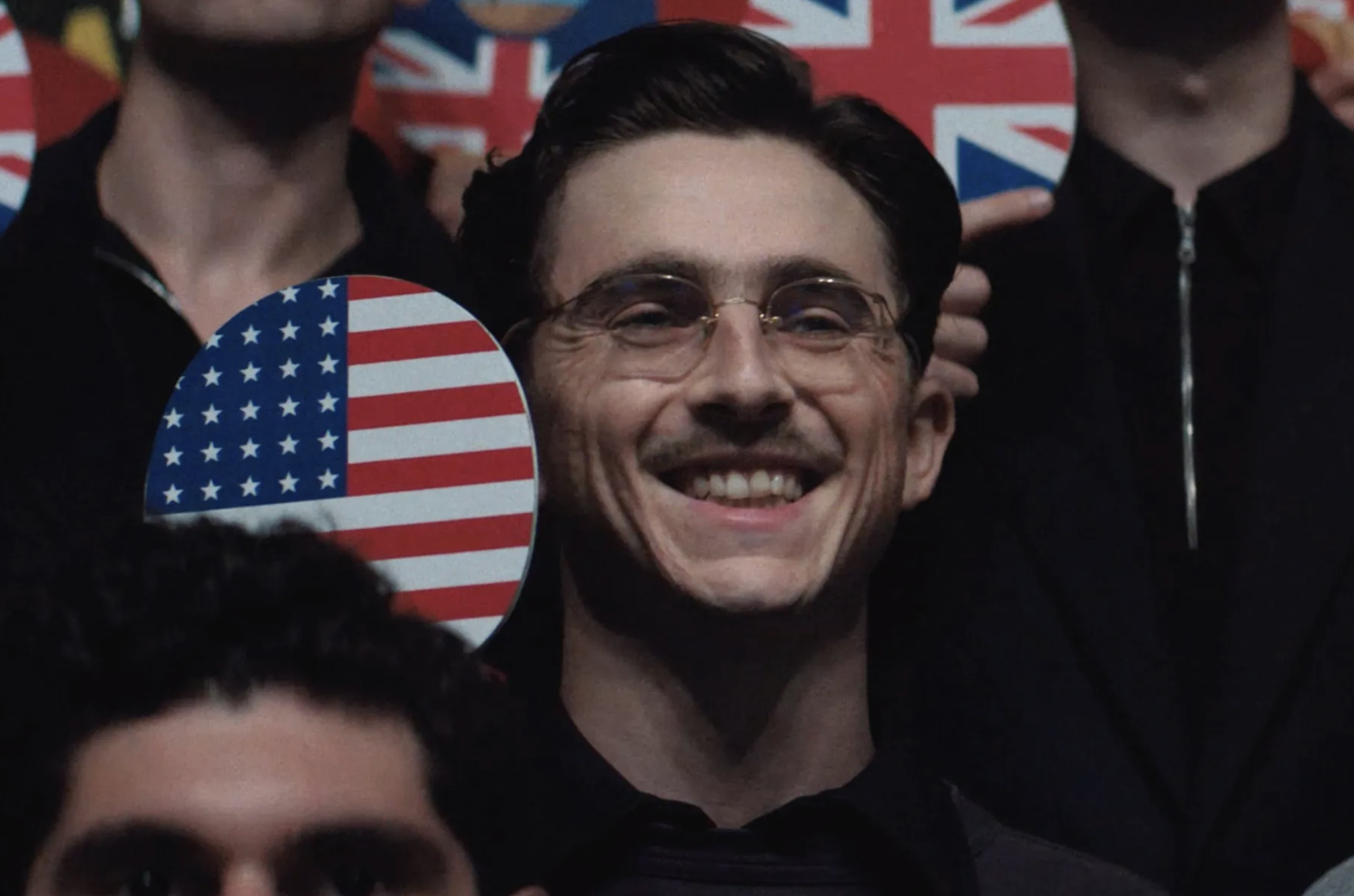
Marty doesn’t reign quite as Supreme as hoped.