
28 YEARS LATER: THE BONE TEMPLE
Directing: B
Acting: B+
Writing: B
Cinematography: A-
Editing: B+
Lest we forget, after four movies, there are technically no zombies in 28 Years Later: The Bone Temple. They’re called the infected. And by this film, they are almost incidental. They’re just a normal part of the landscape, something the skilled survivors on the abandoned island of Great Britain dispatch with dispassionate ease—good guys and bad guys alike.
Although Alex Garland wrote and directed 28 Years Later, released just last June, and returning after having written the original 2002 Danny Boyle film 28 Days Later (I guess we’re all expected to just ignore 28 Weeks Later, released in 2007 and written and directed by neither of them—but still pretty good), Garland once again only wrote the script for The Bone Temple; the director now is Nia DaCosta, who directed Candyman in 2021, giving her horror bona fides, as well as The Marvels in 2023, giving her, let’s say, attempted-blockbuster bona fides. It would seem that The Bone Temple is DaCosta’s most critically acclaimed work to date by a healthy margin, and I would say she’s suited well enough for the project.
I found last year’s 28 Years Later to be compelling but flawed, with very high highs (including some stellar cinematography) and some very low lows, including the coda at the end which I still maintain was dumb as shit, when young Spike (the excellent Aflie Williams) is saved from attacking infected by a group of kids doing parkour off of rocks. The only appropriate response to that was: What the fuck is this shit? DaCosta evidently understands that, and opts not to show the “Fingers” gang doing any parkour in The Bone Temple, thank God.
In the opening scene this time around, Spike is forced into a fight to the death with one of the Fingers, and strikes a lucky blow to a main artery in a young man’s thigh. Aflie Williams is still very good in this film, but isn’t given very much more to do than look understandably terrified, forced into this gang of psychotics as an option barely better than dealing with the infected.
The flashy parts go to the two biggest names in the cast: Ralph Fiennes, who returns as Ian, the iodine-covered doctor who has built a shrine to the dead out of all their many skulls; and Jack O'Connell (previously seen as Remmick in Sinners—this guy knows from unhinged) as “Sir Lord Jimmy Crystal,” the leader of the Fingers and effectively a Satanist cult leader. Personally, I prefer the playful Satanists who use freedom of religion laws to expose Christian hypocrisy, but those guys wouldn’t fit in a 28 movie. This is horror, after all. We need at least one scene in which multiple victims are skinned alive just for the fun of it.
O’Connell really digs into a meaty part as a truly horrifying, human villain; the flip side of this coin is Fiennes, who really goes for it as Dr. Ian Kelson, taking the character’s nuttiness a step or two further than he did in the last film. It’s nice to see really talented actors having fun, especially when we get a subtle but unmistakable This Is Spinal Tap reference.
That said, last year’s 28 Years Later spent a whole lot more time on effective world building, placing us squarely in a place abandoned to these horrors for three decades, but with indicators of how life has moved on around the rest of the world, as well as some fascinating evolutionary changes to the infected. It had some truly funny moments that are noticeably absent here; The Bone Temple leans much harder into the gory-horror aspect of the storytelling of these movies. That doesn’t make it any worse, per se; I just prefer a nice sprinkling of humor. Still, I would have preferred a bit more of the world building as well, and this film sticks mostly to how horrible some of the survivors are—a well-worn idea that the original 28 Days Later already presented with far greater finesse.
We do once again get Chi Lewis-Parry with a giant prosthetic schlong as an “alfa infected,” which you might like to know if you’re into that sort of thing. We get no more evolutionary changes of the infected, but instead Dr. Ian Kelson makes some advances in the possibility of treatment—a concurrent narrative thread with Spike’s harrowing experience with the Fingers, through roughly the first half of the film.
The Bone Temple is also beautifully shot, though—not quite as stunningly as some of the sequences in 28 Years Later, but close. Cinematographer Sean Bobbit treats us to several fantastically composed overhead shots of Ian’s Bone Temple, particularly after he lights it up for a climactic sequence that is delightfully weird and features Iron Maiden’s “The Number of the Beast.” The story concludes in this setting, with multiple sudden double-crosses that are pretty exciting, and in the context of a horror film like this, deeply satisfying.
The Bone Temple does have its own coda, and although it clearly sets up the next film (not likely to be released for a few years, as this one is not yet even in production), I feel fairly neutral about it, the surprising cameo it features notwithstanding. At the very least, it’s far better than the coda to 28 Years Later, which was so dumb it really dragged down an otherwise pretty great experience overall. In the end, albeit for different reasons, I feel the same about this movie as I did about the last one: a horror movie whose memorable performances and great cinematography don’t quite elevate it from being simply a solid B movie.
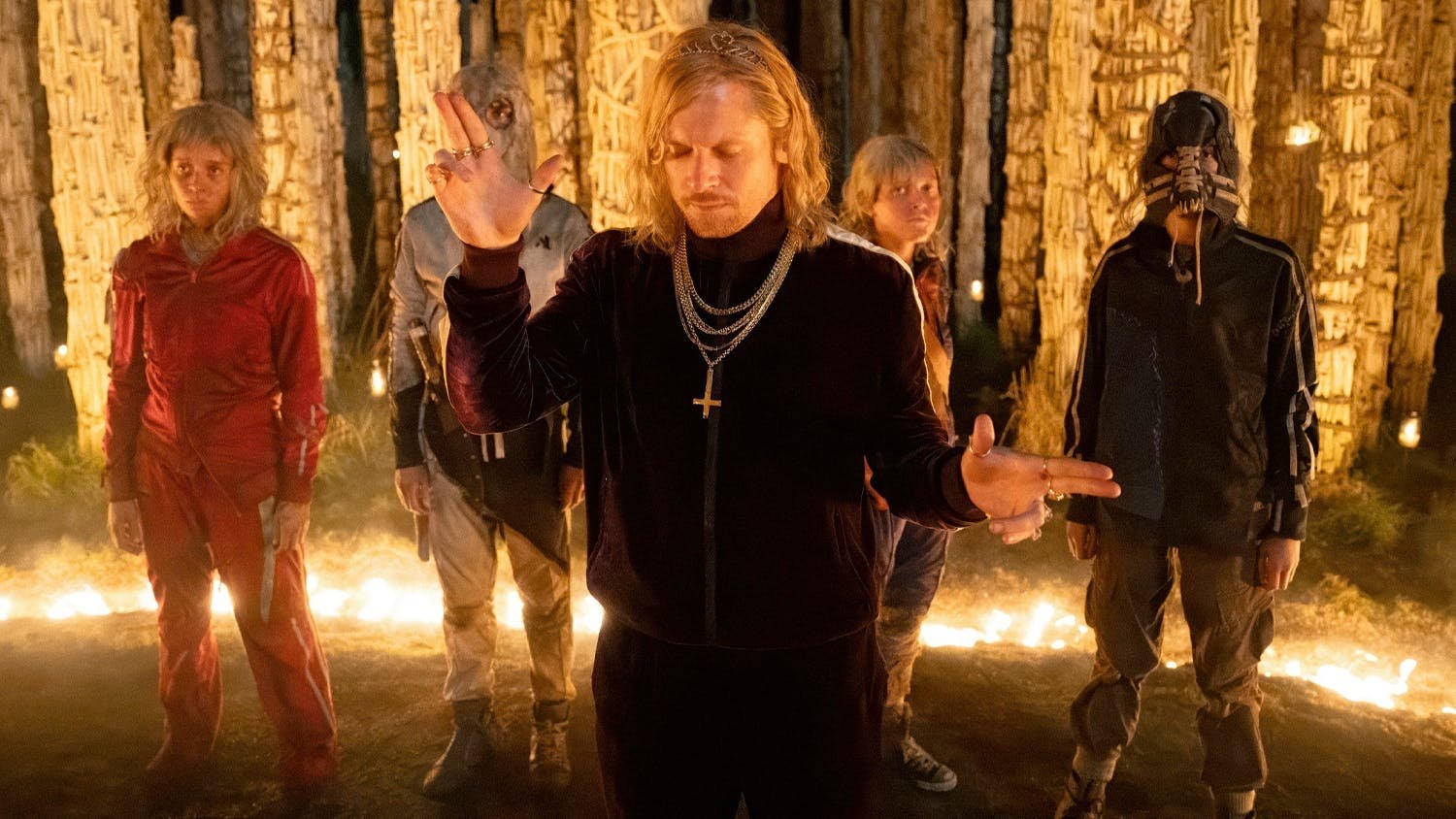
Take me to church!
Overall: B