
THE TESTAMENT OF ANN LEE
Directing: B+
Acting: B+
Writing: B
Cinematography: B+
Editing: B
Music: B+
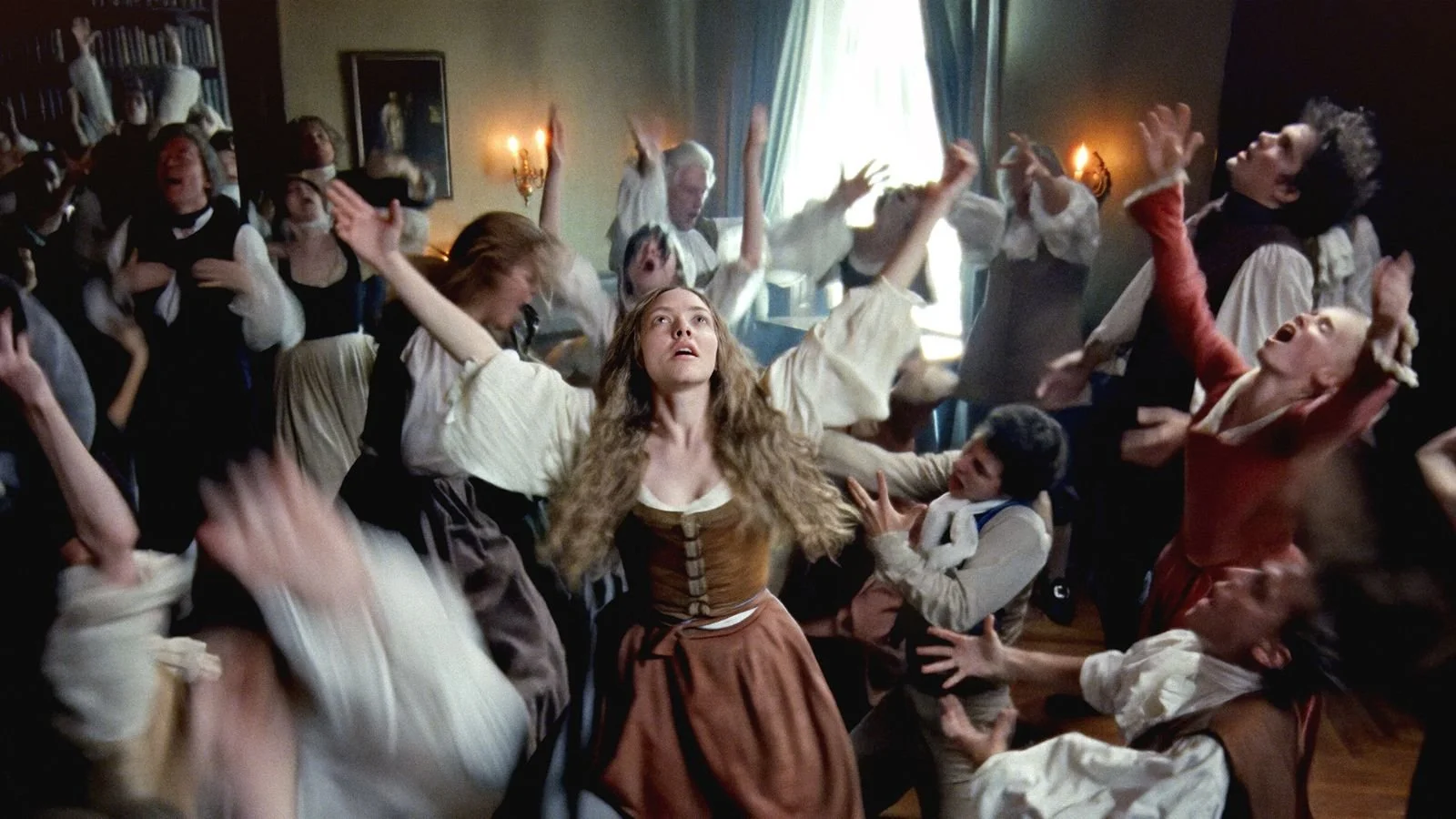
The Testament of Ann Lee is a musical like none other. It’s almost like a musical on a technicality: it has people breaking out into song, for sure, but nothing lyrical or catchy. Instead, it repurposes actual, 18th-century Shaker hymns. The voices, especially that of Amanda Seyfried as the title character, are angelic. But, they are only ever used as a tool to convey deep piety and faith. There is even dancing, but in a sort of physical version of speaking in tongues—the faithful allowing the spirit to move them.
There is a curious and fascinating element to this film, in that it never casts judgment on Ann Lee or her followers. One might even be tempted to call her a cult leader, but we only see the story through her experiences. This is a woman who bore four children, all of whom died before reaching the age of one. The one sex scene that is included features Ann Lee and her husband, Abraham (Christopher Abbott), is early in their marriage, and completely devoid of tenderness or sensuality. Abraham is weirdly obsessed with a ritualistic act in which he whacks Ann Lee on the ass with a sort of broom of switches. It’s unclear to me whether there was some genuinely devotional aspect to this, or if he was just looking for an excuse to engage in a particular kink.
Whatever the case, Ann Lee clearly does not enjoy sex—whether because she’s never had it with her own pleasure in mind or because she’s simply not into it at all is perhaps an open question—and, as she allows herself to become the prophet of a religious movement, she makes celibacy a central tenet of their belief. You cannot be close to go when engaging in the pleasures of the flesh, that sort of thing. I would argue the opposite, but whatever. My life experience is nothing like this woman’s.
There’s something very odd, and detached, almost impenetrable, about The Testament of Ann Lee. It feels like the kind of “high minded” film that regular filmgoers just aren’t going to get. I felt like I barely got it myself. It has an excellent lead performance in Amanda Seyfried, solid performances among the rest of the cast, scenes that are very well shot, beautifully performed music that is otherwise fairly inaccessible to modern audiences. It’s the story itself that seems to aspire to greatness without quite getting there. I can easily imagine a select few people finding this film to be an amazing experience, but I could never fully connect with it.
This may just be a personal thing. While director Mona Fastvold, who cowrote the script with The Brutalist’s Brady Corbet, never cast judgement on the “Shakers” (so named because of how they dance in religious ecstasy), neither do they explicitly endorse them. The story is narrated, a little too much for my taste, by Ann Lee’s close friend Mary (Thomasin McKenzie), with clear reverence for her. We also see Ann Lee’s rise as a religious figure, from Manchester to New York, looked upon by Abraham with utter befuddlement. There’s a scene in which he demands she perform her wifely duties and I feared it would take a dark turn, which thankfully it doesn’t—although what he then does right in front of her is not much better. We’re clearly not meant to be on his side, but I never felt compelled to take her side either, at least not as a religious figure claiming to be the Second Coming of Christ in female form.
This is simply a telling of her story. Ann Lee certainly does suffer some serious hardships, over many years, from the deaths of all her infant children to a horrifying and degrading attack by neighboring locals in New England. There are suggestions of Ann Lee being a witch, but only somewhat in passing. I won’t spoil the age to which she lived, even though it’s a matter of historical record, but I found myself surprised by it. This is a film that follows her from childhood to her death, making it quite definitively a biopic. I’m not a huge fan of life-spanning biopics, and even here it seems like huge swaths of her life get gleaned over. And yet, clocking in at 137 minutes, the style of the storytelling often makes it feel like a bit of a slog.
Much of The Testament of Ann Lee is like an immersion into her psyche. Sometimes a religious-themed film is something conservative Christians can take as an extension of their own faith, but that does not seem likely here. I think Ann Lee is likely to be as alienating to faithful Christians as she would be to those of us who practice no religion at all. This is still a compelling idea, given that the movement she led is a variation on longstanding Christian beliefs from her own culture. It’s so insulated in this way that this film barely touches on her disdain for slavery when she witnesses it for the first time in New York, and we see just one shot of Shakers interacting with an Indigenous man. Surely there are countless nuanced implications here, especially considering this was a group of White people migrating from Britain to the “New World,” but Fastvold isn’t much interested in examining them.
This is all about Ann Lee, and her unquestioning faith in God—her God, anyway. She’s careful to state that people should join them of their own free will, but should they break the rules, they are cast out. One wonders if Ann Lee had a mental health disorder. It’s impossible to say, as this was so long ago that The Testament of Ann Lee essentially amounts of speculative fiction. A fair amount of that speculation is fascinating to me from an intellectual standpoint, but as narrative storytelling I found it to be just slightly less than the sum of its parts.
Overall: B