
H IS FOR HAWK
Directing: B+
Acting: B+
Writing: B+
Cinematography: A
Editing: B+
One might be forgiven for watching H Is for Hawk and saying: We all experience grief, I get it! How many films in recent years have tackled the subject of grief, in one way or anther? And, across genres—countless horror films in particular, presented as “a metaphor” for grief. Grief, grief, grief! Bad grief, weird grief. Good grief!
Well, here’s the thing. I was much more taken with H Is for Hawk that I expected to be. And when it comes to grief, it really cannot be repeated too many times that everyone deals with grief in different ways, all of them correct. In this case, it’s quite the specific expression of grief: college professor and avid birder Helen (a wonderful Claire Foy) gets herself a goshawk to take care of as a massive distraction from dealing with the death of her beloved father (Brendan Gleeson, not given nearly enough screen time, most of which is in flashbacks of Helen’s memories). She lets the massive challenge of taking care of this bird of prey keep her from confronting her emotions, plummeting herself into a deep depression.
I went in thinking, based on the trailer, that this would be a story about a woman who adopts a bird and the experience helps her through her grief. But, it’s actually the opposite: she uses the bird as an excuse not to confront her grief. This does make for a pretty fascinating story, even as her mother (Lindsay Duncan), her brother (Josh Dylan), and especially her close friend Christina (Denise Gough, in quite the departure from her iconically villainous performance as Dedra in Andor) look on helplessly, and attempt to reach out to Helen with increasing futility.
This would all be compelling enough, honestly, but I must mention cinematographer Charlotte Bruus Christensen, because so much of H Is for Hawk is beautifully, stunningly shot. Helen spends a lot of time building trust with the hawk she pointlessly names Mabel, building up to taking her out to fields and forests where the bird can hunt. This film features several scenes of Mabel hunting, and they are absolutely incredible, with some shots defying the imagination. I cannot find any information on whether CGI was used in this film, only reports of the painstaking manners in which cameras were camouflaged to pick up the birds they used for filming. Several stunning shots are in perfect focus of the bird in flight, though, and one memorable shot has the camera trailing the bird in flight—I can’t imagine how they did that practically, but it absolutely looks real. For an indie British drama about a woman denying her grief, they went truly above and beyond with the visuals in this film, to a far greater degree than they needed to. But it left me deeply impressed.
The questions it raises about keeping wild animals in captivity is perhaps another story. H Is for Hawk is impressively frank and objective in how it avoids any anthropomorphization of a bird of prey, and even Helen as a character is quick to clarify that this is a species that does not feel affection. Helen holds no illusions about how Mabel feels about her, and I love that about how this story is told—but, Helen also allows herself to get far too attached to Mabel. There’s even a moment when Christina says to her, “I think you might be overidentifying with Mabel.” Helen responds by saying she’s certain she is not, even though she clearly is.
But, beyond all that—why buy the bird to begin with? When Helen buys the bird, she meets the seller on a pier, and Christine, who is with her, says, “This feels like a drug deal.” Indeed. Conversely, H Is for Hawk features a memorable scene in which Helen is giving a public talk about Mabel, and a dipshit young man attempts to take her to task for “killing for fun,” as if a natural predator is just hunting for kicks. Helen is memorably struck between defending the bird of prey hunt as a natural act and getting flustered due to her state of grief. But what I often thought about, and what the film does not ever directly address, is whether any of this is actually good for the bird itself.
I can’t say that affected my appreciation for the story being told here, however. To what degree a film like this might upset conservationists, I have no idea. My focus remains on the fact that Helen is making ill-advised choices in the thick of grieving the loss of her father, and this is done incredibly well. I am frankly not a fan of any birds, and this movie gave me a new appreciation for them, so there’s that. I suppose we could have a separate conversation about the ethics of how the birds were used in the filming of this movie, and arguably we should have just left the source text of Helen Macdonald’s autobiographical book of the same name at that. To my mind, I am only here to judge what is onscreen, and ultimately, H Is for Hawk just really worked for me.
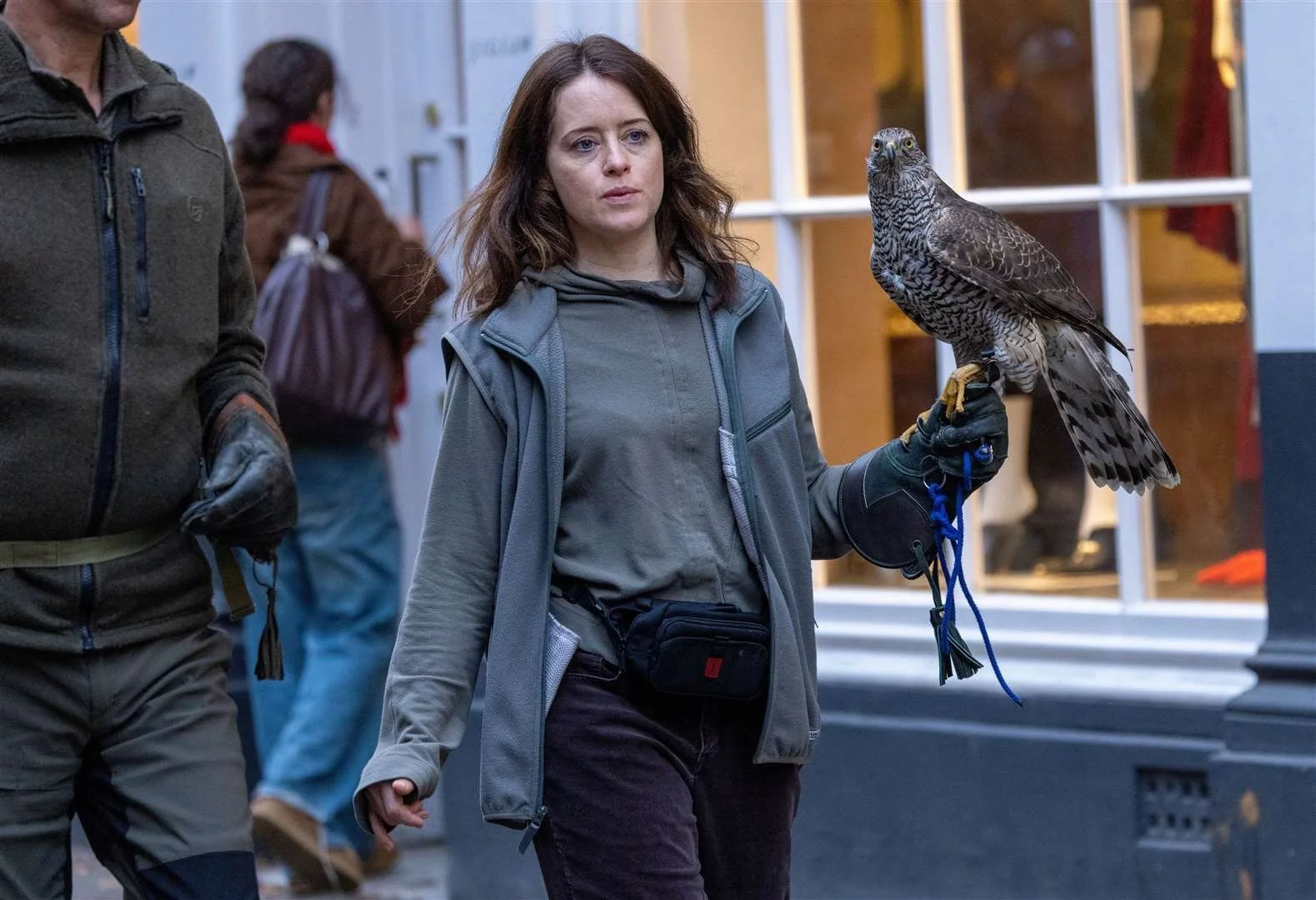
Helen (Claire Foy) walks her unconscious distraction through the streets of Cambridge.
Overall: B+