
Tasveer Advance: LALI
Directing: B-
Acting: B+
Writing: B
Cinematography: B+
Editing: B-
I am clearly not the target audience for Lali, which makes me patently unqualified to comment on it. I can’t even tell whether director and co-writer Sarmad Sultan Khoosat made it with the idea of general audiences worldwide watching it. One would presume so, but consider this user review on Letterboxd: Fucked with this hard and could smell the white people‘s confusion in the entire cinema heheheheh. It is perhaps relevant to note that I am married to a South Asian man, and when the movie ended he asked what I thought; I said: “I didn’t get it.” He said, no fewer than three times: “That was a crazy good movie!”
Context is everything, right? I saw this at the Tasveer Film Festival, which is specific to South Asian film, and that audience ate it up. This is pretty typical of festival audiences, regardless of the festival and regardless of how good the movie really is. I once saw a “documentary” called Orwell Rolls in His Grave at the Seattle International Film Festival, and it was one of the worst movies I had ever seen. There was a Q&A after the screening and the questions were shocking in how they revealed that the audience there clearly thought it was brilliant.
There is nothing so stark going on with Lali, which I kind of vibed with until the unhinged final act. There remains the context of cultural and ethnic experience, this film being dense with both, and which I have almost zero experience with. Even my husband grew up Hindu in India, so I have some broad knowledge of that cultural context—but, notwithstanding the obviously fair amount of cultural crossover, Lali is about a Muslim family in Pakistan. It opens with a wedding, and my husband did explain to me that green is a traditional color worn at Muslim wedding events. This was the first I had heard of that, and that would be the tip of the iceberg when it comes to cultural details densely packed into this narrative that I was unfamiliar with.
Even the experience of being one of only a handful of White people in the sold-out audience otherwise full of South Asians (or Americans of South Asian descent) was a somewhat peculiar experience. Lali is presented as a dark comedy, until the final act when it just slips into straight up (if not necessarily straightforward) darkness, but I was often baffled at what moments people in the audience laughed at. I laughed out loud a couple of times, but even my husband laughed a couple of times at moments when I thought: Is that supposed to be funny?
The basic premise of the film is that Zeba (Mamya Shajaffar) is finally getting married, to a man named Sajawal (Channan Hanif), or Sajju for short—after multiple previous engagements resulted in fiancés winding up dead. The community being convinced that Zeba is cursed is her cross to bear; Sajju’s is is huge birthmark on the left side of his face. The people in his family and community rarely use the word “birthmark,” though, in favor of the far more evocative word “scar”—an indicator of differing degrees of attitudes as compared to the West, perhaps. (Not to suggest that anyone in the West would have it easy with a giant birthmark on their face.)
It took me a while to understand why Sajju was so quiet and brooding. In the opening, wedding event sequence, he’s wearing a headdress with strings of flowers obstructing his face. Soon enough we see the birthmark, and we learn how it shaped him growing up. He has a comically overbearing mother (Farazeh Syed) and a father whose death he eventually reveals he blames on her. In the early scenes shortly after the wedding is finally over, with many people comically paranoid about Sajju’s fate with this supposedly cursed woman, it feels like we are meant to see that he’s deeply self-conscious but a good guy.
Much of Lali is very surreal, and it takes a turn when Sajju is suddenly prone to jealous rages. Maybe because of such deep-seeded self-loathing that he assumes Zeba must be looking elsewhere, despite all obvious evidence to the contrary? All I can say is, when a disturbing scene occurs in which Zeba comes home drunk, pours liquor over Zeba’s head, and the scene ends without depicting but unsubtly suggesting marital rape, it was a jarring narrative leap that felt a bit unearned, after we saw him making odd but still kind gestures toward her. This type of mystifying narrative turn only continues in the final act, in which I completely lost the plot and thought Lali went right off the rails, with both Zeba and Sajju having wild breakdowns that come out of nowhere.
Lal translates as “red” in Hindi and Urdu (this film is spoken in Punjabi but with sprinklings of Urdu). Lali is thus a pejorative nickname for Sajju and his “scar,” which he suddenly leans so far into in the final act that he wraps himself in a red blanket, covers himself with a red oil or paint of some kind, and otherwise starts hopping around and hanging from bars like a lunatic who thinks he’s a bat—all while referring to himself as a jinn, a dark spirit from Arabic mythology. The nickname is used exclusively by a neighbor woman who visits frequently and was much more kindly welcomed by Sajju’s mother than by Sajju himself; her condition is never specified but she is clearly mentally disabled in some way. If there is some symbolic meaning there, I completely missed it.
And therein lies the challenge in my experience with this film, which, while it left me baffled in the end, I did not hate—largely because the performances of both the leads were equally excellent. And I certainly cannot write it off the way I might have if it were made by an American director and writer and infused it with equivalent amounts of American or Western mythology. I read enough reviews and reactions to this film to know that I was certainly not alone in it losing me in the final act—what would be interesting but impossible to find out would be what the ethnic breakdown of these reactions were. It may be that it’s simply the audiences who are not of Muslim, Pakistani or South Asian background who do not get it. Lali is clearly dense with meaning that only a certain population can fully grasp. They get it, and I don’t, and I guess that’s okay.
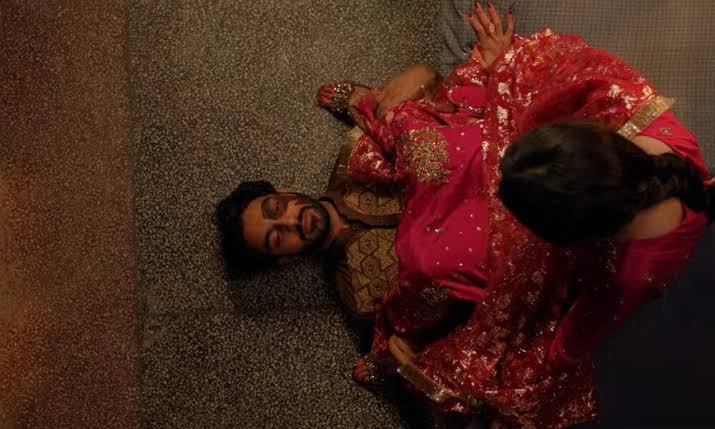
Lali may surprise you, but who knows how much you’ll vibe with that surprise?
Overall: B