
YOU CAN SEE EVERYTHING
Directing: A
Acting: B+
Writing: A
Cinematography: A
Editing: A+
There is a scene quite early on in You Can See Everything that will stay with me for a very long time. Granted, many scenes in You Can See Everything will stay with me for a very long time—but, this one in particular: it has only just started to become apparent how intimately Nathan Fielder, his co-director Lance Oppenheim, and their documentary film crew have been integrated into the daily home lives of Elizabeth Holmes and her boyfriend, Billy Evans. And it’s a brief shot, just a few seconds—but, it’s of Billy taking a shower, brushing his teeth at the same time. Not from behind anything, not even though a frosted glass shower stall door: it’s straight-up, full-frontal, head to toe. Billy Evans, brushing his teeth in the shower, fully naked on camera. It cuts then to Nathan Fielder himself behind the camera capturing that shot, immediately underscoring the uncertainty of what he’s getting himself into with this project.
From the film’s perspective, that very much seems to be the point: this is an example of the so-called “radical access” Holmes and Evans are giving this film crew, months after speaking to no media at all, and only a couple of months before Holmes is set to serve an 11-year prison sentence for fraud. Their position is that they “have nothing to hide,” hence the access. But from Billy Evans’s perspective, in this shot in particular, what is the point? “Radical access” does not have to mean everything short of watching them have sex or use the toilet on camera, but this seems to be the pointed suggestion. Or is this, perhaps, also a subtle kind of posturing, a strangely misguided display of dominance?
This, among a great many things in You Can See Everything, is up for debate—and a big reason why this film is essential viewing. Rare indeed is the documentary feature that astonishes at this level, with this consistency. It has to be seen to be believed, and I have never before seen a film in the documentary genre that begs not to be spoiled. Usually spoilers are moot with documentary filmmaking, because they tell a story that’s already been reported. Except You Can See Everything slowly turns into the story of its own making, which means it is packed with details you could never see coming. So yes, I suppose telling you Billy Evans appears full-frontal nude on camera is itself a spoiler, but what can I do? I have to tell you some things in order to convince you to see the movie.
I can tell you this: “strangely misguided” is an apt phrase for virtually everything we see both Holmes and Evans doing and saying. Perhaps the biggest surprise is that Holmes herself is the bigger mystery—it’s almost impossible to decide what to make of her. Is she wildly deluded? Is she the most naive woman on the planet? Is she a supervillain whose greatest power is master manipulation? All of these things seem to be on the table, at all times, from beginning to end.
One thing is certain: Holmes has a brain that functions unlike any other. To call her “neurodivergent” doesn’t even get to the right connotation. In a key scene, Fielder shows her a clip from an old movie to demonstrate how she understands things differently, and even Billy gets on board with the analogy: he’s right, Billy agrees; you do think differently from other people. (I’m dying to tell you what clip Fielder shows her, but this I will not spoil; it’s far too apt, critical, and delicious to the overall story.)
There are times when both of these people seem straight up sociopathic. And this especially evokes some cognitive dissonance because of how warm, welcoming and inviting they are. They both talk about working on a new prototype, the “next step” in developing the very thing that never actually worked—a blood testing device that did not actually work—as if there is any chance that will ever happen. A couple of times we see Elizabeth’s parents visiting, and in one close-up shot of their faces as they listen to them talk about this stuff, it’s as though you’ve never seen sadder people. In the meantime, Elizabeth Holmes is constantly answering questions with wide eyes and a smile so consistent it quickly becomes genuinely creepy.
The film’s title, You Can See Everything, is a direct reference to the “radical access” this film crew is given into their lives—including Fielder’s eventual decision, after some reluctance, to accept the invitation to stay in their guest house. There’s a big difference between watching people’s every move at home and watching them at work, however, and things do get more tense later when Fielder starts asking questions of people outside of the Holmes/Evans household. Evans himself is less mystifying than Holmes is, albeit not by a huge amount—they simply gradually reveal themselves to be mystifying in different ways.
This would be in large part why You Can See Everything justifies its own length: even at two hours and 54 minutes, not a moment onscreen is wasted; there is no filler here. And things take a big turn roughly two thirds of the way through, when Fielder starts getting to know Amanda Seyfried, who played Elizabeth Holmes in the 2022 Hulu miniseries The Dropout. When this turn occured, I found myself quickly drifting into deep skepticism: What is going on here? I don’t know if I like this. And then, this turn quickly reveals itself to be a brilliant device for telling the rest of the story, which is precisely about telling the rest of the story.
You Can See Everything gets to a point where it blurs the line between fact and fiction, fact-finding and fictionalizing. We start to see reenactments of deeply relevant things that happened but were not on camera, which is how this film became the first documentary I have seen in which acting can still be evaluated. We see people talking about the scripts written for the reenactments; we see them reacting to the details revealed in them, evidently while reading and hearing about them for the first time; and we see that intercut with the reenactments themselves.
I spent a lot of this film expecting it to end at the point where Elizabeth Holmes finally goes to prison, because that’s the basic premise set up from the beginning. There are moments when Fielder is openly unsure as to whether he should stay and marinate in whatever akwardness is happening, right up to within a couple of hours of Holmes being taken in. But then You Can See Everything goes far beyond any of this, breaking open far more narrative threads to all of this than you ever thought possible.
Given Nathan Fielder’s history and the ways in which he often inserts himself into his own projects—and it is made very clear that Holmes eagerly invites him into this project having no real sense of his work whatsoever—it’s easy to wonder what extent his own penchant for invention goes in this film. How can a “real” documentary be this beautifully shot, for example? The cinematography by David Bolen—who also shot Primetime, which Lance Oppenheim also directed—is beautiful. This is evident from the very opening shot, of Billy’s face looking up from the lying position in perfect lighting, laying out exactly what we are there expecting to see: an intimate documentary portrait of people claiming they have nothing to hide. (We later watch Amanda Seyfried watching this very same clip.)
Some shots are too gorgeous not to be suspect. We see Nathan Fielder and Amanda Seyfried chatting in comfy chairs in front of a fireplace with burning logs in it—again, beautifully lit. How was this set up? Was this itself at all rehearsed? Did someone just figure out how to create the perfect visual setting for a real-life discussion featuring reactions to the story we are actively watching unfold?
There’s also a curious element of Fielder and Oppenheim being co-directors, but with Fielder being the active onscreen participant and Oppenheim always being the silent director behind the camera—but, presumably both were typically in the room. When we get shots of Fielder holding a camera, someone else is holding a camera to show us that. Whatever is going on, it seems to get normalized very quickly: in another early shot, Elizabeth enters her living room and says “Hi, guys” with a smile, clearly to the whole crew. It’s very rare but there is a couple wide shots showing most of the crew in the room, while Elizabeth and Billy go about their business as though none of them are there.
In spite of it being nearly impossible not to think and wonder about these things, it all works. Oppenheim and Fielder have clearly molded a massive amount of footage into a coherent story—impressively so, given the way it starts to fold in on itself, with people onscreen talking about how this very film got greenlit, how they set it up, and how they are actively putting it together as they go along. Truth, trust, deception, and artistic license are all recurring themes, to the point where this film’s portrait of Elizabeth Holmes and Billy Evans does change your perception, and maybe even your opinion of them, but does not make them any less jaw-droppingly baffling. Is Elizabeth Holmes acutely aware of everything going on and actually pulling the strings? Is Billy Evans actually manipulating her? Are they both stunning narcissists? Maybe it’s all of the above, but You Can See Everything makes the very act of contemplating it a spectacular experience.
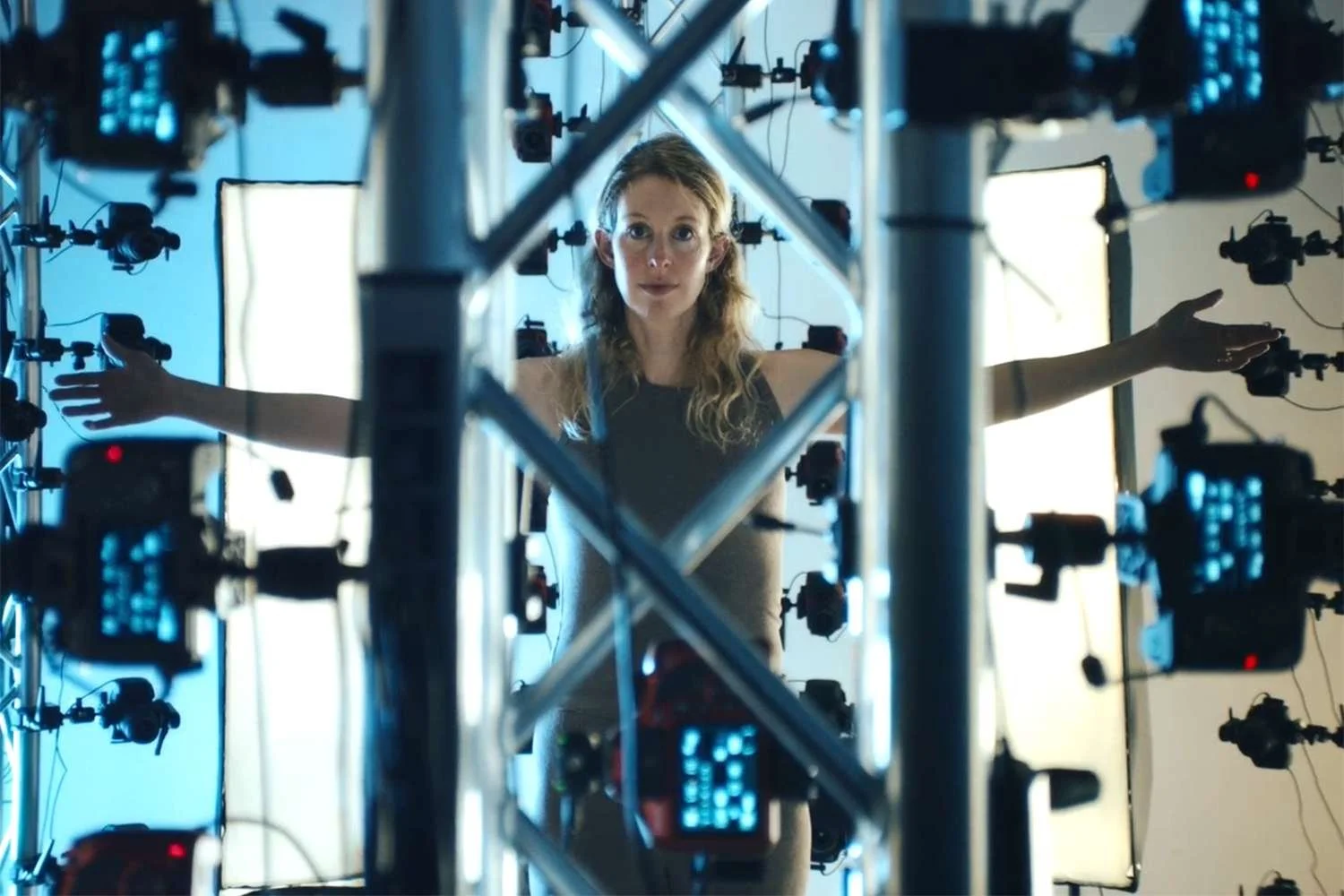
Okay but I can’t tell you everything because you simply have to see it.
Overall: A