
FJORD
Directing: B+
Acting: B+
Writing: A-
Cinematography: A-
Editing: B+
Fjord is quite the cinematic Rorschach test, making it quite easy to elicit empathy for different characters depending on your own cultural and religious background. Set in a village on the west coast of Norway, it all comes down to the cultural and legal judgment of a deeply conservative Christian family who immigrates from Romania, and the degree to which they may or may not be abusing their children. And this is really the crux of it: some might say the word “abusing” is being used loosely here, while others would say there is no other word for it.
Where might you side on this matter? Conservative Christians might easily side with the argument that Norwegian Child Protective Services involvement amounts to religious persecution. Progressives might easily side with the argument that authorities should intervene when parents get physical with their children at all.
The amazing feat of Fjord, written and directed by Cristian Mungiu, is that, so long as you don’t have particularly extreme views in any direction, it’s easy to empathize—if not necessarily agree with—all parties involved. There certainly is a subtle sense of xenophobia among some of the school staff who report the existence of bruises on one of the children, even though it’s never clear that she got them from her parents. Police interview records state that these parents admit to “repeatedly hitting” their children, when all they ever explicitly admit to is a swat on the butt or a slap on the hand.
But, in short order, CPS takes the children and places them in foster homes, and a criminal trial ensues. Many other complicating factors come into play, from the local school principal being a neighbor with whom the family has become friendly, to that family’s teenage girl who consistently convinces the two older children to disobey their parents. There is also the fact that these children seem perfectly well-adjusted, happy at home, and actually want to be reunited with their parents.
I find myself wondering how this film was received in Norway, where it is set. Was it very controversial? It seems there has been some controversy, but not a huge amount. Making the conservative family here Christian seems like a very deliberate choice. What if the family had been written as Muslim, its growing size in Scandinavian countries being a contentious issue (as everywhere)? That likely would have caused a far bigger stir, both in Norway and its surrounding countries as well as in the U.S.
I’m not judging the choice to make it a conservative Christian family, mind you, but one wonders if there is any sort of allegory at play, perhaps for other religions. Secular aversion to any kind of religious orthodoxy works in a story like this, however, and using Christianity was likely safer. And coming from a strictly Christian upbringing myself, I am by default inclined to judge this family—but, I always have great respect for films that portray Christian characters with the kind of dimensionality they do not often get in wide release films. Portraying them as wild fanatics is a trope that grew tired long ago.
In the story here, the situation is further complicated by the mother in this family being Norwegian, but who fell in love with and married a man in Romania. The husband, Mihai Gheorghiu, is played by Sebastian Stan, who happens to be Romanian by birth; still, his accent work and physical transformation here illustrates his stunning versatility as an actor. The wife, Lisbet Gheorghiu, is played by Renate Reinsve, in a performance so understatement you might wonder how good the acting is—until you see her ncredibly different performances in other films.
As the leads, Stan and Reinsve are incredibly compelling. It feels difficult to judge the rest of the cast, many of whom are Norwegian actors, with some who are either Romanian or of Romanian descent—such as the two eldest children, Elia (Vanessa Ceban) and Emmanuel (Jonathan Ciprian Breazu). The director, Cristian Mungiu, is himself Romanian, and as an American viewer with no experience in Scandinavia, it’s impossible to tell whether the uniformly stoic delivery of nearly every other person on camera is a reflection of the local culture or a specific artistic choice on the part of the filmmaker. I will say, I found the consistently deadpan delivery a bit distracting.
The deeply provocative story is another thing entirely. I wish I could have seen it with someone, so we could spend a great deal of time discussing the many questions it raises. Setting aside the actual scientific evidence to support the idea that physical punishment is broadly ineffective: where do you draw the line in terms of dictating what parents can or cannot do with their own children? There is a blurred line somewhere in there, between “discipline” and “abuse.” At what point does it justify removing children from their parents? Is it wrong to acknowledge that even when you disagree with certain behaviors, there are still degrees of severity? And when all of these questions are considered on a case by case basis, to what degree does xenophobia inform those decisions in one case versus another?
We never see Mihai or Lisbet physically discipline their children onscreen, which is the right choice, as otherwise too many of these questions would get—or seem to get—cut and dried answers. We do see them get disciplined, however, such as Elia and Emmanuel being forbidden from attending the birthday party of their neighbor friend Noora (Henrikke Lund-Olsen), after roughhousing dangerously around the baby. We see others use arguments against the Gheorghiu parents with debatable relevance, such as Elia stating to Noora her belief that being a lesbian is a sin, among other things. (Noora’s sexuality as a plot point, especially as she becomes closer friends with Elia, is a bit underdeveloped. It is never clear if the friendship makes Noora question her lesbianism at all, or if Noora’s influence in any way loosens Elia’s belief on the matter. Noora is clearly a bit smitten with Elia, but we never see any consequences of that.)
I have reached my own conclusions regarding how Mihai and Lisbet live their lives and raise their children, and it may not be exactly what you expect. I am eager for others to see the film and come to their own conclusions, which is the unique way in which Fjord is a must watch.
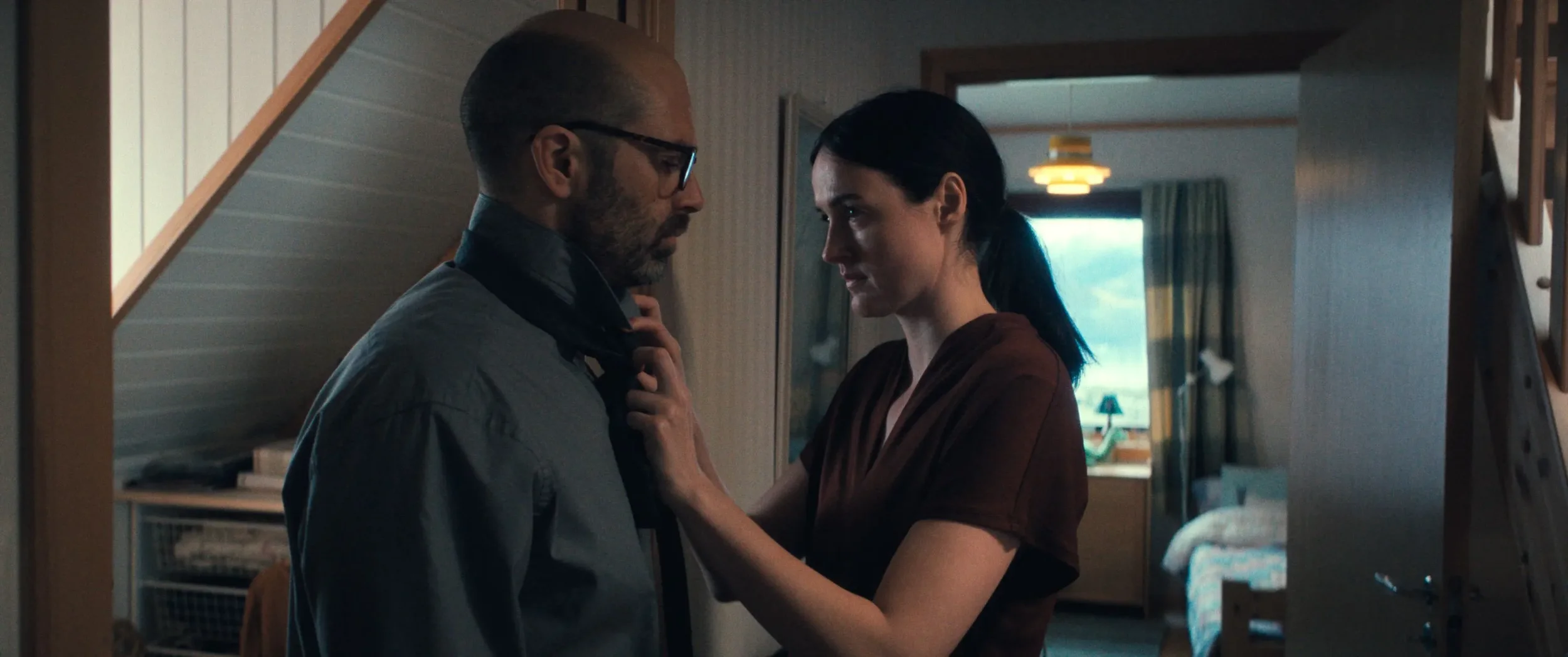
Should we just let them be happy in their own way?
Overall: B+