
TWO PROSECUTORS
Directing: B
Acting: B-
Writing: B
Cinematography: B-
Editing: B
I didn’t get too far into Two Prosecutors before I got a sense of where it was headed. This was hardly a surprise, or a spoiler; this film is about a man navigating the rampant corruption of 1937 Soviet Russia—or “Stalin’s Great Terror,” as the film puts it. It’s fascinating how many films we have gotten over the decades about Nazi Germany, and the comparatively few we have gotten about Stalinist Russia. It’s also ironic, given that Stalin’s regime killed more people than Hitler. Which is to say, in Two Prosecutors, the young prosecutor Kornyev, played by Alexander Kuznetsov, is headed nowhere good, as he investigates the treatment of prisoners in his district.
He only manages to meet with one such prisoner, a very old man named Stepniak (Aleksandr Filippenko) who has been falsely imprisoned and by some miracle managed to get a note out of the prison. Not having been provided any writing utensils, he wrote the note in his own blood. Come to think of it, he sure did manage neat and tidy writing in blood with no writing utensils.
Fully the first half of Two Prosecutors follows Kornyev as he is stalled at every turn, making his way through the maze of the prison where Stepniak is being held. He waits, and he waits—and so do we. I got the feeling that Ukranian director and co-writer Sergey Loznitsa’s intent was to make us quite literally feel Kornyev’s frustration. And I’ve got to say: it worked. Two Prosecutors has a glacial pace the likes of which I have not experienced in ages, and is sure to alienate any casual movie watcher.
Of course, this is not a film for the casual movie-goer. It exists to challenge, and force us to confront the dangers of fascism in the most mundane of environments—and how the mundane can be used to mask horrors. This is a movie about a man who is increasingly brave as he insists on doing the right thing, and following the letter of the law, and we know far before the end that he will only be punished for it. I was reminded of the end of the far more exciting All Quiet on the Western Front: all that effort, for this?
After Kornyev finally meets his prisoner and is a first-hand witness to how horribly the NKVD (the abbreviation for the agency that translates as People's Commissariat for Internal Affairs) treats the countless people they arrest without cause, the second half of Two Prosecutors has Kornyev traveling to Moscow to meet with the Prosecutor General—hence the film’s title. Here he walks the labyrinthine halls of government offices rather than those of a prison, but he is stalled in exactly the same way. And we once again spend what feels like an eternity, waiting with him.
It would be one thing if it were just the waiting, but nearly every character is ridiculously stoic. Neither Kornyev nor anyone whose path he crosses has any personality to speak of. The guy who finally grants him permission to visit Stepniak in prison does laugh at his own joke, with a sort of mirthless glee. Once Kornyev finally gets his meeting with the Prosector General, the Prosecutor General listens to Kornyev’s litany of allegations with nary a facial expression. Then he provides him with a train ticket ride home in a train car that’s quite the contrast to the crowded car he traveled to Moscow in. On his ride home, he meets two engineers already sharing the room he’s put in, and these guys are the only characters in the movie who exude a modicum of warmth. And you should know instantly not to trust that.
Two Prosecutors is drab, dull, and bleak—all with clear intentionality. I have a hard time deciding what to make of it, overall. It kind of won me over in the end, as I got a sense of what it was doing. Nevertheless, I do not recommend watching this when you haven’t had enough sleep. You’re guaranteed to nod off, just as Kornyev himself does on more than one occasion.
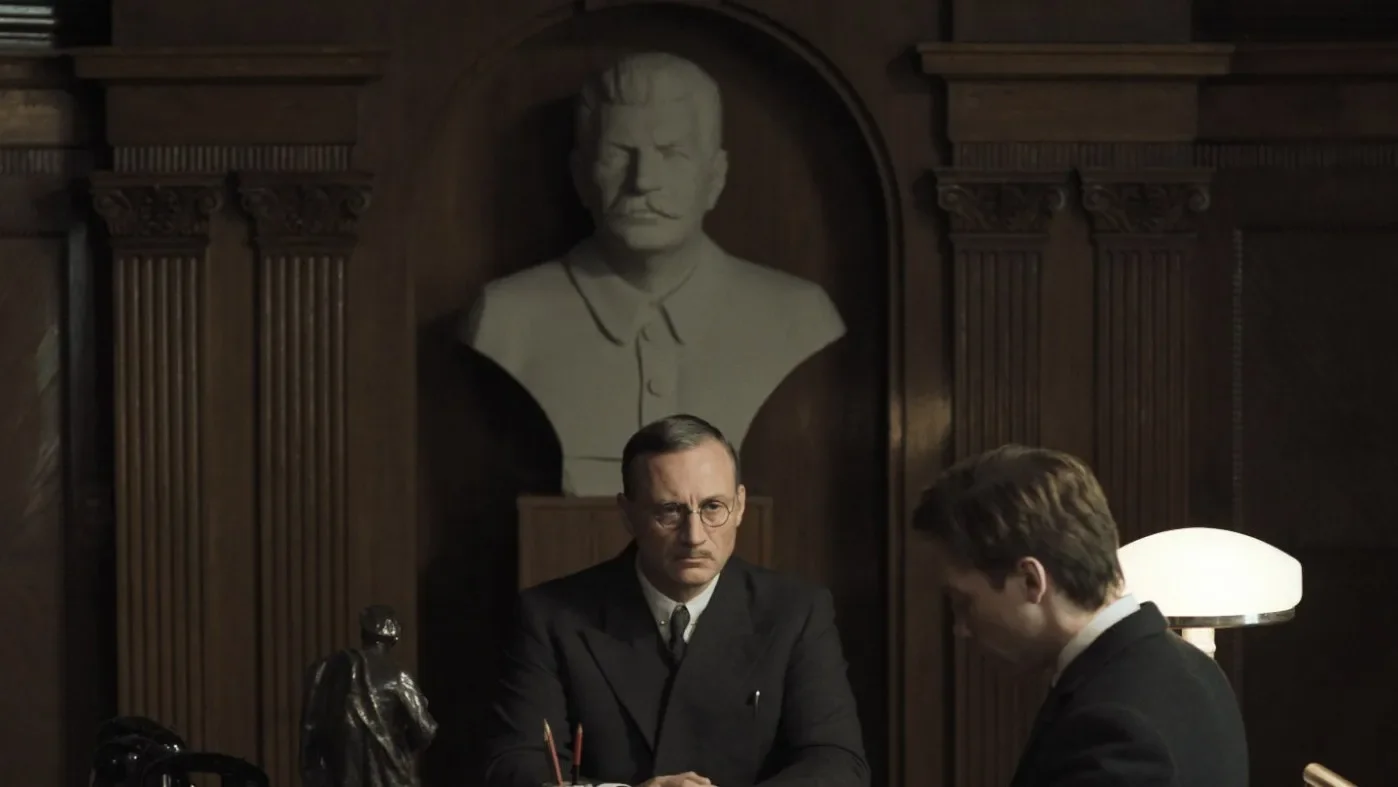
Yep, this movie has Two Prosecutors in it.