
BLUE HERON
Directing: B
Acting: B+
Writing: B-
Cinematography: B+
Editing: B
Blue Heron is an “art film” that, on the surface at least, really takes itself seriously as such a thing. It predictably delights critics, regular movie-goers only somewhat less so, a statement that basically ignores the legions of people who rightly assume this movie isn’t for them and so they don’t watch it at all. As is often the case in scenarios like this, I fall generally somewhere in the middle.
I wanted to love this movie, but I just couldn’t quite connect with it. Maybe it’s because of my own issues with memory, which Blue Heron explores in a unique way, as it presents the family life of Hungarian immigrants who have recently moved to Vancouver Island as remembered by the one girl, Sasha (Eylul Guven), among four children. She and two of the boys all seem quite close in age, approaching preteens but a couple of years away from it, give or take. The eldest, however, is Jeremy (Edik Beddoes, blond and with glasses that, while they are given a logical explanation, make him look a bit like a teenage Jeffrey Dahmer), is 14 years old, and the entire reason for the telling of this story.
The first half or so of Blue Heron is almost radically naturalistic, with effectively complementary cinematography by Maya Bankovic. It’s a series of vignettes that offer random slices of their everyday lives, seemingly somewhere between pleasant and innocuous at first. Very gradually, Jeremy is revealed to be a bit of a nuisance, acting out, causing trouble, being generally annoying. In the first example of this, he is seen laying down on their front porch as though dead, for so long that the neighbors call his parents, according to his father, to report that their “son is dead on the front porch.” But, over time, Jeremy’s antics evolve into things a bit more alarming and sinister, his behavior increasingly sociopathic. He gets arrested for shoplifting, a crime he never once shows any remorse for doing. He climbs onto the roof of the house and freaks his parents out as he refuses to come back down. In one example, his mom is woken up in the middle of the night by the sound of a window breaking, and she finds that Jeremy has cut his hand badly on it.
There seem to be dual ideas intermingling in the presentation of Blue Heron: what could possibly be the best option for a truly uncontrollable child in a world with very few genuinely workable options; and how the reconstruction of that story is complicated by memory itself.
In the far more naturalistic first half of the film, which is presented with an almost documentary-like quality while also being something close to dreamlike at times, I was much more taken with it, even as there seemed to be no real plot to speak of. We never actually see Jeremy do any truly horrible things; mostly we see him just being occasionally annoying. His parents, played by Iringó Réti and Ádám Tompa, are characterized as doing the best they can while also contending with the needs of three other children and their own lives separate from them. The father spends a lot of time on a nineties-era Mac computer (because these sequences are set in the late nineties), and we never know exactly what he’s doing on it. Does he work from home, even in that era? What the hell is he doing? At one point he sets Sasha on his knees and shows her how to draw and color a picture using the mouse.
And all the while, Sasha is observing. About halfway through Blue Heron, there is an abrupt jump forward twenty years, and we see Sasha as an adult (Amy Zimmer). She’s now a filmmaker, and hosting a focus group in which she asks how a case like Jeremy’s might be handled differently today. There is a pointed comment about how resources are scarce for kids like Jeremy even now.
It took me a minute to even realize the time had jumped forward. I thought: Wait a minute. She’s holding an iPhone. Indeed, this turns out to be the very iPhone she’s shown recording her childhood hometown with in the opening scene, before it jumps back to the nineties. From here, though, Blue Heron gets sort of meta, and certainly confusing if you’re not paying the right kind of attention. She drives to her old house, presses “record” on her phone and hides it in her purse, and then suddenly she goes to the front door to announce she’s making a health visit. Except, it’s her father, the same age (and same actor) as in the flashbacks, who interacts with her as though she’s the social worker she remembers having visited when she was a child. Part of this sequence we have already seen, with Sasha as a little girl and a different actor playing the social worker. And by the end of this sequence, Adult Sasha walks out of the room and Young Sasha walks in, having just been eavesdropping through the door.
Perhaps other viewers will find this very obvious, but my experience with it was a film that turned toward the inaccessible, toward something a bit obtuse. Given the notoriously unreliable nature of memory, I can see the reasoning behind it. I just can’t decide if it actually works.
It also gradually becomes clear that this is really Sasha’s story, and not Jeremy’s, and about how memory complicates a fraught history. It’s noted that sometimes Jeremy was scary and sometimes he was sweet, and this is precisely how we experience him in the first half of the film. This is also reportedly a largely autobiographical account of writer-director Sophy Romvari’s own experiences. It would seem that she was more interested in how memory affects her perception of family history, than she was in simply writing something more straightforward that, in a fictionalized world at least, might have provided some closure. I’d have been more interested in the latter, but it takes all kinds, I guess.
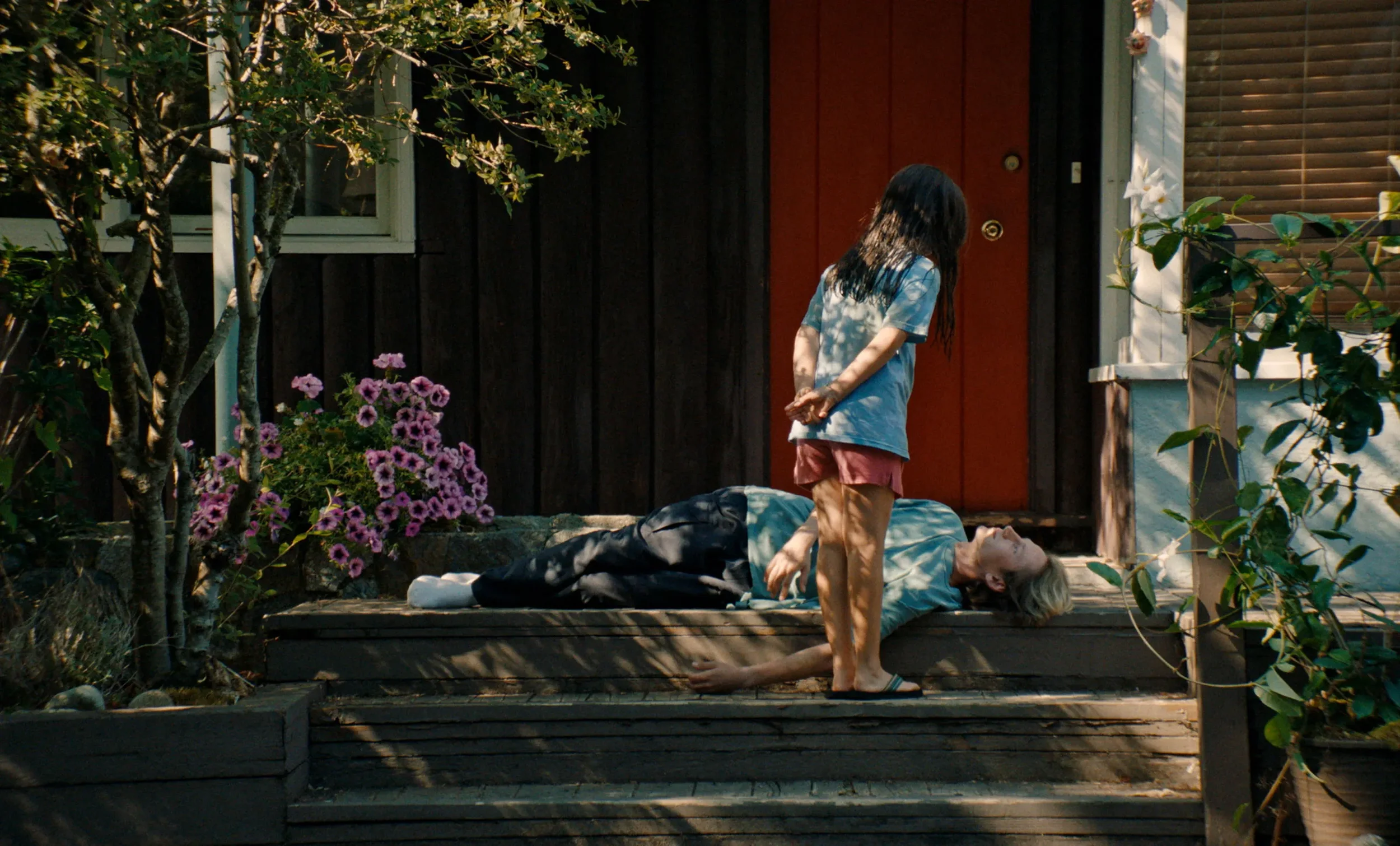
Hey I don’t remember any blue herons!
Overall: B