
MOTHER MARY
Directing: B
Acting: A-
Writing: B-
Cinematography: B+
Editing: B
Special Effects: B-
Music: B+
Both Anne Hathaway and Michaela Coel seem to be having A Moment this year, albeit to different degrees. Coel has had two film releases this year, all of one month apart—the first being The Christophers, the second being Mother Mary. As for Hathaway, though she has been working steadily all along, the last lead performance of hers that got any notable attention was for the fascinating film Colossal in 2016, and that was not a very big movie. And after languishing in a sort of obscurity, at least relative to her earlier success, this year she has five films coming out—and, due to my own life circumstances, I happened to see both of the first two, two days in a row this week: The Devil Wears Prada 2 and Mother Mary, even though the latter was released in my local market one week prior.
I managed to see Mother Mary in its last day in theaters, which I really wanted to do because of Hathaway’s role as the title character, a hugely successful pop star, with pop songs she actually performs—quite well—herself, written by Jack Antonoff and Charli XCX. I downloaded the EP of her seven songs recorded for the film, with Anne Hathaway herself listed as the artist and the album title Mother Mary: Greatest Hits. I like it a lot, and assumed it would enhance the viewing experience of the film to have familiarized myself with the songs first. Now, I’m not sure it really mattered—just as I’m not sure if it makes a difference if you eventually just watch this film on a streamer rather than in theaters (a predictable inevitability: this film grossed $2.4 million in its three weeks of theatrical release). It turns out Mother Mary spends most of its time as a dialogue-heavy two-hander, with just two people talking in a room.
Mother Mary is directed by David Lowery, and if you are familiar with his work, in spite of his resume being surprisingly varied (he directed both the wonderful 2016 remake of Pete’s Dragon and the perfectly pleasant 2018 film The Old Man & the Gun, both of which starred Robert Redford), then you know to be unsurprised when his films turn out to be very challenging and weird (he also directed both A Ghost Story in 2017 and The Green Knight in 2021). Mother Mary is much more in the vein of his more challenging films, in that it’s frustratingly tedious until it becomes compellingly baffling. In short, Lowery is a director with an established history of films I can’t understand, to the point of utter frustration, only for them to find some way to pull me in by the end. I know nobody in particular I would recommend his more challenging films to, and yet they are consistently films I can imagine gaining greater appreciation for myself, upon repeat viewings.
Mother Mary opens with Anne Hathaway as the title character, performing onstage to an adoring audience, with backup dancers. The pop music is super catchy from the start, so you might reasonably assume the music would play a significant role in the film. But, by the time the opening sequence is over, Mother Mary is rushing into the house of her former costume designer, Sam (Coel), insisting that she needs to design her a dress. There follows a lot of completely straightforward, unstylized scenes of dialogue between just the two of them, albeit with some scenes of Sam’s assistant, Hilda (Eurphoria’s Hunter Schafer), peppered in. It’s maybe halfway through the film before things predictably turn weird, and we find out that Mother Mary is now possessed with the spirit (rendered as a red fabric) that Sam had some time before expelled.
It seems Mother Mary is mostly about friendship, how it can be excruciatingly intimate and then devastatingly strained, and how the baggage of those strained connections can weigh on those affected. Honestly, this is my first pass at what that red-fabric-spirit represents as a metaphor, because in true David Lowery style, he never makes this explicitly clear. Even though Mother Mary and Sam literally talk about whether or not what they’re speaking is metaphor.
Mother Mary eases back into stylistic flourishes as these two regale each other with their respective experiences with this ethereal spirit, with no human personality or clear intention. We just know that it enters and exits Mother Mary’s body through open wounds. And I must say, there are certain scenes with this floating red-fabric-spirit in a black void that are hauntingly beautiful—and also some scenes in which it is rendered with surprisingly janky, herky-jerky visual effects. Lowery is usually known for great visuals, so I don’t know what the deal is there. Anyway, as they tell each other’s stories, one of them will open a door in Sam’s huge warehouse of fabrics, or turn their head, the camera will turn, and suddenly they are looking upon the flashback we transition to.
The more the film shifts in this manner, the more cuts we get back to Mother Mary’s stage performances. It’s worth noting that there has been some debate as to what real-life pop star most inspired Mother Mary, and to be it’s preposterous to think there is any debate at all: it’s clearly Lady Gaga. Mother Mary comes onstage in a high-waisted one-piece very reminiscent of many Lady Gaga costumes, at one point complete with a staff reminiscent of the “disco stick” from Lady Gaga’s “Lovegame” video. There’s even Sam’s brief mention of Mother Mary once arriving at an event “wearing nothing but freshly poured honey,” a clear nod to Lady Gaga’s infamous “meat dress.” And finally, what star besides Lady Gaga even has a pop persona in quite the same vein as “Mother Mary?” This would be why Sam’s signature element of her costume designs for Mother Mary are her so-called “halos,” a pretty obvious nod to the very name—and something we can easily imagine Lady Gaga having done if she were Mother Mary instead.
Mother Mary even seems to be at a similar stage in her career, with Sam referencing the biggest hits “between 2003 and 2015,” indicating Mother Mary is at least 20 years in, past the height of her career but still important to legions of fans. (Lady Gaga broke out in 2008, but 18 years is still pretty close.) I rather wish more of the movie focused on Mother Mary’s career, actually, or at least on her music and its effects. The EP title Mother Mary: Greatest Hits has a sort of meta amusement to it, because these tracks are really fun but hardly timeless; this would never be the collection of songs on anyone’s career-retrospective of hits, but are serviceable as a fictional version of one. It helps that Hathaway is surprisingly adept at performing them—she sang live on set—which is another reason I wish more screen time was given to the music.
The most unfortunate thing about Mother Mary is that Anne Hathaway’s EP is far more fun than the movie, which has a somewhat awkward ebb and flow between compelling and tedious (Lowery is increasingly revealing this to be his trademark). There’s something about it that keeps it in mind for me, though, and once again I suspect it may benefit from another viewing, especially now that I know where it eventually goes. If nothing else, the acting is excellent: Hathaway is an undeniable star and actually convincing as a pop icon; Coel’s performance is as stupendous as ever, and always the biggest reason to keep watching the scenes that don’t take place onstage. I may not quite be able to make heads or tails of the story, but how it’s told onscreen, even when veering into the objectively ridiculous, keeps me invested.
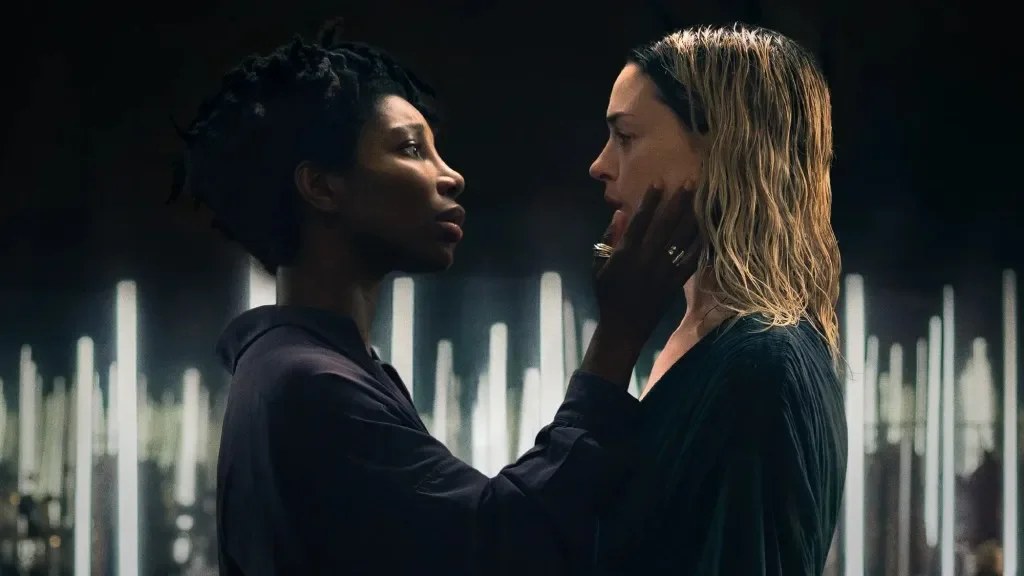
Sam has conditions for accepting Mother Mary’s apology for the ways in which this movie alienates its less perceptive viewers.
Overall: B