
THE DEVIL WEARS PRADA 2
Directing: B
Acting: B
Writing: B-
Cinematography: B
Editing: B+
There’s a moment, relatively near the end of The Devil Wears Prada 2, when Miranda Priestly says, “I just love working, don’t you?” This is the line that is staying with me the most, as I wonder whether the meta aspect of it was at all intentional: the line is delivered by Meryl Streep, who might as well also be speaking for herself and her acting career. It serves as an explanation, beyond the obvious paycheck (Streep was paid a reported $7 million to reprise this role), for why she would bother with revisiting this role a solid 20 years later.
In 2006, the original The Devil Wears Prada came roughly 30 years into Meryl Streep’s career, and it became by some distance the most successful movie she was in—a record broken only by the ridiculous Mamma Mia! only two years later, in 2008. No role in her career has ever been more iconic than that of Miranda Priestly, however, as she singlehandedly turned what otherwise would have been a cinematic piece of mediocrity into a wildly rewatchable entertainment.
So how does the sequel stack up? In context, in its time, I’d say it roughly matches the original—with some elements that fall short. But, the original also had elements that fell short; they were just different. And, even 20 years on, we love these characters too much not to have a pretty good time. They brought back all of the heavy hitters, after all: Streep, of course; Anne Hathaway as Andy Sachs, now much more grown and confident; Stanley Tucchi as Miranda’s long-suffering professional sidekick; and Emily Blunt as Emily Charlton, now working leverage against Runway Magazine as the largest advertiser at Dior (the product placement and fashion cameos are, predictably, off the charts). Even Tracie Thomas returns as Andy’s best friend Lily—something I took way too long to clock, mostly because, while she still looks objectively great, she looks more naturally aged by 20 years than any of the other major actors do.
It’s worth noting that the original The Devil Wears Prada had things going for it that this film does not, most notably the notoriety of its source material: it was based on the 2003 novel of the same name by Lauren Weisberger, in which the Miranda Priestly character was widely known to be a thinly veiled representation of Anna Wintour. The speculation surrounding these facts fed the buzz around the film, although Meryl Streep came in and truly created a unique character quite distinct from Wintour. It’s probably telling that Weisberger wrote two sequels, but The Devil Wears Prada 2 is not based on either of them; both films’ scripts were written by Aline Brosh McKenna, but this time the story is entirely original.
Well, not entirely—it still has a credit that states it’s “based on characters created by Lauren Weisberger,” after all. It even slightly pokes fun at that, with a character scoffing at the idea of writing a book about a boss you don’t like. And, much like the previous film, a lot of the story is pretty contrived—especially the setup now that forces all of these same people back together. In the opening scene, Andy and all of her newspaper journalist colleagues are fired via text while she’s accepting an award for her work, and coincidentally Runway is experiencing a PR disaster. Andy, now a respected journalist, is offered a job at double her previous salary in an effort to restore credibility to the magazine.
Much of Andy’s and Miranda’s reintroduction is pretty entertaining, in that Miranda doesn’t (or maybe pretends she doesn’t) remember her. Streep’s acting is great as always, but I found her characterization in this film somewhat curious, in that she is uncharacteristically more personable than she was before, even as she’s being rude to people (and particularly to Andy). I don’t know if this was meant to be an indication of how she’s changed a little over the years or what. That said, The Devil Wears Prada 2 spends a lot of time acknowledging how the world, and especially both journalism and fashion, have changed over these past 20 years. This would include regular corporate workplace norms, as there is a funny running bit about how Miranda has to choose her words more carefully now to avoid HR interference.
What love interests there are, are different this time around—fine by me, as Andy’s boyfriend from the first film, while very cute, was pretty dull as a character. This time she has a meet-cute with an Australian played by Patrick Brammall, and he’s moderately more interesting than the first guy, if distractingly performative with his eyebrows. Emily, for her part, is seeing a billionaire played by Justin Theroux, who also happens to be the ex-husband of Sasha Barnes, rendered significantly wealthy in her own right, a desired target for an interview with Runway after some years of reclusiveness. Sasha is played by Lucy Liu, a very interesting actor in a part that gives her virtually nothing interesting to work with.
Miranda is now married to a guy played by Kenneth Branagh; B. J. Novak plays the incurious heir to Runway’s parent company; even Lady Gaga makes a special appearance as herself (performing an original song, which, to be honest, sounds like a generic version of Lady Gaga—it turns out she recorded four original songs for the soundtrack). To say this film has a stacked cast would be an understatement, although it could be argued it was the first film that transformed about four of them into the stars that they are.
I was feeling kind of indifferent to the story for much of this movie, but still taken by the characters; this is how “lega-sequels” successfully traffic in nostalgia. It does have some similar beats to the first film, in terms of the tensions between Andy and Miranda; Andy trying and awkwardly failing to impress Miranda; Miranda finally deigning to be impressed. I’d be lying if I said I wasn’t taken with the movie by the time it was ending, though. These movies never made grand promises, just modest ones, which they deliver on. I still left the theater with a warm and appreciative smile.
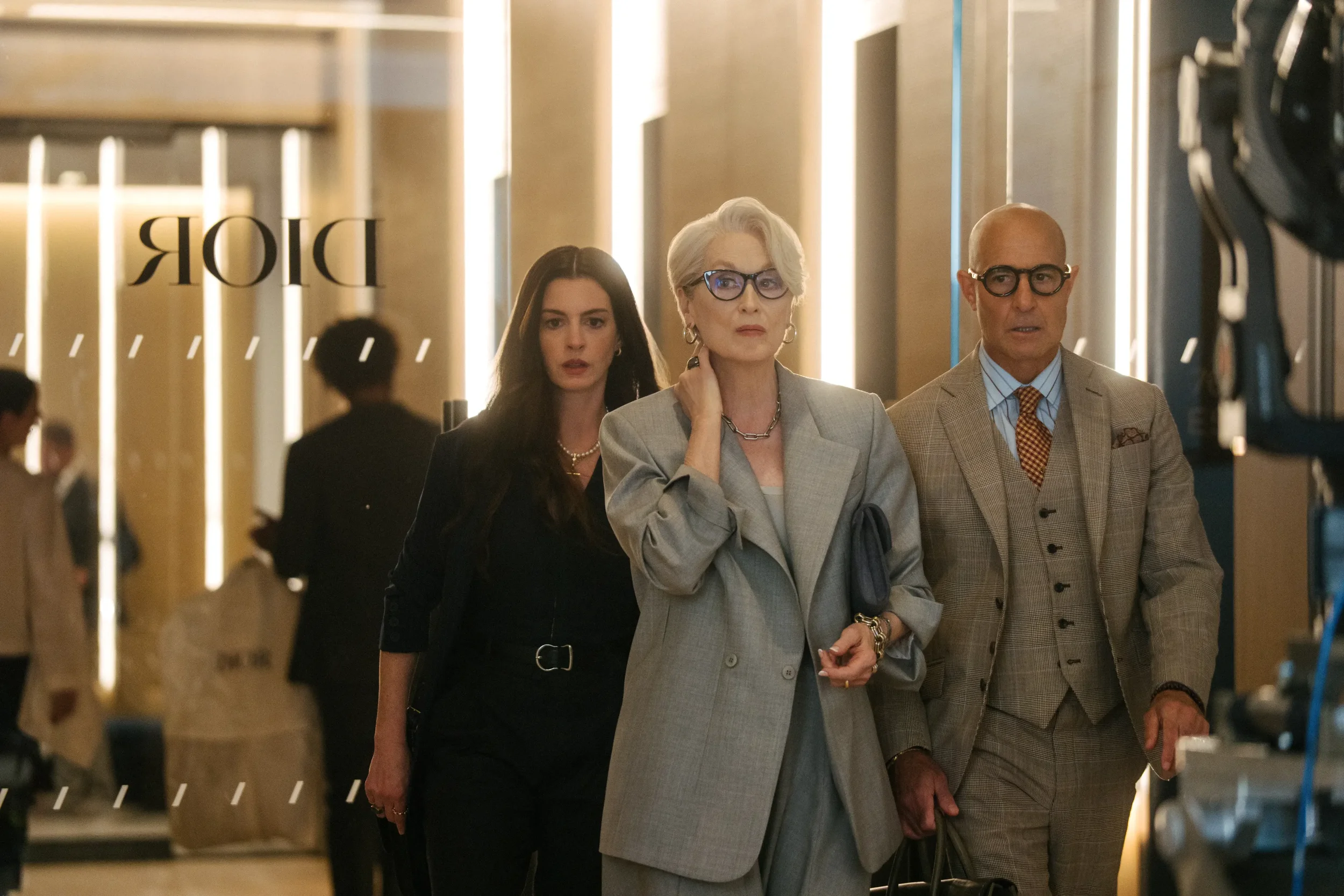
The gang strikes an uneasy pose in a new and rapidly changing world.
Overall: B