
YOU HAD TO BE THERE: HOW THE TORONTO GODSPELL IGNITED A COMEDY REVOLUTION, SPREAD LOVE & OVERALLS, AND CREATED A COMMUNITY THAT CHANGED THE WORLD (IN A CANADIAN KIND OF WAY)
Directing: B+
Writing: B+
Cinematography: B
Editing: B+
Between The Cycle of Love and You Had to Be There, I’m not sure I have ever experienced such heartwarming uplift strictly from documentary filmmaking—particularly within the space of just a couple of weeks. People expect “feel-good movies” to be fictional narratives, but this are easily the most “feel-good” of movies I’ve seen all year. It’s too bad so few people will actually see them. This is exactly the kind of uncynical storytelling the world needs.
It’s all about sharing love—and in the case of You Had to Be There, it’s love in many directions: cast mates in a 1972 original production of Godspell in Toronto quickly developing deep love and affection for each other, and individually blossoming over ensuing decades to become truly beloved figures in the entertainment industry. To be fair, there are varying levels of beloved-ness, perhaps sitting at the top including Martin Short; Eugene Levy; and Gilda Radner, who remains a mythical figure in comedy circles nearly forty years after her passing. But this original-run cast of Godspell also included Paul Shaffer; Andrea Martin; and Victor Garber (who is now perhaps best known as the ship designer Thomas Andrews in the 1997 Titanic). Also included in that cast—and all of them giving contemporary intervies for You Had to Be There—are Second City veteran Dave Thomas; Jayne Eastwood; local Toronto performer Rudy Webb (the only Black person in the cast, something not discussed here); Valda Aviks; and Avril Chown.
Chown, as it happens, represents the one moment of darkness in You Had to Be There, revealing apparently for the first time, on camera. the reason she did not stay in the entertainment industry for very long. After Godspell, she was cast as the sole woman on a children’s show with five men, and she was repeatedly sexually assaulted. This turned her off of the industry, but she still keeps in touch with that cast—You Had to Be There ends with what appears to be one of a regular reunion between all of them, still close friends, more than fifty years later. What happened to Chown is clearly an important detail to note, but it does not fit very comfortably within the narrative of this story. That’s not to say it needs to be comfortable, far from it—but, director Nick Davis transitions a bit abruptly from that anecdote, straight into how beloved Gilda Radner was.
Given that the Toronto run of Godspell was in 1972—not the first run of the show, but after only the Off-Broadway debut and a London run, both in 1971—it’s not a huge surprise that all the subjects are now in their seventies or older. I found myself thinking about how much longer these wonderful reunions will be able to continue. You Had to Be There is itself thus a deeply appreciated record of this particular history, of a group of actors who went on to do great things from Second City to Saturday Night Live to SCTV to great film roles and much more. Nick Davis is rather playful with the documentary production, starting with the official, full title: You Had to Be There: How the Toronto Godspell Ignited the Comedy Revolution, Spread Love & Overalls, and Created a Community That Changed the World (in a Canadian Kind of Way). That’s thirty words.
Plenty more people are interviewed for the film, from directors and writers who worked on the play, to a smattering of contemporary, younger artists who speak reverently about the people from the Toronto Godspell. It’s not always clear what connection they have or why they would be especially relevant for inclusion; among the most prominently featured are Lin-Manuel Miranda; Janeane Garofalo; and SNL cast member Heidi Gardner. This rounds out all the interviews a bit, but the clips with present-day interviews with Godspell cast members are by far the most compelling, especially when they are surprised with a video clip of one rehearsal that most of them appear to have no idea ever existed. The emotions and delight it elicits is very touching.
Other than that, and one illegally captured tape recording Martin Short made of a single performance, no footage of this prodiction of Godspell exists. This means a lot of recreation has to happen to break up the talking heads, much of which is rendered in animation flourishes in a very old-school style, kind of like 1970s episodes of Scooby-Doo. Sometimes this is synced to Short’s taped audio, and sometimes it's just matching interview anecdotes. It works fine, if also somewhat transparently a trick for visual filler.
By far more than anything, what makes You Had to Be There work is the chemistry among this cast, how fondly they all remember not just launching their careers with Godspell but decades of resulting friendship. The reunion sequence is the perfect way to conclude this story, as it illustrates a group love that has endured for decades and will live on. I left the theater feeling buoyed by it.
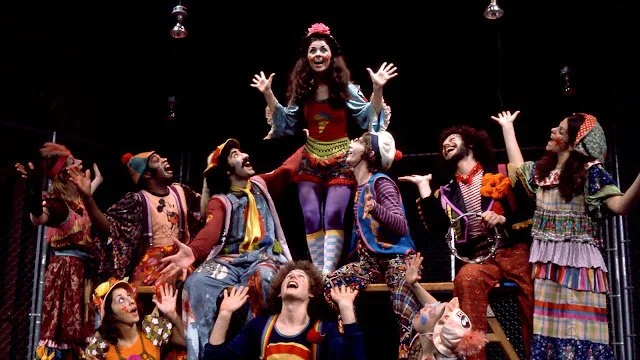
I wish I had been there—disciple clowns and all!
Overall: B+