
THE MARCHING BAND
Directing: B+
Acting: A-
Writing: B+
Cinematography: B
Editing: A-
I can just hear all the criticisms by film snobs of The Marching Band: it’s emotionally manipulative, it’s treacly, it’s occasionally contrived—you know, all the things that make a crowd-pleasing movie work. Well, this movie very much worked on me, and I’m happy to say I thoroughly enjoyed it. It’s practically the definition of a crowd-pleaser, and isn’t that precisely what the crowd wants?
It also has far more depth than it might seem at first glance, thanks to a tight script that was co-written by director Emmanuel Courcol. A ton of plot happens within just the first act: successful orchestra conductor Thibaut (Benjamin Lavernhe) discovers he has leukemia, and when his sister, Rose (Mathilde Courcol-Rozès, making the most of fairly little screen time), takes a DNA test to see if she is a match for a bone marrow transplant, it is revealed for the first time that Thibaut was adopted. He also discovers he had a brother he never knew he had, Jimmy Lecocq (Pierre Lottin), whose DNA is a match.
Most of The Marching Band is far less about Thibaut’s cancer than it is about the budding relationship between these two brothers who have only just learned of each other’s existence. This is one of the many surprising delights of The Marching Band, the title being a reference to Jimmy’s own extracurricular interests—something he keeps from Thibaut at first. It seems Jimmy, in spite of Thibaut’s discovery that he has perfect pitch, has a bit of an inferiority complex.
A whole lot of the story that unfolds here deals with class differences and the assumptions made by people born of privilege. Thibaut is understandably furious at his parents for not telling him he was adopted—”Lies kill!” he shouts at them—but takes a while to register the opportunities that would not have been available to him if not for his adoptive family. More than once the two brothers contemplate what their fates might have been had they actually grown up together: Thibaut in Jimmy’s working-class environment, or Jimmy in Thibaut’s world of comparative education and opportunity. (By way of brief explanation as to why Thibaut’s parents did not also adopt Jimmy, it is explained that they thought they were unable to have children, but then Rose was “a miracle” that left them ill-prepared to take on yet another child.)
The Marching Band also naturally brings up age-old questions of nature vs. nurture, at least when it comes to innate talent: Rose was not up to par with violin lessons in school; Jimmy is a natural musician. Jimmy is a divorced dad of a 13-year-old daughter he doesn’t get to see often enough, playing trombone in a community marching band in northern France. When the band’s conductor has no choice but to take a job in another region in order to pay off significant debts, the first suggestion is that Jimmy step in, but he has no confidence. Thibaut steps in to help him, with the encouragement of another band member, Sabrina (Sarah Suco), who Jimmy is too blind to see has a thing for him.
The whole cancer backstory seems to take a surprising backseat after the first half an hour or so, until it comes up again in a way that some may find surprising and some may find predictable—I was so taken with this movie, its characters, and particularly its performances, that I was happy just to go with the flow as the story went along. And in the end, all the story threads and the musical threads come together in a kind of emotional and musical crescendo that you’d have to be dead inside to resist. I was so moved by it, I really wish I had known to bring tissues.
It’s easy to see how The Marching Band became a smash hit in France, earning over $20 million in that country alone, and more than $30 million globally, before finally coming to the United States. This is happening, a bit inexplicably, nearly two years after it was first in wide release in France (November 2024). I’m a little baffled that this movie is not more well-known here; I only discovered it when checking to see what was playing in my local market at SIFF Cinemas. Time will tell whether France will enter this as their selection for the Best International Feature Oscar, but it is well deserving, and would give it greater exposure to American audiences. Otherwise, if you happen to see this review, and you enjoy deeply heartwarming dramas, then either check your local listings for this movie or make a note of it for eventual VOD or streaming options.
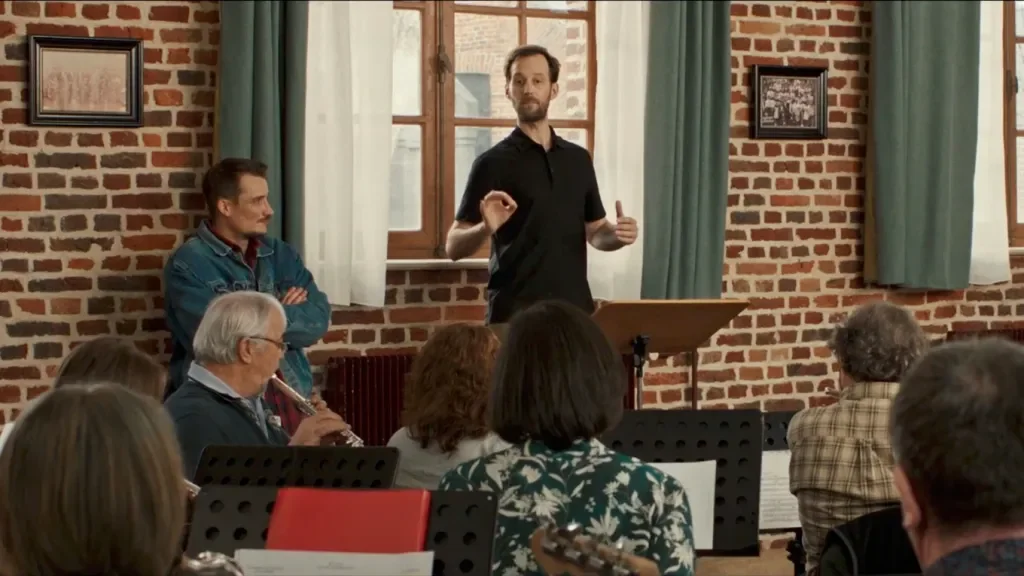
The orchestra conductor slums it with The Marching Band.
Overall: B+