
Tasveer Adance: 49 TO 51
Directing: B
Writing: B+
Cinematography: B
Editing: B+
Grief is different for everyone, and I was glad to see this notion stressed in 49 to 51, a documentary feature about the experience of someone suffering the loss of a loved one to suicide. In spite of it being an oft-repeated sentiment, it really can’t be repeated enough. I had an aunt once tell me that there are many ways to express grief, “all correct,” and it was something I found equally comforting and beautiful.
A significant qualifier in 49 to 51, however, is that there are also different and identifiable types of grief, and grieving loss to suicide is a very particular one. Director Ambalika Khadria, in her feature film debut, finds a fascinating subject to focus on: Indian-American mental health advocate Pooja Mehta, who herself has experienced suicidal ideation and speaks openly about her own suicide attempts—but this is about how she copes with the suicide of her younger brother, Raj.
49 to 51 is constructed on a “microbudget,” as Khadria herself called it in a post-screening Q&A, and at times, this shows—particularly in the film’s opening moments, which quite slowly ease into the details of Pooja’s family life in the hours and minutes leading up to his body being discovered in his bedroom. We learn that he texted a friend about the homework he was working on, only 20 minutes before he was found. Raj himself had no evident history of mental health struggles of his own, and he left no note. His motivation for this act is an eternal mystery, something that will likely haunt his family for as long as they live.
Pooja talks onscreen about how well she knew her brother, how certain she is he would tell her if he was not well, and that he could not have been himself when he did this. I don’t mean to be argumentative, but what immediately came to my mind is how we can never truly know anyone outside of ourselves, not even our closest family. Raj may have had mental health struggles and simply hid it extraordinarily well. It is also stressed in the film that there is no reliable correlation between mental health and suicide, and I’m not attempting to dispute that. One of many struggles with Raj’s suicide is simply the not knowing. What could possible have motivated him to do this, and evidently so impulsively?
49 to 51 wisely does not dwell on this question, as the focus is on Pooja, and the evolution of her expression of grief, especially in a South Asian family in which suicide is a taboo subject. It’s natural to be curious about Pooja and Raj’s parents, who suffered the tragic loss of their child. But they are much older and far less comfortable discussing such intimate details of their own grief, especially on camera. Khadria worked on this film for roughly five years, and did speak to the parents many times, eventually earning enough trust for them to allow footage of Pooja’s arrival for a visit home in their foyer, and that’s about it. We do get some archival footage of them speaking at Raj’s memorial service, which, among many other scenes in this film, is heartbreaking.
Still, Pooja makes for a uniquely compelling subject in this story, given her own mental health history and her longstanding work as a mental health advocate. Grieving the loss of someone to suicide is already very complex, and this adds a whole new level of complexity. And it would seem that if there is any overall message to this film, it’s an encouragement to talk about grief, both your own, and that of others. More often than not, people actually want to talk about the person they are grieving. Others around those who are grieving are often terrified of doing or saying the wrong thing, but this is not something the person grieving is really thinking about. Just ask them what they need, maybe give them options: do you need space? do you need someone to listen? There can be this idea that this approach is more dangerous territory of the lost loved one took their own life, but it isn’t, really. Suffering in isolation is the worse option.
Pooja is a rather brave person to bare her grief not just so frankly, but on camera. We see footage of her two and three years apart, intercut with each other. In the beginning of the film, it’s very focused on her; as the film progresses, we see her with certain dear friends, or visiting India, or reuniting with the man who ran her survivor’s support group.
49 to 51 won the Best Documentary Feature prize at the Tasveer Film Festival, and I found myself wondering how emotionally taxing it might be for the filmmakers to present and sit through this film over and over again; the post-screening Q&A I attended was deeply insightful but, naturally, pretty melancholy in tone. I hope they have space for joy in their lives, even while immersed in a massive, multi-year project about grief, which likely has people crying—as I did—at every screening. Before the film, they did show a photo of their film festival award, the crew surrounding in from behind with bright smiles. Balance is always good.
The title, 49 to 51, is at least a reference to something a bit more lighthearted, a bit of an inside-joke between Pooja and Raj revealed very near the end of the film. The last shot, though, is a deeply impactful and memorable one, of Pooja watching a video clip on her phone of Raj laughing uproariously, and Pooja is laughing and crying at the same time. In the end, this is a film that effectively honors both the departed and those who will always miss them, however complicated the circumstances may be. There is no distribution yet planned for this film, but I do hope it finds a home somewhere that people can access. It’s a rare kind of film that is both a tough sit and also a comfort, particularly if you have grieved a complicated loss.
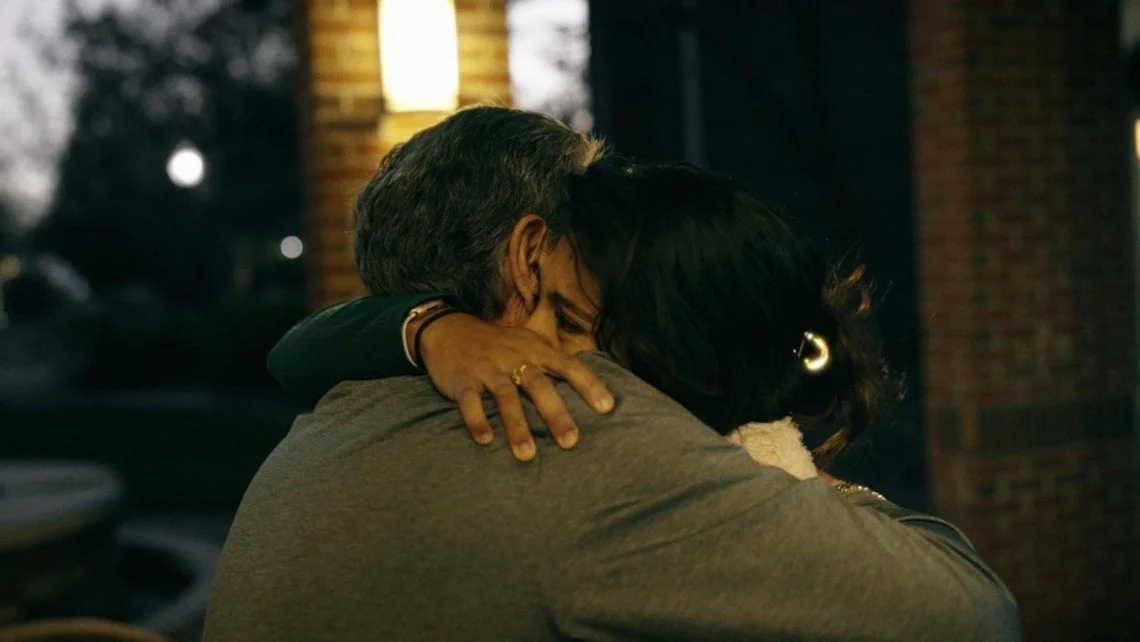
It’s an oversimplification to call this a tearjerker, but you do probably want to have tissue handy.
Overall: B+