
WICKER
Directing: B+
Acting: A-
Writing: B+
Cinematography: A-
Editing: B+
It may take a few beats to feel immersed in the world of Wicker, a fantastical film based on the short story The Wicker Husband by Ursula Wills. That title clearly gives a bit away: it’s about a husband made entirely out of wicker, woven by Peter Dinklage’s Basket Weaver at the request of Olivia Colman’s Fisherwoman. The character names here are just what they do, you see: Doctor (a nearly unrecognizable Richard E. Grant); Tailor (Nabhaan Rizwan); Bottlewasher (Gustav Lindh); Baker (Ben Ashenden). With the exception of Fisherwoman, however, the women in this little village are only addressed in relation to the man they are married to: Tailor’s Wife (Elizabeth Debicki); Baker’s Wife (Ella Bruccoleri); Bottlewasher’s Wife (Marli Siu).
These rigid gender roles are quite literalized very early on, with marriages featuring the groom putting a metal collar around the bride’s neck. The minister shouts, “Man and Woman becomes Man and His Wife!” Fisherwoman is established quickly as not just an aging spinster, but one the villagers make fun of for her fishy odor. But when Fisherwoman goes to the Basket Weaver to request he make her a husband, he’s startled by the request, but tells her to come back in a month, and in that time he has one for her. But not before Fisherwoman leaves him and we see Basket Weaver perform an extended monologue, something that occurs twice in the film and is one of the few things I found did not quite work. It feels like an attempt at something playfully Shakespearean, but even though Dinklage is up to the task as always, it lands awkwardly.
What’s amazing about Wicker, however, is how much of it does not land awkwardly when you might easily expect it to. A live, man made of wicker? Yep, that’s what we get here—and one incredibly well-rendered, I might add, with almost entirely practical effects. Wicker is a feminist fable, and fables often feature anthropomorphized non-human characters; I suppose a man made of wicker qualifies. The trailer to this film already made amply clear that the Wicker Man and the Fisherwoman have lots of sex, which leads to the obvious question: how on earth can anyone comfortably have sex with wicker? Aside from a very brief but delightfully shocking glimpse of his anatomy, I regret to inform you this question never gets answered—and, I will reluctantly concede, it is entirely beside the point of the film.
The villagers quickly become jealous of Fisherwoman’s and Wicker Man’s happiness and harmoniousness: the women of Fisherwoman getting so freely satisfied sexually (not to mention constantly volunteering to help around the house); the men feeling inadequate in the shadow of someone their wives clearly wish they were more like. Even the Fisherwoman gets caught up in the cycle of mistrust and jealously, leaving the Wicker Man as the only person who is too new to existence to even quite understand all this pettiness.
I will admit that at first I couldn’t quite decide what to make of Wicker, it is so brazenly odd, but the more I think about it, the more taken with it I become. This is a film that is very much its own thing, constructed from a simple fantasy universe that feels simultaneously familiar and unique. The performances are excellent all around, particularly on the parts of Olivia Colman and Alexander Skarsgård, who plays the Wicker Man with a physically stiff but heartfelt devotion that is easily melting hearts. This is an incredible achievement, given the obvious constraints of his wicker suit, and the fact that his eyeballs are the only part of his actual person we ever see. (We do see the Basket Weaver polishing an eyeball while constructing him; why a Basket Weaver would have eyeballs laying around is one of the many questions you are meant not to ask when being told a fable.)
Wicker is not only quite clearly not for everyone, but this is a case in which one might quite understand it not working for some. I suspect that for those susceptible to its charms, however, it works quite well. In the end, I am one of those people—admittedly, largely because Alexander Skarsgård remains irresistible even when all you are really getting are his eyes and his voice.
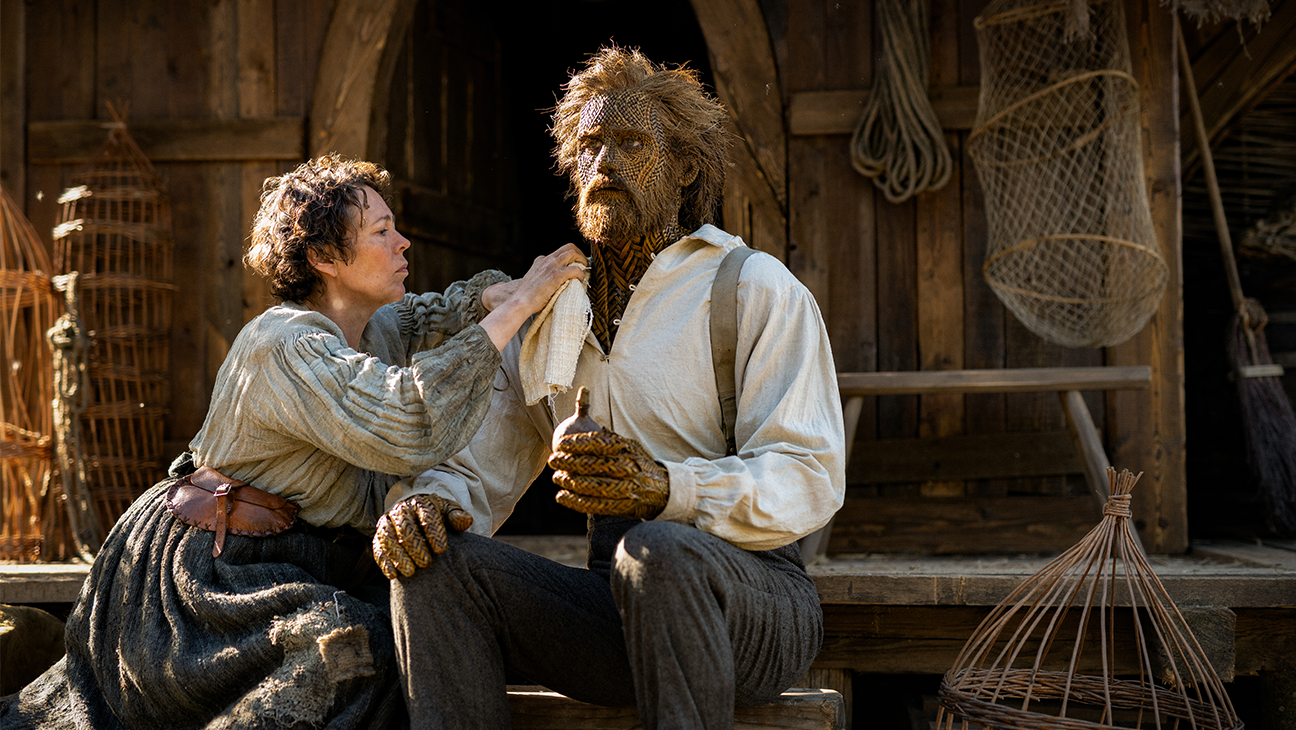
A match made in the willows: a loose Olivia Colman and a stiff Alexander Skarsgård complete each other in Wicker.
Overall: B+