AVATAR: FIRE AND ASH

Directing: B+
Acting: B+
Writing: B-
Cinematography: B+
Editing: B-
Special Effects: A-

I think James Cameron wants the Avatar films to be the 21st-century equivalent of the Star Wars films—a modern mythology, with the same cultural impact as well as staying power. (Some might argue that Marvel already achieved this, but their moves are not going to have the same staying power.) Cameron is such a directorial megalomaniac, he’s probably convinced these films already have that status. He would be wrong.

To be fair. it had long been widely understood that it is a mistake to underestimate James Cameron. But these movies can only run on their own steam for so long. Avatar was a monumental technical achievement in 2009, and was worthy of its Best Picture nomination (although it would have been a crime had it won). The same could be said, actually, of Avatar: The Way of Water, the sequel Cameron took 13 years to make because he was waiting for technology to advance enough so it could achieve his aims. And it’s worth repeating that The Way of Water was so stunning on a visual level, it arguably moved visual effects forward for the entire industry in a way no other film has since Jurassic Park.

So here is where we run into Avatar: Fire and Ash, only three years after the last one—usually a pretty standard duration between films and their sequels, but we all know the Avatar franchise is a different beast altogether. And the criticisms of this film as being entertaining but repetitive are fundamentally valid. With one notable exception, the characters are all the same as they were in the last film, and the things that happen onscreen offer us very little that’s new. Okay, there are some very cool new Panodorian creatures, including giant floating beasts that pull ships for travel, and vicious squid-like creatures that live in the oceans.

None of them feature as actual characters, though. The only beasts who do are the Tulkun, the highly intelligent whale-like creatures that featured prominently in The Way of Water, and do again here. And so does Quaritch (Stephen Long). And so does Captain Mick Scoresby (Brendan Cowell), who—spoiler alert!—did not die in The Way of Water after all. I walked out of this movie saying that if this series has taught us anything, it’s that any onscreen “death” cannot be trusted. More than one character in Fire and Ash meets an end that is one way or another is left ambiguous. But even if it were unambiguous, would it matter? This is a world in which “sky people” (humans from Earth) can be transformed into Na’vi and there can be an Avatar-maculate conception, after all.

Side note on the Tulkun whales: who the hell does their piercings and tattoos, anyway?

All of this is to say: if you’re looking for a 2025 blockbuster with endless opportunity for nitpicking, I present to you Avatar: Fire and Ash. I’ve barely scratched the surface here, but it’s worth mentioning that this has a franchise-record runtime of three hours and 17 minutes (exceeding The Way of Water by five minutes), and it is far less successful than its predecessor at justifying its own length. The Way of Water is easily broken up into three parts, the middle of which is world-building that easily wowed audiences; the last of which is a truly thrilling succession of action sequences. Fire and Ash attempts to building on that foundation, but does far less world-building, overindulges on action sequences, and at the sacrifice of character development.

To be fair, I was still perfectly happy to have gone to see this movie, as many of its action sequences are indeed thrilling. The visual effects are nearly as stunning as they were in the previous film; the inevitable downside to this coming out only three years later is that it’s unable to offer us anything truly novel on that front. The visual effects are the reason to see any of these movies, though, and they are what sets these films apart from others that use 3D as a cheap trick. Cameron knows how to make 3D worth the effort, and this is an extremely rare case in which I was also thrilled to see it in that format. That said, while the creature and Na’vi designs are exceptional, there are still moments when characters leap long distances and don’t quite move the way they should. It’s very subtle, but still gives them a hint of looking like video game characters rather than a believable character in a richly built universe.

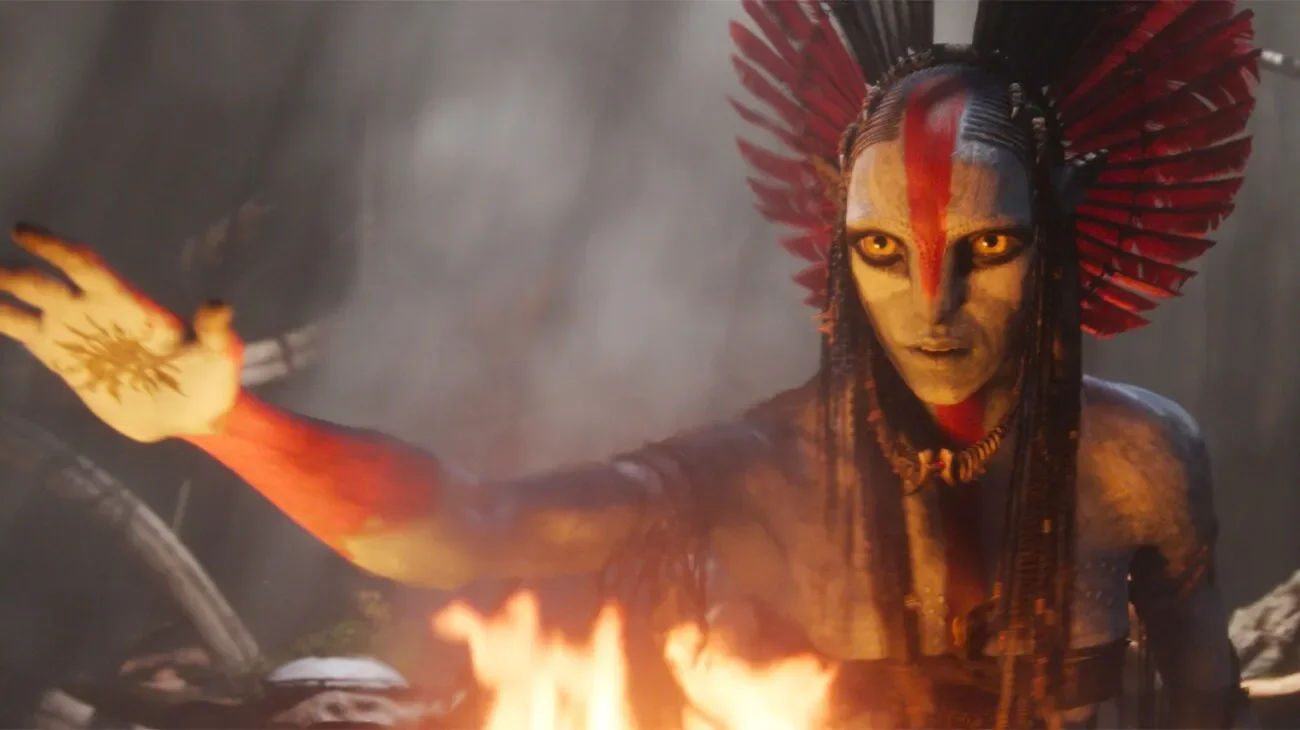
In addition to Quaritch, who is really growing stale as an antagonist in all three of these movies, Fire and Ash does give us one new major villain: Varang (Oona Chaplin), leader of the Ash People, a clan of Na’vi whose forests have been decimated by a nearby volcano. This is a compelling addition to this world, especially the idea of warring clans on Pandora whose beefs actually have nothing to do with the Sky People. Except the Ash People’s motives, and especially Varang’s, are never clearly defined, and as a people they are given far less nuance than the Na’vi. At least we can understand the Na’vi as a narrative example of cultural appropriation. The Ash People are just angry and sadistic, and read a little too much like so-called “savages” of the Old West who are thought to commit unspeakable horrors against outsiders for no discernible reason.

I wish Varang had more depth as a character, and certainly more autonomy. Here she’s just hungry for the power of Sky People’s military guns, and that hunger is easily manipulated by Quaritch. Thank Eywa we have the likes of Neytiri (Zoe Saldaña) and Kiri (Sigourney Weaver, a 76-year-old woman again doing motion-capture as a teenager) and Ronal (Kate Winslet) to serve as women characters who actually have some dimension. At least Fire and Ash passes the Bechdel Test.

Most of the time in Fire and Ash, though, there are just battles raging. One after the other, and this with multiple subplots that don’t all feel necessary. Maybe Cameron feels all of these narrative threads are vital for what’s to come in future sequels, but I’m not sure how much that matters. Kiri’s power to lock in with Eywa stayed mysterious through all of The Way of Water, and gets some further expansion and explanation here—some of which is legitimately dumb. I suppose that could be the tagline for Avatar as a franchise: “great action epics, some of which is legitimately dumb.”

Fire and Ash does bring Jake Sully (Sam Worthington) back around to his status as “Toruk Makto,” the legendary leader who unites the clans—his Leonopteryx, the giant bird-like creature he rides, is a loyal friend who is to a degree a creature-character in these films, as are, to a lesser degree, the banshees ridden by all the other Na’vi. None of this changes the problematic trope this title represents. When we hear the line, “Toruk Makto is coming!”—what. heard was: “White Savior is coming!” (Just because Jake was transformed into a blue-skinned human/Na’vi hybrid does not change what he represents in the narrative.)

And yet. And yet! This is how it is with all Avatar movies: they are riddled with flaws, particularly in the writing but also increasingly in the plotting and even the editing—but the things that are actually great about them make the flaws easier to overlook. Is that right? Perhaps not. Does James Cameron even understand a nuanced discussion of these things? I have my doubts. Is the man still a master at delivering mesmerizing entertainment? Absolutely. There is no question that I was on the edge of my seat and dazzled by Fire and Ash a whole lot of the time. I can’t say I was ever bored, in spite of the bloated runtime. What still defines this film more than anything, however, is this franchise’s diminishing returns. We can only hope that Avatar 4 will offer us something genuinely new, but being the fourth film in a series makes that a pretty tall order. It may be that we underestimate James Cameron at our own peril, but it’s starting to feel like he’s getting tired.

Overall: B

DUST BUNNY

Directing: B+
Acting: B
Writing: B+
Cinematography: A-
Editing: B+
Special Effects: B

Why does nobody know about this movie? This is a movie that deserves to be known, and I can’t even remember where I heard about it. If I ever saw a trailer, it was only once. Dust Bunny opened this last weekend on 402 theater screens and it made . . . $341,283. It was #17 its opening weekend. To be a little fair, it made an average of $848 per screen (and if we average $15 per ticket that’s about 57 tickets per screening). I can tell you this much: at the showing I just went to, I was one of three people in the theater. It’s hard not to conclude that someone in the marketing department at Roadside Attractions really dropped the ball.

Granted, Dust Bunny, a dark and twisted fantasty-action-monster movie, is not the kind of movie people pack theaters to see anymore. I actually took a public transit ride, on both a light rail train and a bus, for nearly an hour to a suburban theater to see it—and I found it to be completely worth the effort. I doubt I could find another person who would feel the same. Perhaps a fair number of people will soon discover it on a streamer. I can only hope. I’m already eager to introduce it to people I’m sure will have never heard of it.

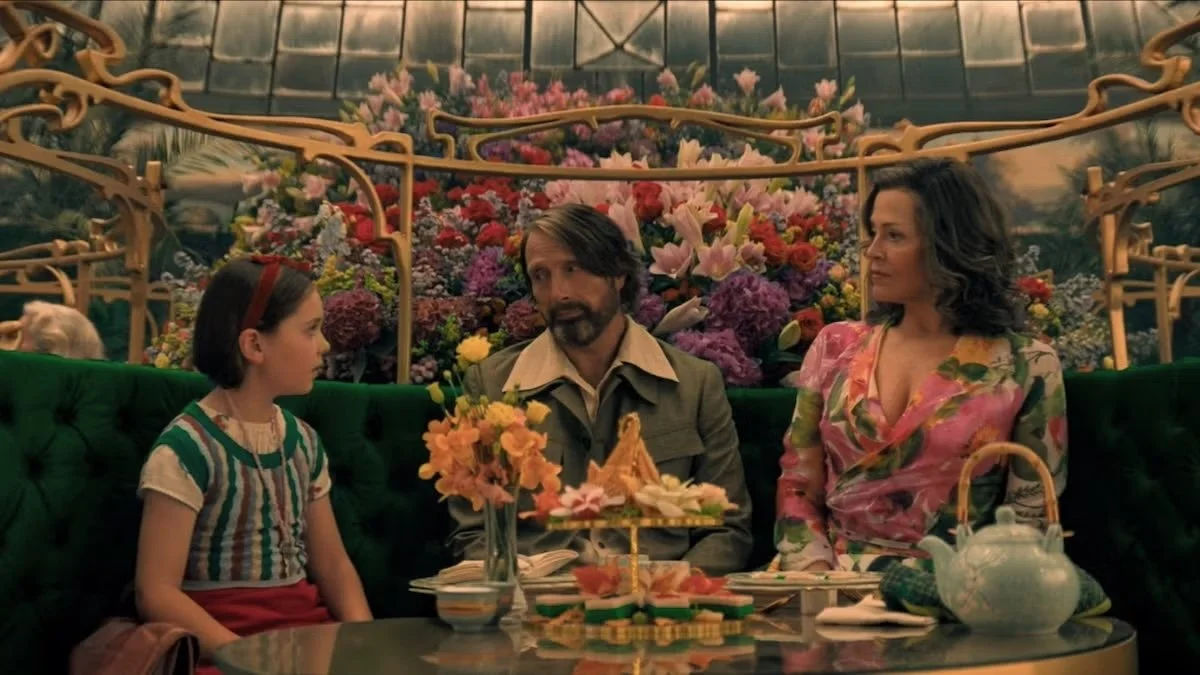
This is a pretty impressive feature film debut by writer-director Bryan Fuller, who up to now made a long career out of writing and producing television shows, from Pushing Daisies to Hannbial, not to mention no fewer than four different Star Trek series over the past three decades. Dust Bunny stars Mads Mikkelsen, who played Hannibal Lecter in the aforementioned Hannbal series. This is the one major involvement in Fuller’s past career that has a clear connection to Dust Bunny, which is a lot like a cross between Where the Wild Things Are and Kill Bill.

To be fair, I struggle to pinpoint who exactly the target audience is for Dust Bunny, unless you count—me. I am exactly the target audience for Dust Bunny, which I found utterly delightful. Its playful use of a child’s wild imagination crossed with real-world violence is very much my jam. It’s a fantasy movie, a monster movie, and an action movie all rolled up into one. It has a sensibility largely like a kids’ fantasy, with a little girl named Aurora (a wonderful Sophie Sloan) at its center. Mikkelsen plays the unnamed neighbor hitman who Aurora hires to kill the monster under her bed, who she believes ate her parents.

In the opening sequence, we see a tuft of dust floating through the air, past a city skyline that is clearly a mashup of London and New York, and into an apartment window. The camera follows it as it wafts through the apartment, picking up more tufts, until it becomes a little bunny, hiding under Aurora’s bed. Aurora is terrified, and over the course of the film, the bunny grows into a monster that lives under the floorboards of her room. The angled boards tip up in very cool ways as the dust bunny eventually breaks through the floors to eat its victims—and, spoiler alert, there are many victims.

Several scenes go by before it becomes even halfway clear what the hell is going on, but I was locked in from the first frame, with the darkly colorful production design and swooping camera movements, almost like the movie Hugo had gone through some kind of underworld filter. Aurora follows the hitman through the city, observing him from rooftops as he appears to slay a dragon—something he later insists was a group of men. Many scenes follow in which Aurora insists there is a real monster under the floor, and the hitman insists she just thinks that’s what she saw but there have been dangerous men in her apartment. Dust Bunny never wants to make clear which thing is actually going on, although it does eventually lean hard on one side, at which point I’ll admit that if it was going for metaphor, it kind of lacks clarity on that front.

But I can hardly be bothered to care, I had such a good time with this movie, from start to finish. I haven’t even mentioned Sigourney Weaver yet, who shows up as an associate of our hitman, evidently a longtime mentor, perhaps something with a deeper connection. Weaver is 76 years old now, and after seeing her clearly de-aged in the Avatar movies, it’s refreshing to see her actually looking her age. Her Laverne in Dust Bunny is both subtly and delightfully villainous; two characters get key moments in this movie involving stiletto heels, but Laverne’s hybrid pistol-heels are my favorite. There are also well-played smaller parts by The Woman King’s Sheila Atim and The Suicide Squad’s own Polka-Dot Man, David Dastmalchian.

There’s a peculiarness to the tone of Dust Bunny that really speaks to me, such as the moment we are introduced to Laverne, she suddenly opens her mouth wide in an almost grotesque way, explaining that she needs to do it in order to un-clench her jaw. Laverne spends the entire movie talking about how Aurora needs to be killed, because she’s seen the hitman’s face, and other killers are apparently after her. Eventually we learn that Aurora is a foster child now in her third family; this, I guess, makes it easier to take that who we initially assumed were her parents disappear from the movie after only a couple of scenes. Mikkelsen’s hitman has taken a liking to Aurora, which Laverne deduces is his attempt at working through his own childhood trauma.

The whole London/New York vibe is hard to pin down given that all the characters speak with American accents, save for the hitman, who speaks with Mikkelsen’s Danish accent—something quite directly looped into a running joke about his inability to pronounce “Aurora” correctly. Clearly, Dust Bunny exists out of time and place, lending itself to the fantasy element it leans hard into. As for why the monster under Aurora’s bed is a giant bunny, I couldn’t tell you—except that it rings true as a creation of a child’s imagination. Aurora admits, after all, that she wished for the monster, and I guess she got more than she bargained for out of it. There is a key moment when the hitman says, “He’s your monster, and you’re going to have to live with it.” Aurora says she wished for the hitman as well, though she catches his attention by offering him money, the source of which I won’t spoil here. Suffice it to say that Aurora proves to be a pretty effective badass in her own right. This is a kid who not only knows where the bodies are buried but actively helps dispose of them. What more do you want?

Overall: B+

WICKED: FOR GOOD

Directing: B
Acting: B+
Writing: B-
Cinematography: B+
Editing: B
Special Effects: B
Music: B-

I think I made the right decision not rewatching last year’s Wicked: Part I right before seeing Wicked: For Good. It could only have made For Good more of a disappointment—because Part I was undeniably, unequivocally better. Not by a wide margin, mind you, but a distinct one. One is left wondering what justification there was in even splitting this story into two parts, aside from box office hopes. I actually rather enjoyed Part I, even though at 2 hours and 40 minutes, I still thought it was indefensibly long—based on the first half of the stage play, which was only 5 minutes shorter than the entire stage play (including the 15-minute intermission). Here, For Good clocks in at 2 hours and 18 minutes, which means director Jon M. Chu has given us a combined four 4 and 58 minutes adapted from what was originally 2 hours and 30 minutes of actual content.

Which begs the question: why not just adapt this into a far tighter, 3-hour entertainment spectacular? I think I already answered this, really. We have to bleed this property for all it’s worth, right? Indeed, it’s easy to forget how complex the history of Oz is, with the original L. Frank Baum novel having been published in 1900; that book being adapted into the 1939 film The Wizard of Oz; the original Gregory Maguire novel Wicked: The Life and Times of the Wicked Witch of the West, a revisionist take on Baum’s characters, having been published in 1995; Stephen Schwartz’s stage musical Wicked having been first produced on Broadway in 2003; and then just last year, we got Wicked: Part I, the first half of Jon M. Chu’s film adaptation of the musical.

Every iteration of stories in this universe has had their devoted fanatics, of course—albeit none with more staying power than the 1939 film, which was enjoyed untouched for nearly 60 years, unless you count the bizarre 1985 film Return to Oz, which never garnered the same kind of devotion. I never read the original novel Wicked, and perhaps I should; I suspect I would like it better than the films—and to be clear, I do enjoy the films (and I particularly enjoy Part I). After seeing Wicked: For Good, which was a movie I wanted to be delightful but which was just fine, I rather wish I could see a direct film adaptation of Gregory Maguire’s novel, rather than a film adaptation of a stage musical adaptation of the novel, which by necessity strips an original story of much of its detail and nuance.

For Good spends a lot more time than Part I on drawing connections to The Wizard of Oz, right down to offering origin stories for the Cowardly Lion, the Tin Man, and the Scarecrow. In each case, the retconned explanation for their existence is a stretch at best, even in a world of magical characters. Dorothy even shows up here, sort of—she figures surprisingly prominently in the chain of events, but only as a shoehorned narrative device, often as a somewhat forced in-joke. It’s easy to imagine how this can work better in a stage production, in which our main characters refer to a Dorothy we never see except as a silhouette. Chu, on the other hand, gives us glimpses of her, either very briefly from behind or just parts of her body, which makes her feel much more real, and therefore inexplicably ignored.

A lot that was established, and even leaned on hard, in Part I gets little payoff here—particularly the existence of talking animals who are oppressed by the governing characters of Oz. There are only a few brief scenes with animals actually talking here, which is actually fine because this element was one of my least favorite parts of Part I. That’s a lot of effort for such little satisfaction of resolution, though. I did enjoy the arc of the flying monkeys, one of the elements I like in both films: their origins, who they were originally loyal to, and the manner in which their loyalty shifts to Elphaba. They also, collectively, make for some of the more memorable cinematic images in For Good.

And yes, there are some good songs in For Good, particularly “I Couldn’t Be Happier” and especially “For Good.” Again, though, they still pale in comparison to what we got in Part I (and, by all accounts, this is a common refrain about Act I versus Act II of the stage musical): “Dancing Through Life,” “Popular,” and especially “Defying Gravity,” which serves as the spectacular big finish of both the first act of the play and the first of these two films. Part I also featured delightful choreography, which is all but nonexistent in For Good. This film spends much more time on Oz’s society turning for the worse, and a reconciliation between Elphaba and Glinda that is ultimately tragic.

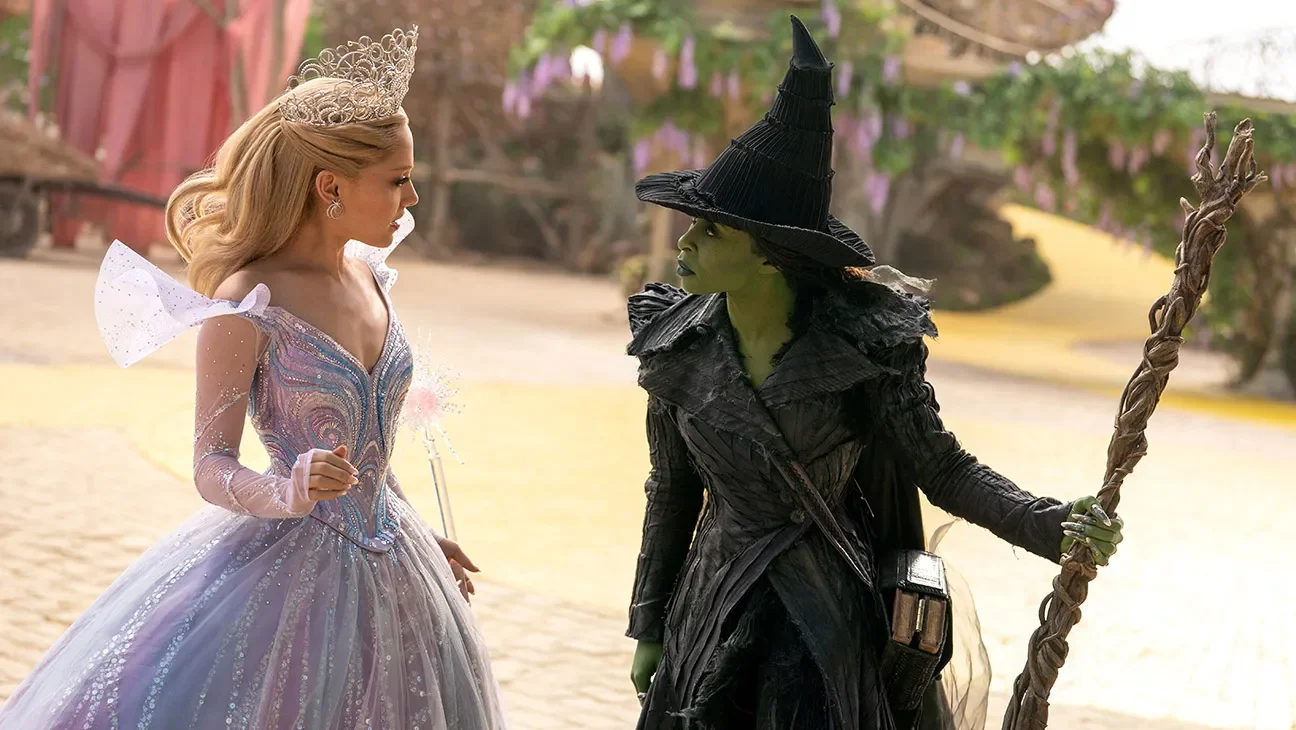
Part I was so enjoyable, though, that it creates a lot of goodwill that carries into For Good, in a way that I don’t think For Good would be able to sustain on its own. People went to see the first film multiple times, and there’s no way that’s going to happen as much, if at all, with For Good. But we still love these characters, who mean just as much to us now as before, thanks in large part to the production for both films having taken place at once. We feel the love and struggle between Elphaba and Glinda because Cynthia Eivo and Ariana Grande embody them, respectively, so wholly and fantastically, with such clearly genuine affection for each other. If there is any reason to see this movie, it’s the two of them.

Splitting Wicked into two films really does both films a disservice. Part I feels like a great start that we now know had no hope of living up to expectations; For Good is decent but inherently inferior. I had a fine time at the movies, but can’t imagine going out of my way to watch this again. Had this been adapted into a single film, it likely would have elicited a much more enduring affection.

I don’t know who they think they are!

Overall: B

HOW TO TRAIN YOUR DRAGON

Directing: B-
Acting: B
Writing: B-
Cinematography: B-
Editing: B-
Special Effects: B+

The burning question right now is this: what was the point of a live-action remake of the Dreamworks Animation hit How to Train Your Dragon, all of fifteen years later? What purpose does it serve, aside from greater box office earnings?

I’m coming up short on an answer. When the original animated film was released in 2010, one of my minor complaints was about its “needlessly breakneck pace from start to finish,” in a film with a runtime of 98 minutes. With this 2025 live-action remake, however, the runtime is 125 minutes—and that feels about 20 minutes too long.

Disney has already cashed in on a string of live-action remakes of classic animated features, which were also mostly pointless but for their box office potential. Dreamworks is apparently eager jump on this bandwagon, even though the animated How to Train Your Dragon already spawned two sequels, the most recent of which was released only six years ago. Sitting through the live-action version today, I found myself struggling to see how it justified its own existence, especially given how similar it is to the original, just fleshed out to a runtime far too long for an ostensibly “family film” one can assume would include children in its audience. Kids were rapt by the 2010 film; they may get bored with this one. For more likely, adults will.

What’s more, “live action” is a term used very loosely here, as all the dragons are rendered with CGI animation. The only difference is the human characters actually acted on camera. The most fun thing, arguably, about this How to Train Your Dragon is that Gerard Butler reprises his role as Stoick, the disconnected father of Hiccup, this story’s hero.

Hiccup was voiced in 2010 by Jay Baruchel, who was 28 at the time but still had his youthful-sounding voice. He’s 43 years old now and clearly can’t play a teenage character onscreen—he wouldn’t even have been able to 15 years ago—so he’s replaced by 17-year old Mason Thames, much more convincing as the scrawny Viking kid who dreams of being a dragon killer but only manages to wreak havoc with his awkward mistakes instead. Thames is well cast as a live-action avatar for how Hiccup was drawn as an animated character, and he holds the screen well too.

On the off chance you don’t already know, the basic premise here is that Hiccup discovers the dragons of this world, of which there are many, are misunderstood animals and not the ruthless killers the Viking villagers have regarded them as for generations. He manages to injure the elusive “Night Fury” dragon, but when he goes to hill the dragon, whom he later names “Toothless,” he befriends him instead. What follows is a struggle for Hiccup to convince his village that the dragons are smarter than they appear and mean them no harm.

Hiccup is very effectively an awkward outsider, which makes for a lot of awkwardness in the first half of this film, which sometimes works and a lot of times doesn’t. A lot of this How to Train Your Dragon is so cutesy and cartoony, it again begs the question: why not just let the animated feature stand on its own? Nothing truly realistic occurs in this “live action” rendering, least of all the way Hiccup eventually figures out how to ride Toothless. And I said this in my review of the 2010 film and it still feels the same now: the creature design of Toothless has an uncanny resemblance to that of Stitch from Lilo & Stitch—and ironically, a live action remake o Lilo & Stitch is also in theaters right now.

To this new How to Train Your Dragon’s credit, it gets better as it goes along—the second half is much better, and certainly more exciting, than the first half. I suppose that’s better than it being the other way around. I eventually found myself invested in the characters and in the story, in ways I wasn’t for some time at the start. And some further fun casting includes Nick Frost as Gobber, the guy who trains upcoming dragon slayers; Julian Dennison (the kid previously seen in Hunt for the Wilderpeople, Deadpool 2, Godzilla vs. Kong, and Y2K) as one of Hiccup’s fellow dragonslayers-in-training; and Nico Parker (Joe’s daughter from the premiere episode of The Last of Us) as Astrid, Hiccup’s eventual love interest.

By the time of How to Train Your Dragon’s conclusion, I had to admit I was pretty entertained. It just had to go through a bit more awkward, cartoony cutesiness to get there than I would have preferred. Entertaining or not, I remain unconvinced there was any great reason to make this movie to begin with, but if it’s the thing on the screen in front of you then it works well enough.

This seems awfully familiar.

Overall: B-

A MINECRAFT MOVIE

Directing: B
Acting: B-
Writing: B
Cinematography: B
Editing: B
Special Effects: B+

I could have had a field day ripping A Minecraft Movie apart—if it weren’t funny. But, the thing is, I laughed a lot. And maybe you won’t. Maybe you will. This movie has a pretty specific and peculiar sensibility, which gets very goofy and dumb, for no other reason that its self-reward. It spoke to me. And I don’t even have the slightest bit of knowledge or familiarity with the 2011 video game on which it’s based, although plenty of the action feels like a video game. Or what I imagine a video game to be like, anyway. What do I know? I played a few video games at a friend’s house in the summer of 1989, decided fairly quickly that it wasn’t for me, and haven’t bothered with it since. Most of this movie’s audience will have been born after that.

How easily I settled into A Minecraft Movie’s delightfully absurdist humor only better serves to recommend it. Anyone open to its brand of humor can enjoy this movie, whether they’re familiar with the video game or not. Granted, the setup a paper thin and utterly stupid, introducing us to Jack Black’s Steve, a doorknob salesman with a lifelong dream of being a miner. He follows his dream, goes down into a mine, and within minutes uncovers an “orb” (it’s actually a cube) that opens a portal into “the Overworld,” a place where creativity knows no bounds—well, except for the unstated fact that apparently everything has to be designed in cubed shapes.

Anyway, everything that so quickly gets Steve to the Overworked is ridiculously convenient and untied to any backstory to give Steve any character dimension whatsoever. I don’t seriously think this is the case, but I suppose you could argue that this setup is itself a meta commentary on the thinly contrived characters in any typical movie of this ilk. There are no intellectual pursuits here—getting right to the delightful absurdities is very much the point.

I could have lived without the way Jack Black’s delivery is far more over the top than it needs to be, every single line he delivers. He’s overly excited about everything he sees onscreen, or even any particular thought he has. It’s on-brand for Jack Black, I guess, and makes him fit better in the Overworld than he does in the real world. The others that find themselves sucked into this world give more naturalistic performances, with the exception of Jason Momoa as Garrett “The Garbage Man” Garrison, a former “Gamer of the Year” in—speak of the devil!—1989.

Not all of the humor in A Minecraft Movie lands. What makes it work is that most contemporary absurdist comedies, especially wide-release big-budget ones, have far more humor that falls flat than that works. A Minecraft Movie is the other way around. For every gag that doesn’t work, there are five that do. I laughed far more consistently at this movie than I expected to.

Not all of the characters really work either, to be fair. Jennifer Coolidge appears as a high school Vice Principal, who invites a Minecraft villager to dinner after he wanders through the portal to the real world and she hits him with her car. Director Jared Hess, working with a script written be a team of six writers, cuts back and forth between the Overworld action and this dinner date, enough times to make you wonder what the point of the dinner scenes even is. In the end, the point seems to be only to get to a bit between Coolidge and the CGI villager during the end credits. Well, the bit is hilarious, one of the funniest things in the movie, so I guess it’s worth it?

Rounding out the principal cast are Sebastian Hansen as Henry, a very creative kid just starting high school in the Idaho town of Chuglass; Emma Myers as Natalie, Henry’s older sister who hardly looks like she should be out of high school herself (Myers is 23) and has been hired as the social media manager for the town’s potato chip factory; and Danielle Brooks as Dawn, the local real estate broker with a mobile zoo as a side hustle. Brooks in particular is a known talent who is somewhat wasted here, as all these characters are easily interchangeable with any serviceable actor, but they’re still all fun enough. Momoa, Coolidge and to a lesser degree Jack Black provide the most color as characters, although only Momoa provides a kind of colorfulness that fits neatly into the video-game-adaptation context.

The bottom line is, none of the plot, such as any plot exists, matters. What matters is a bevy of well-executed, adorably bizarre details, such as the villainous borde of cube-headed “piglins” from another dimension, led by a piglin witch named Malgosha. By and large, there is little to no rhyme or reason to anything that happens in A Minecraft Movie, but it’s the execution that makes it work—humor that works more often than it doesn’t; and more actors with charisma than without. It’s an impressively staged bit of organized chaos, set in a world rendered with surprisingly artful special effects. It’s a movie that is ultimately meaningless but kind of a blast, but sometimes a mindless blast is its own reward.

Which of these characters is the most fun? You get one guess!

Overall: B

DEATH OF A UNICORN

Directing: B
Acting: B-
Writing: C+
Cinematography: B
Editing: B-
Special Effects: C

The first thing you should know about Death of a Unicorn is the visual effects are kind of shit. It was made with a $15 million budget, and it looks like about $10 million of that went to cast salaries. That’s probably not how it actually was, but it’s certainly how it looks. Writer-director Alex Scharfman, in his feature film debut, employs a lot of camera tricks to minimize the amount of time we see actual unicorns on camera. Some of the time, it’s an effective technique for either illustrating the creatures’ enormity, or underscoring their darkly dazzling otherworldliness. Most of the time, it’s a transparent reflection of budget constraints. This is a film with many visual references to other, much better films, from Jurassic Park to Alien. Perhaps we are meant to see Death of a Unicorn as also an ode to Jaws, which also had to obscure its monster due to budget constraints and equipment failures, but with skilled editing became a masterwork of suspense. Once the shark was seen onscreen, audiences were in awe. Once we see the monstrous unicorns onscreen here, there isn’t awe so moch as a question of which cheap off-the-shelf effects software was used.

The second thing you should know about Death of a Unicorn, which makes up for a whole lot of flaws and mediocrity, is it is exceptionally well cast. Granted, most of them are basically phoning in their performances, especially Paul Rudd as Elliot, the misguided dad trying to ingratiate himself to a dying wealthy employer on a weekend retreat at his house in the mountains “this far north”—the most specific reference we get to the location. Are we in Alaska? Where? (It was filmed in Hungary.) But there are others, even when phoning in, who have such strong personas that you can’t help but have fun with them in this context: Richard E. Grant as Odell Leopold, the aforementioned dying employer; Téa Leoni as Belinda, his equally selfish and money-hungry wife; Will Poulter as Shepard, their even more single-minded, dickish son (who is constantly wearing pleated shorts, and somehow, it’s a perfect touch). Possibly my favorite among the cast is Anthony Carrigan, best known as NoHo Hank from HBO’s Barry, as Griff, the Leopolds’ increasingly put-upon butler. Jenna Ortega plays Ridley, Elliot’s daughter, and in the year 2025, Ortega probably qualifies as the film’s biggest star. Now 22 years old, I found myself wondering how long she can continue playing teenagers—although, to be fair, this movie never says exactly how old she is, and does make one reference to college studies.

The film opens with Elliot and Ridley, traveling to this weekend retreat, and it’s while they are driving through the mountains, frustrated with sudden loss of juice in their electronics (later a key plot point), when they hit a “horse-like creature”—or, as Ridley later puts it, “A fucking unicorn.” When the Leopolds discover the healing properties of this creature, and particularly synthesized powder from its horn, everything this greedy, wealthy family does from then on is utterly predictable—as is Death of a Unicorn overall. Let’s just say that the script is not this movie’s strongest element.

There’s something undeniably fun about the story in spite of its flaws, however. Death of a Unicorn might ultimately have been more successful if Scharfman had focused more on directing and collaborated with some other writers. To Scharfman’s credit, though, he strikes an unusually nice balance of tone, with consistently effective humor sprinkled into sequences that overtly veer into the horror genre, as the juvenile unicorn’s parents show up to exact their revenge. This movie has plenty of jump-scares, and I spent plenty of time covering my eyes with my hand.

How often do you get a horror-comedy-fantasy that is also a genuinely good time? This is not a movie that will still be talked about generations from now—or next week, really—but it’s a kick while it’s happening (sometimes literally). Even special effects that are subpar, if not outright terrible, do not detract from that. A lot of movies try to be simultaneously stupid and fun, but typically they land solidly on the side of stupid. Death of a Unicorn pulls off the minor miracle of succeeding at the fun part. With a bit more discipline, it could have been far better, but sometimes you leave a movie satisfied by the fact that it could have been much worse.

Death of a career? Not quite, but a fun step in that direction!

Overall: B-

TUESDAY

Directing: B+
Acting: A-
Writing: A-
Cinematography: B
Editing: B+
Special Effects: B+

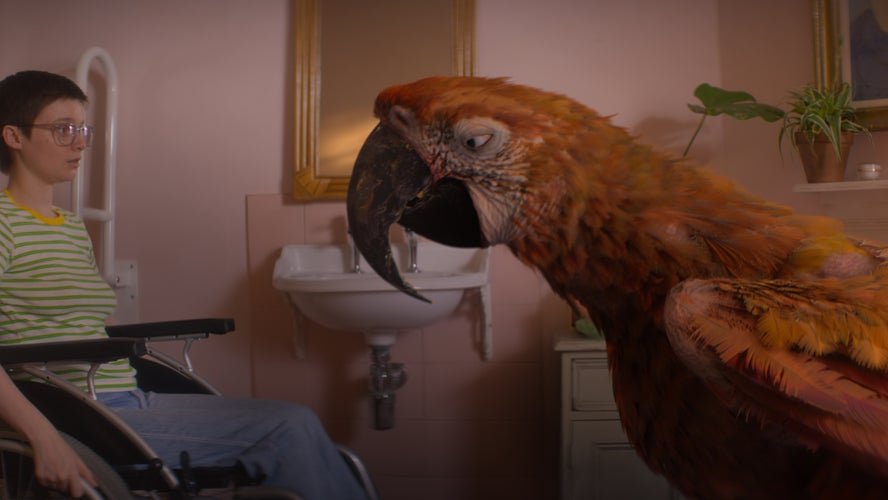
It can be astonishing when something comes along that is utterly original, unlike anything you have ever seen before—sometimes, to the point that it comes close to inexplicable. Since when does Death manifest itself as a deep, scratchy-throated parrot, anyway? Ever since Daina Oniunas-Pusic thought to write and direct Tuesday, I guess.

Maybe it’s just that the black cloaked figure with a scythe has long since played out. Tuesday offers no explanation whatsoever as to the use of a parrot instead, but rather, presents him as a character with challenges and internal struggles like anyone else. Not even that is a particularly novel approach, but how it gets contextualized here certainly is.

Death can be tiny, and he can grow to a giant size, a detail that becomes a surprising plot point later on in the film. When we first see him, he is so tiny he is nestled into the corner of a man’s eye, something we don’t even realize for the few seconds it takes the camera to pan out. This is part of an opening montage that makes it quite unclear what the tone of the film is going to be, in which we see Death release random people around the world from their pain, waving his wing over them.

I had a peculiar experience with this film on a number of fronts. I never saw a trailer for Tuesday, and chose to go see it based on a fairly high MetaCritic score of 70, and a brief synopsis I found both odd and compelling: a mother and teenage daughter must confront Death when it arrives in the form of a talking bird. That honestly sounds a bit whimsical, possibly bordering on corny, but late-career Julia Louis-Dreyfus has made some very interesting choices, tending to be in movie projects that are both a bit off the beaten path and reliably entertaining.

All that said, when Tuesday opened on a shot of Earth from outer space and the ominous sounds of countless people longing for death, shifting between voices like the movement of a radio dial, for a minute I wondered if I had gone into the wrong theater. Is this a horror movie? Not quite. Is it a comedy? Definitely not, even though it has a through line of irreverence that gives it several genuinely funny moments. Is it ultimately a tear jerker? Definitely yes, but still in a way that leaves Tuesday a movie that defies categorization. It’s sort of a sad mood piece with a surprising amount of humor. You don’t see that every day.

“Tuesday” is actually the title character, the terminally ill teenage girl played by Lola Petticrew, who Death (voiced by Arinzé Kene) is summoned to visit by the sounds of her wheezing, evidently indicating that tonight is her time. But rather than freaking out when the bird appears on the table in her backyard, Tuesday suddenly launches into a joke, an earnestly cute one that involves penguins in the back of a car and actually made me laugh. (I did wonder how that would play on rewatch, when the punch line is already known.)

Death is disarmed by this, which causes him to hesitate, and then agree to wait until Zora, Tuesday’s mother, gets home.

This is where Julia Louis-Dreyfus comes in, as she is perfectly cast in the role, which becomes more significant as the story plays out. She is more than anything what makes Tuesday worth seeing. Ultimately, Tuesday is a movie about accepting the inevitability and ubiquity of death. It just uses a wild premise and some very odd turns to get us there, a journey you might have mixed feelings about on the way but in the end you’ll be glad you went on.

Given how low the budget for Tuesday clearly was, Daina Oniunas-Pusic does a lot with very little, focusing most of the movie on all of two characters, with one supporting character, an in-house nurse (Leah Harvey) as a third who comes and goes. Oniunas-Pusic manages to use subtle cues and sparingly used special effects to render the apocalyptic consequences when Death is taken out of commission for a while—thanks to some jarringly inventive tactics on the part of Zora, who cannot cope. In a way, Tuesday is a demonstration that our very universe does not work if death does not happen in it.

As is often the case, it’s the terminally ill person who accepts their fate, and the people who love them who cannot. When Zora meets Death, she isn’t freaked out by a magical bird so much as the knowledge that he is there to take her daughter away. Zora then quite understandably acts out of desperation, ultimately only prolonging the inevitable.

As odd as this movie is, I can see it being deeply moving to anyone who lost a loved one, particularly one gone before it should have been their time. It has far more depth and far more nuance than its simple premise might suggest. And Louis-Dreyfus gives a magnificent performance, by turns funny and heartbreaking. It may be a challenge to open your mind to it at first, but if you can manage it, you’ll be glad you did.

No, this isn’t a family comedy: it’s an exploration of our emotional connection to Death (which is also a bird).

IF

Directing: C+
Acting: B-
Writing: C-
Cinematography: B
Editing: C
Animation: B-

I found this movie utterly baffling. A story can be any kind of fantasy it wants to be, but once it establishes the rules of its own universe, it needs to follow them. If does not do that.

Ater having written and directed A Quiet Place and A Quiet Place Part II, John Krasinski has clearly built up a lot of goodwill—arguably too much. With If, he turns his attention away from horror and toward family-fantasy fare, and brings with him the voice talents of every movie star imaginable, from Steve Carell to Louis Gossett Jr. to Phoebe Waller-Bridge to Awkwafina to George Clooney to Bradley Cooper to Matt Damon to Bill Hader to Bill Hader to Richard Jenkins to Christopher Meloni to Matthew Rhys to Sam Rockwell to Maya Rudolph to Amy Schumer to Jon Stewart—and more!—all of them voicing a different, animated “Imaginary Friend” (IF). For some reason, somehow, they are all still hanging around Manhattan after their kid friends have grown up and forgotten about them.

All of these “IFs” might have made for a fun combined cast of characters, were this movie to have as much pep as the trailer clearly aimed to suggest. None of the marketing for this movie suggests how incongruously wistful it is in tone, sometimes downright melancholy, certainly downbeat. There are certainly peppy moments, but virtually all of them were in the trailer. You come to this movie and instead find a story about a 12-year-old girl who is growing up too fast due to the death of her mother.

Lest we miss an opportunity to get even more maudlin, our little-girl hero, Bea (Cailey Fleming), is now worried about her dad—played by writer-director John Krasinski—staying in the hospital for a major surgery. What kind of surgery is never explicitly stated, although the gag of his “broken heart” suggest perhaps heart surgery. Bea has already lost one parent and is now facing the risk of losing another. What fun, family entertainment!

Honestly, in spite of several genuinely fun “IF” characters that get too little screen time, I can’t see IF really working for children viewers of any age. This seems to be more aimed at adults who feel wistful about their own inner children.

While Bea’s dad is in the hospital, she goes to stay with her grandmother (Fiona Shaw), where she and her dad had also stayed when her mother was dying. It’s in this building where Bea discovers all the IFs hanging out in a sort of junk room up on the top floor, alongside the one evident human who can also see all the other IFs. This man is played by Ryan Reynolds, who gives a serviceable if surprisingly muted performance. Every once in a while, IF would give me genuine chuckles, among them a running gag where Ryan Reynolds keeps tripping over the one who is invisible.

What purpose these IFs serve in the movie, though, is never presented in a way that quite makes sense. First Bea is helping Ryan Reynolds match IFs with potential replacement kids, like they are running some kind of imaginary orphanage. When that doesn’t pan out, they set about reuniting the IFs with their original kids who are now adults. In one cast, a nervous adult played by Bobby Moynihan gets reassurance from his own IF right before some kind of job interview. What we are supposed to understand is happening there exactly, I couldn’t tell you. This guy’s Imaginary Friend would have been an original figment of his own imagination, right? So he’s gaining confidence for an interview (or presentation, or whatever the hell it is) by tapping into the imagination of his own childhood, in a way that’s beyond his control? What?

The fundamental problem with IF is the evident blank check Krasinski was given after his previous success, where no one else bothered to step in with some guard rails outside his own passion. This movie clearly means something to him, and presumably it made sense in his head. It has some fairly imaginative ideas in it, to be fair, but it also feels like it came from the imagination of someone who recently had a lobotomy.

The story improves, slightly, by the time IF reaches its final half hour or so—a fact that is undermined by the real fear that maybe Bea’s father will also die. Somewhat ironically, the best part of this movie is Fiona Shaw as the grandmother, a character who spends most of the film seemingly unrelated to any of the IFs (although you can probably predict where things are going there). Cailey Fleming as Bea is clearly a talented young performer, but a little mismatched with this movie, having that precocious quality of so many child actors that stops just short of unsettling.

Furthermore, no one in this movie has a conversation that sounds like actual people talking. There is a subplot of a budding friendship between Bea and another little boy in the hospital (Alan Kim), and after their first conversation I literally thought to myself, That was really weird dialogue. In short, Krasinski threw so much talent at his passion project that he could not properly organize it, and the final result is a total mess. If there was anything that genuinely impressed me was how a mess could be not so much chaotic as strangely dull. At least some more consistent gags might have kept me awake.

I’m very sorry to inform you this movie’s condition is terminal.

Overall: C

SASQUATCH SUNSET

Directing: B+
Acting: B
Writing: B
Cinematography: B+
Editing: B+
Special Effects: B-

I went into Sasquatch Sunset expecting a kind of gross-out comedy that happened to be about Sasquatches. I had heard there was a lot of Sasquatch fucking and shitting. These things do happen in the movie, but, if you can believe it, they are used sparingly—which only heightens the impact when it does happen. What I was not quite prepared for was an ultimately bleak mood piece about extinction. In retrospect, the very title of the film should have been a clue.

There are only four characters in this movie, and none of them speak anything beyond a somewhat organized series of grunts. While watching, I kept thinking of the 1986 film The Clan of the Cave Bear, in which no verbal language is ever spoken. What I forgot about that movie is that they have established a form of sign language, with which the film presents subtitles. Sasquatch Sunset doesn’t even have that; in this movie, we just get the grunts. Beyond that, all communication and emotion is conveyed through a sort of mime by actors in hairy suits.

To say that Sasqutch Sunset isn’t for everyone is an understatement. There were reportedly many walkouts when the film played earlier this year at the Sundance Film Festival. This is not difficult to believe: I was one of six people in the theater when I went to see this, and a person in the row in front of us did indeed walk out in the midde. She even booked a seat for an AMC screening of Dune Part Two on her phone before getting up and leaving. An excellent choice, to be fair, but still, side note: don’t do that shit. Your phone screen is distracting and annoying—it’s why I know what movie you booked as an alternative, which you should do after leaving the theater.

I really thought Sasquatch Sunset would be funnier. If there’s so much sex and shit, why wouldn’t it be? Well, co-directors David and Nathan Zellner, working with a script by David, have created something akin to a nature documentary—but with mythical creatures as its subjects. They also mark their territory with piss, and in one fairly gross instance we see one vomit after eating too many fermented berries. But the thing is, once I got a recalibrated sense of the meditative tone of this film, I found myself surprisingly engaged by it. In the end, it’s a kind of family tragedy. About Bigfoot. But it takes an unusually “realistic” approach to what Sasquatch might actually behave as feral animals in the forest, particularly as a kind of “missing link” species between great apes and humans.

Speaking of humans, another curious detail of Sasqutch Sunset is that there are none. Inevitably, the Sasquatch characters encounter human civilization, in the form of things like a red X spray painted on a tree trunk, or a campsite. But, they never encounter any human beings. It’s unclear to me whether we are supposed to infer a loss of habitat due to human activity, though we do see them observe smoke from a forest fire in the distance. Several times the Sasquatch characters we’re following smack sticks against trees together in a coordinated pattern, clearly a signal to any other Sasquatch who might hear it. But, these are the only ones we ever see, and —spoiler alert—not even all of these ones make it to the end of the movie. I got to a point where I began to assume they would all be dead by the end of the film, but that’s not exactly how it ends. I suppose it depends on how you look at it.

I’ll definitely give Sasquatch Sunset credit for being absolutely unlike any other movie I have ever seen. I can’t think of a single person I would recommend it to, but I’m not sorry to have seen it. It’s certainly compelling to know that the Sasquatch characters are played, under intricate layers of makeup and prosthetics, by the likes of Jesse Eisenberg and Riley Keough, playing the one female among the group. There is also a juvenile played by Christophe Zajac-Denek, and Nathan Zellner himself plays the “alpha.” There is also a baby Sasquatch, performed mostly through what appears to be puppetry, with somewhat mixed results.

There are indeed a few genuinely funny moments, but Sasquatch Sunset plays much more like a meditative drama. And given whose story we are seeing unfold, your mileage may vary. By the time it ended, this Sasquatch story had kind of lost me and then, somehow, brought me back around again. This is a fascinating specimen of experimental cinema, with an unusual blend of absurdity and sincerity. Whether you’ll be into it, even if the premise intrigues you, may very well depend on when you watch and and what mood you’re in. Somehow, in my case, it had a hook that ultimately got me.

They have been to the top and it wasn’t what they were expecting.

Overall: B

THE AMERICAN SOCIETY OF MAGICAL NEGROES

Directing: B-
Acting: B+
Writing: C+
Cinematography: B
Editing: B-

There were multiple ironies to my experience watching The American Society of Magical Negroes, starting with the fact that the theater I went to see it at started to show the wrong film at first. After deeply confusing those of us in the audience with this very film’s trailer playing amongst all the others before the feature started, they then played American Fiction—a vastly superior film in every way imaginable.

Eventually, once the correct film was playing, after some time I registered another irony. This is a film about Black people whose literally magical job is to ease the discomfort of White people. And this film is so blandly inoffensive, with a premise with great potential to be effectively biting, it plays as though the movie itself exists to ease the discomfort of White viewers.

On the one hand, The American Society of Magical Negroes just can’t win. It triggers the Fox News set by quite directly suggesting the most dangerous animal on the planet is “White people.” Then it rankles leftists by having its Black protagonist risk everything by falling in love with a White woman. (Sort of. We’ll get back to that.)

And here is where we get into the fundamental difference between The American Society of Magical Negroes and American Fiction. American Fiction didn’t give any of its White characters a pass. This movie, by contrast, wants us to think it’s highlighting the absurdity of the myth of the “Magical Negro,” and then gives its White characters a pass at every turn. There’s an impassioned speech near the end, delivered by Justice Smith as Aren, a new recruit for the Society of the film’s title, explaining to his coworker Jason (Drew Tarver) what it’s like for him to live in this country as a Black person. And—spoiler alert!—a minor light goes on in Jason’s head, showing a definitively contrived, if small, step toward White understanding. Except to present all this in the context of literal fantasy genre filmmaking rather undermines the message we’re meant to get from this movie.

This is a film of endlessly missed opportunities. It doesn’t even play with the concept of a “Magical Negro” as a historic stereotype specifically in literature, cinema, and television, where Black supporting characters reliably come to the aid of White main characters. Instead, while trying to convince us it’s using the concept subversively, it’s just continuing the tradition of its use. The only difference is that now, the protagonist of the film is the Black supporting character, and the White main characters are its target audience. The oddest thing about this movie is that it’s like a low-rent Harry Potter but with an undercooked premise and a lead actor who is actually more charismatic and talented than Daniel Radcliffe.

Because this is the one major strength of The American Society of Magical Negroes: the winning cast. Justice Smith embodies his character wonderfully, playing both awkward and increasingly confident with equal skill. David Alan Grier exudes warmth as Aren’s mentor, and Michaela Watkins is a welcome presence, if relatively inconsequential, as his boss. An-Li Bogan has great chemistry with Smith as the love interest for whom Aren ultimately risks everything. The story here rather lacks focus and suffers from uneven tonality, but the cast alone makes up for a lot, and together make this movie watchable, if ultimately forgettable.

A particularly curious element of this film is the multiracial ethnicities of both its protagonist and his love interest. Aren even mentions at one point that his mother was White, yet never offers any clarity on what must be unique to that experience, distinct from either being White or having two Black parents. Lizzie is briefly referred to as “ethnic” but never clarified beyond that—evidently we are to understand that, as a matter of fact, she is not a White woman. At least not fully: she’s Asian and White. But, given that Jason makes a comment about not realizing she’s “ethnic,” it would seem she’s “White enough.”

It may be that I’m splitting hairs here, and overdoing the parsing of ethnic heritage in characters—except that this movie is quite literally asking for it. It seems to give White women a pass in particular, in the end offering Lizzie a last-minute “twist” that underlines the role of women in society as “supportive wives and girlfriends.” This is incongruously problematic on its own, as it creates a a false equivalency between the otherwise very real struggles of women, including White women—something that has its place in film for sure, just not this one and not in this way—and Black people experiencing racism.

The American Society of Magical Negroes has some genuine charms (including Nicole Byer as the Society’s president), but it ultimately fails at what it aims to be, and struggles to clarify its point of view. Everything it aspires to, American Fiction achieves with ingenious finesse. I recommend you just watch that movie instead.

We’re meant to learn how White people are more dangerous than sharks, except this movie has no bite.

Overall: B-