SPIDER-MAN: BRAND NEW DAY

Directing: B
Acting: B+
Writing: C+
Cinematography: B
Editing: B-
Special Effects: B

I can’t for the life of me figure out why there seems to be this unwritten rule these days that superhero movies need to be two and a half hours long. It’s bad enough we’re all obligated to sit through the credits in order to see a tacked-on scene at the end; they have to make the movie over-long as well? Side note: the post-credits “scene” in Spider-Man: Brand New Day is arguably the lamest moment in the movie. I really didn’t think it was worth waiting for.

Was the rest of the movie worth sitting through? I guess. It was fine. There’s something to be said for Tom Holland in the role that made him a star (and no other role he’s ever had came even close to having the same effect), and the undeniable chemistry that he has with Zendaya, one of the most gifted actors alive. There’s even a kind of comfort in seeing Jacob Batalon yet again as Peter Parker’s friend Ned, even though, like all of them, he is noticeably older, and there’s been an understandable about of chatter regarding how the dynamics of Spider-Man change when he and his friends are no longer teenagers. He even says at one point in this movie, “I’m not in high school anymore.”

It would seem, however, that Marvel Studios have backed themselves into a corner, with this insistence on connective tissue, even after their content has long since saturated the market. The Spider-Man character does have a kind of appeal that is broader than most other superheroes, and as series fourth-installments go, this one actually is pretty entertaining and charming. It’s also over-stuffed, with not just John Bernthal as The Punisher, but Florence Pugh as “Thunderbolt” Yelena Belova, here using a sauna as her office; Michael Mando as The Scorpion, a bit under-used; Tramell Tillman as Head of Department of Damage Control Bill Metzger; The Bear’s Tramell Tillman as Detective Jean DeWolff, who seems to serve as replacement for JK Simmons in the previous three films (The Daily Bugle doesn’t even get mentioned here); and even Marissa Tomei in enough flashback scenes to land her eighth-billing in the credits.

And none of those are even the primary villain in this movie, played by Sadie Sink, her character being apparently such a spoiler that I won’t name her here, even though it’s also widely known. Suffice it to say she serves as even more connective tissue for the broader MCU narrative going forward, in a way many Marvel fans are thrilled about and I’m just like: okay, whatever, fine. I will say it’s a fascinating pivot to see one of those movies have a tiny, 24-year-old young woman as one of the most powerful villains ever.

“Most powerful” is always relative, of course. Mark Ruffalo also returns as Bruce Banner, AKA The Hulk, who is evidently indestructible whenever he’s Hulking out. This has always been my problem with superhero movies, and Marvel movies in particular: the characters are effectively gods, which saps them of any need for emotional investment. At least Peter Parker is undergoing an evolution of his powers this time around, which leaves him unmoored and vulnerable. Somewhat ironically, this aspect of the store is also underdeveloped, because writers Chris McKenna and Erik Sommers—who also wrote all three of the previous Spider-Man movies—had to pack so much shit in there.

It’s worth noting that the first three Spider-Man movies were all released two years apart: 2017, 2019, and 2021. I found the first two to be pretty generic superhero movies, but the third one, No Way Home, ran with the “Spider-verse” concept and became a cultural moment the likes of which Marvel had not seen since 2019 in Avengers: Endgame, and has not seen again since. And it’s been five years—half a decade—since No Way Home was released. That movie was a pretty spectacular climax a trilogy that would have been well served to be left alone; Brand New Day was reportedly intended to be the first in a new trilogy. Holland is a charismatic performer, but how many of these movies do we need? Not counting other Marvel movies the character appeared in, there have now been 11 of these movies in the past 24 years.

All this is to say, Brand New Day is at multiple disadvantages. In addition to how much older Peter Parker is, it’s inevitably a bit of a comedown after the thrill of how surprisingly well-constructed No Way Home was. Brand New Day will make a shit ton of money, which is precisely why they keep making these movies, but it never had any hope of living up to what came before it. So, it evidently doesn’t even try. There’s nothing especially clever about the story here, and getting back to the point of its excessive run time, it makes the inevitable mistake of engaging far too long with chaotic, CGI-fight battles. The visual effects aren’t terrible in this movie, but neither are they great.

It’s the cast that elevates the material. Holland and Zendaya are plainly irresistible screen presences, and most of the rest of the cast have complentary charisma (though I must admit The Punisher as a character does little for me). This is a movie that isn’t anything special, but neither does it disappoint. I got about what I expected out of it. I suppose enough other people will feel the same way to justify its existence.
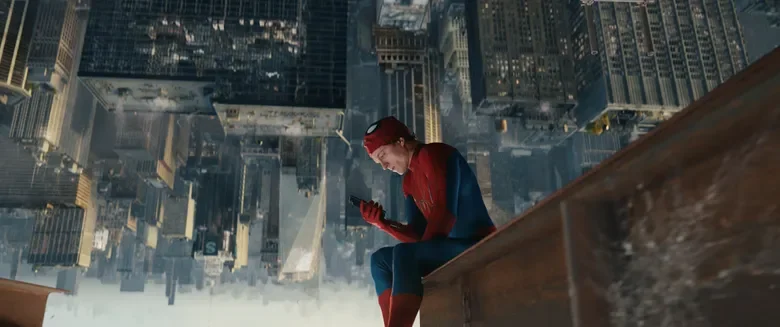
Why don’t you just straight up rip off Spider-Man: Across the Spider-verse while you’re at it?

Overall: B
THE END OF OAK STREET

Directing: B-
Acting: B-
Writing: C+
Cinematography: B-
Editing: B+
Special Effects: B

If there is some deeper context to The End of Oak Street, I couldn’t tell you what it is. It seems safe to assume writer-director David Robert Mitchell feels there is one, but he is not wholly successful at communicating it. Once the deeply uneventful plot involving fundamentally uninteresting characters takes a turn, it can’t be denied that this film becomes wildly entertaining—but it’s also the epitome of a popcorn flick, delicious but empty cinematic calories.

I spent a lot of the movie trying to figure out what year it was supposed to be. All the men and boys are wearing incredibly short shorts, even by today’s standards; I figured it had to be either the seventies or the eighties. A scene featuring a car dashboard cassette player leaned me toward the latter, but I also wondered if it was meant to be some undefined place in time. But then, very near the end, there is literally the dialogue exchange, “What year is it?” and “It’s 1982, of course!” Okay, so we’re getting specific now.

I suspect it’s no accident that Mitchell set this movie the same year E.T. was released. The End of Oak Street is quite obviously a riff on the Spielbergian tones of the time, crossing the adventure and subject matter of Jurassic Park with the setting and tone of movies like E.T. and Poltergeist. That said, Oak Street also feels like a riff on J.J. Abrams’s 2011 film Super 8, which was itself an homage to Spielbergian sensibilities. It’s worth noting that Abrams produced The End of Oak Street, which thus feels like a copy of a copy of a copy.

I’ll give it credit for an odd twist, at least: instead of scientists cloning dinosaurs in the modern age, as in Jurassic Park, a random wormhole ports an entire neighborhood, a couple of miles in diameter, into prehistoric times. This produces the same effect, of dinosaurs interacting with modern people and streets, the difference being that we’re in their time instead of them in ours. But, the main characters never leave this neighborhood, largely because the light that ported them has created high cliffs at the circle’s edges.

The family in question consists of married couple Denise (Anne Hathaway) and Greg (Ewan McGregor, in arguably his least remarkable performance ever); their children Audrey (Maisy Stella) and Brian (Christian Convery), and to a lesser degree neighborhood adolescent Jeannette (Jordan Alexa Davis). Rounding out the principal cast are their neighbor who hates their dog, Mel (P.J. Byrne); the elderly neighbor who is encouraging Denise’s writing, Mrs. Huddleston (Anne Gee Byrd); and the local librarian, Mrs. Valcourt (Emily Kuroda). Nearly every character who is not a member of the principal family gets some degree of a setpiece, some of them getting spectacular death scenes.

And that is all we’re here to see, really. The End of Oak Street can’t quite pick a lane when it comes to tone, opening with an almost self-consciously obtrusive score by Michael Giacchino (Cloverfield, The Batman), and quickly shifting from the facade of 80s suburbia to most of those suburbanites appearing as dead bodies on clean streets and manicured lawns. And I’d be lying if I said I didn’t absolutely eat that shit up—once the porting of the neighborhood occurs, I was rapt until the end of the film. I was always very conscious of how blandly plotted it was, especially with a certain death of a character that the film cheats its way out of in the end.

Say what you will about the sappiness of Steven Spielberg, but at least he has narrative integrity, even when he’s got plot holes. But some of the storytelling in The End of Oak Street is just plain egregious. It barely qualifies as “science fiction,” providing no semblance of an explanation except that these bright lights somehow “moved” their neighborhood—the Oak Street of the title now ends at a humid jungle.

And of course, at first Mitchell is coy about the dinosaurs, keeping them hidden behind bushes or around the corners of houses. One striking detail is how furry and/or feathery the dinosaurs in this film are, a clear nod to more recent research suggesting they probably looked more like birds than reptiles. This would not have been the prevailing view in 1982, of course, and yet none of the characters here say anything along the lines of, “They’re hairier than I expected.”

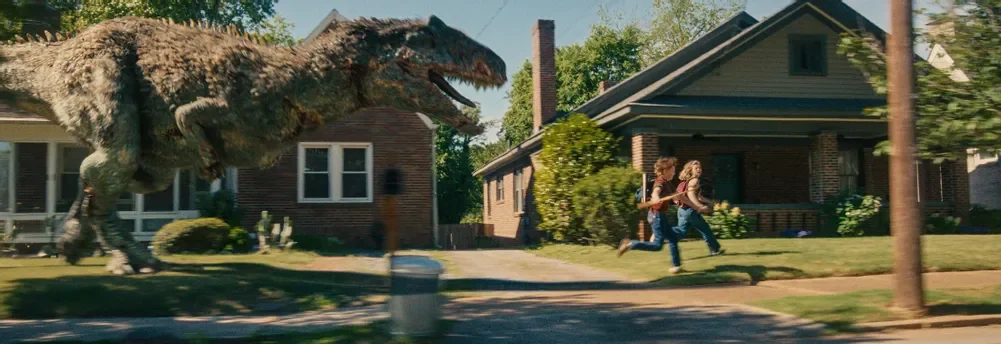
If you imagine the scenes in Jurassic Park where two kids and a couple of adults are scattering away from dinosaurs in pursuit, then you’ve got the gist of about 75% of The End of Oak Street. I regard Jurassic Park as one of the best movies ever made, so this is actually a complimentary comparison; it’s just that Jurassic Park was brilliantly paced and plotted, had real ideas for both the characters and the audience to ponder, and had incredibly sharp wit. The End of Oak Street gets about halfway there on all fronts, all the while using actors who are known widely to be deeply gifted but who give performances that feel phoned in. The delivery of some of the neighborhood kids is especially wooden. On top of it all, cinematographer Mike Gioulakis shoots some scenes with the camera looking at the character who is speaking from behind another character in very odd close-ups, which is very distracting. (Gioulakis also shot the 2014 It Follows, which was also written and directed by David Robert Mitchell.)

I had a great time watching The End of Oak Street, while also recognizing early on that it’s nothing special. It’s strange when a movie this thrilling to watch is simultaneously disappointing, though a lot of viewers clearly won’t care about that. If you’re just looking for a thrill, this movie will work for you. Although I still think you’d get more out of simply rewatching Jurassic Park, which had a depth that this movie doesn’t even aspire to.

Listen, this guy needs protein too.

Overall: B-

THE ODYSSEY

Directing: A-
Acting: A-
Writing: B+
Cinematography: A
Editing: B+
Special Effects: A-

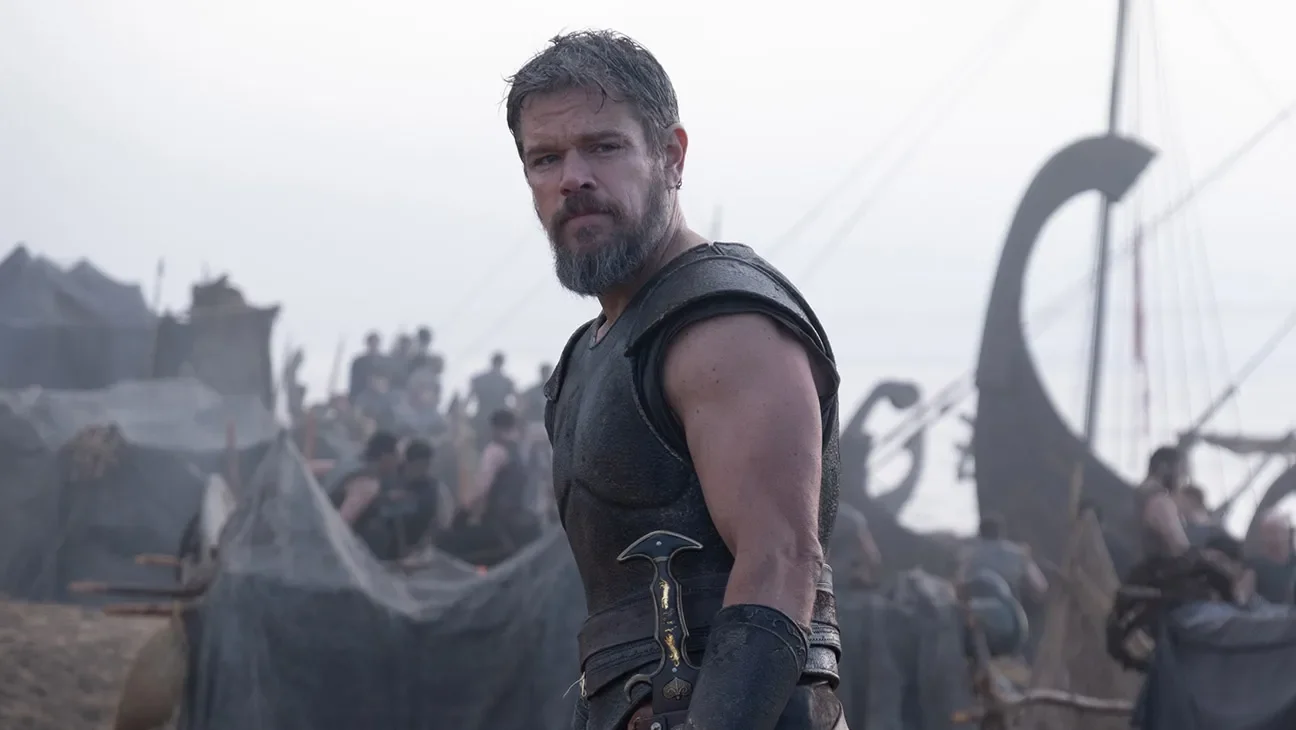
It’s only taken me a few hours to realize I liked The Odyssey even more than I thought I did. And I had mixed feelings about it for a while, particularly during the first hour, in which it felt like a bit too much was going on for me to take in. But then, in its second half, The Odyssey really pulled me back around, and in the end both its 172-minute runtime and its climactic final act felt deeply earned.

How long has it been since we had a truly epic film like this, anyway? Or at least one that was successful? “Epic” is a term pretty broadly applied, granted, but it may be safe to say that The Odyssey is the greatest epic fantasy film we’ve been given since the Lord of the Rings trilogy, the last of which was released 23 years ago.

The source text, of course, was written by the Greek poet Homer somewhere around the 8th century B.C. I won’t pretend to have any insights about writer-director Christopher Nolan’s adaptive choices, as although as an English major I presumably did read this once or twice, I remember basically none of it, aside from what has seeped into permanent pop culture through millennia. I can say that anyone upset about Lupita Nyong'o being cast as Helen of Troy, or Elliot Page as Greek warrior Sinon, or even John Leguizamo as Greek servant Eumaeus, is a straight up idiot. I suppose if you really wanted to be regressive you could call this the Bridgerton-ization of The Odyssey, but really: who gives a shit? Ancient or not, this is still fantasy—indeed, along with The Iliad the oldest fantasy fantasy of European origin there is—and the geographical area covered in The Odyssey quite logically covers ethnic groups of multiple skin tones.

If I really wanted to nitpick with any sense of justification, it might be the choice to have every single character in this version of The Odyssey speak with an American accent. This was not just because Matt Damon, in the lead part, happens to be American so everyone else was asked to follow suit; it was instead reportedly that Nolan wanted to break the long-held trop that ancient characters would speak in a British accent and thus make their speech sound of a higher class. (The modern British accent is only a couple hundred years old anyway, and ancient Greeks pre-date it by, again, millennia.) To be sure, something as simple as hearing a character like Tom Holland’s Telemachus refer to his parents as “mom” and “dad” as opposed to “mother” and “father” is a little jarring. But that’s about the extent of it, and actually you quickly get used to the anachronistically modern way of speaking. It gives the dialogue an accessibility, at least to American audiences, never before had with Homer’s works. It’s easy to envision classrooms watching this adaptation as the default going forward, after they read Homer’s The Odyssey.

In a way, this version of The Odyssey brings us full circle in pop entertainment. There have been countless adaptations and reimaginings of this work over the years, particularly over the more than a century that motion pictures have existed. Just a couple examples include the Coen Brothers’ brilliant 2000 film O Brother, Where Art Thou?, and even The Wizard of Oz frequently gets compared to it. To be fair, for The Wizard of Oz to be closer to The Odyssey I suppose the Cowardly Lion, the Scarecrow and the Tin Man would have had to be killed by the end. In any case, Nolan has brought us back to a more direct adaptation of the ancient text, just with an update to the language.

Surely there is a lot of artistic license in the adaptive process, as always. This, I think, is among the chief complaints by the vocal minority who are dismissing this film as “silly”—which was not a word I would use. Thrilling is a better word. And it’s thrilling in multiple ways. For instance, Anne Hathaway’s performance as Odysseus’s wife Penelope: if anyone in this film deserves an Oscar nomination for their performance, it’s her. I have long thought she was a great actor, but I was enthralled by her screen presence here.

You may have also heard that every actor with a pulse is in this movie, and it certainly does feel that way. This was also reportedly a conscious choice on the part of Christopher Nolan, who wanted to use star power as a means of underscoring the iconic nature of these characters: Athena the Goddess of Wisdom (Zendaya); the witch Circe (Samantha Morton); Calypso (Charlize Theron); Menelaus the king of Sparta (John Bernthal); Odysseus's second-in-command Eurylochus (Himesh Patel); Antinous, a sleazy suitor of Penelope (Robert Pattinson).

Even Bill Irwin, who had voiced the TARS robot in Nolan’s 2014 film Interstellar (which, incidentally, both Matt Damon and Anne Hathaway were also in), was tapped as the on-set performer as the giant cyclops Polyphemus. This is the first of several thrilling sequences in The Odyssey, although a word of warning to those going to IMAX screenings: the action sequences in particular are really loud. I literally had to plug my ears several times, it was so loud, and it began with Polyphemus’s roaring. So, maybe bring ear plugs. Once that’s done, you can delight at watching a cyclops casually munching on Greek warriors, or at the fascinating creature design choice of Polyphemus’s face. It’s like he was born with a facial deformity, where his one eye and nose are sideways. Somehow, it works, and to a degree actually humanizes the creature.

Between the cyclops, the giant Laestrygonian soldiers, a huge whirlpool, a multi-headed sea monster, a witch that turns men into pigs, and much more (including a lot of screen time dedicated to the Trojan Horse, which is only covered at length in the Latin Aeneid), there is plenty to thrill and entertain in Christopher Nolan’s The Odyssey. The onscreen effects are almost always thoroughly convincing, and if you actually pay attention you’ll see that the cinematography is incredible, particularly paired with elaborate staging and blocking so finely choreographed it almost goes unnoticed. The more I think about it, the more I want to watch this movie again.

Dude, where’s my penteconter?

PROJECT HAIL MARY

Directing: B+
Acting: B+
Writing: B+
Cinematography: A-
Editing: B+
Special Effects: A

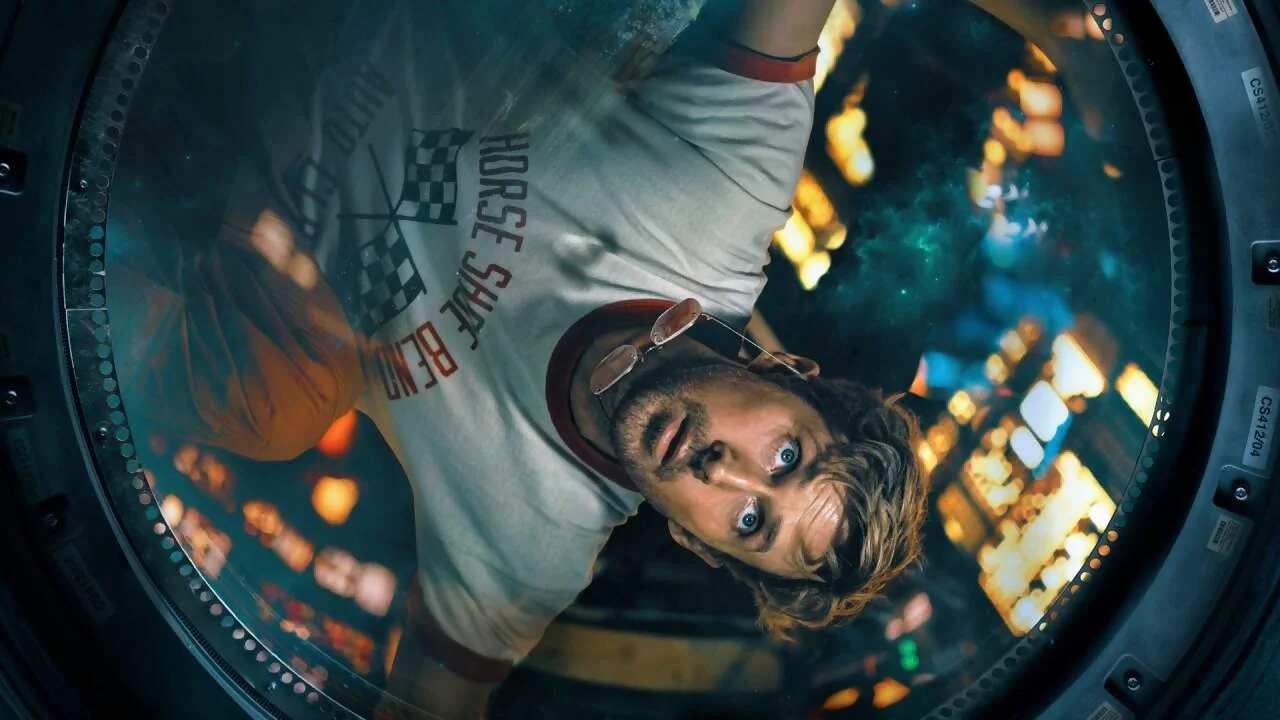
If you’re looking for an incredibly charming and entertaining science fiction flick, for the next several weeks your go-to choice will be Project Hail Mary, easily the best film of 2026 so far. This one ticks an incredible amount of boxes, and will work for people looking for different things. It’s going to be a kick for science nerds, assuming they don’t get too picky about accuracy—and, being a layman myself, it all seems perfectly plausible to me. Many people loved The Martian, the last film based on a best-selling Andy Weir novel, precisely because of how (mostly) scientifically accurate it was. There is no reason not to expect the same here.

It seems worth noting that I am in a somewhat peculiar position of perspective in the case of Project Hail Mary, given that I quite recently read the novel on which it’s based. I have said over and over that films should be judged on their own merits, but I possibly made a mistake by making that impossible for myself in this case. I read the novel too recently and cannot separate the two experiences, most notably in that this film, as directed by Phil Lord and Christopher Miller, and especially as adapted by writer Drew Goddard (who also adapted The Martian), is a great achievement in adaptation. But how do I know I only feel this way because I have read the novel? Would this film have been as easy to follow had I not read the novel? I’m honestly not certain—especially given that the film, even at 156 minutes in length, really felt to me like it rushed through a whole lot of the story.

Because a lot happens in this story: Ryland Grace (a perfectly cast Ryan Gosling), a middle school science teacher, through a whole lot of happenstance winds up as the Science Officer on the interstellar ship The Hail Mary, sent to investigate the one sun that has not been infected by a cellular alien life form, thereby dimming its power and thus threatening the life of the planet in its orbit that otherwise supports life—in the case of humanity: Earth. All the known suns within relative proximity have been infected, except this one that is roughly 12 light years away.

Grace is part of a three-person crew sent to study this sun and see if they can figure out why it is not infected and use that information to save Earth. He wakes up from an induced coma to find his two crew mades have died, but he doesn’t remember why he’s on this ship or how he got there. His process of figuring this out lasts through several chapters in the novel, complete with flashbacks serving as memories sporadically coming back to him; in the film, this happens over just the first few scenes.

And given that Grace wakes up alone on the Hail Mary, there are not a lot of characters in Project Hail Mary. The film does have 31 credited actors, but for a huge amount of screen time, Grace is the only character seen onscreen: Gosling truly carries this film, largely on the strength of his uniquely quirky charms, mixed with his improbable good looks. Cumulatively speaking, maybe half the run time, if not more, Gosling is the only human character we see. Through maybe the second half of the film, he is one of two characters, the other being “Rocky.” If you have read the novel you know exactly who that is; if you have seen the trailer you can easily guess who that is. This whole thing would be way more fun if you just watched the movie not knowing who the hell Rocky is at all, but if that were the case, why would you even be reading this review?

Any other characters are seen in flashback, which are Grace’s memories resurfacing as part of the plot mechanics of the novel, but function more as straightforward flashbacks in the film, providing us with backstory. Sandra Hüller is also very well cast as Eva Stratt, the largely humorless but compassionate leader of the international task force created to solve Earth’s problem. Grace also enlists the aid of a security guard named Carl (Lionel Boyce) as he runs his experiments and somehow learns about “astrophage,” the star-eating cells causing the cooling and potential environmental collapse of the Earth, faster than anyone else around the globe.

So we jump back and forth between Grace getting his bearings and slowly coming out of amnesia on the Hail Mary, and the flashbacks; this is mostly how roughly the first act of the film goes. In the next act, Grace learns he is not alone, and in the final act, Grace and Rocky do a lot of collaborative problem solving. This is specifically what characterizes the vast majority of the novel: a lot of science and problem solving. Weir had also provided a ton of fascinating detail about how evolution might have worked on another planet with a totally different atmosphere, and none of this gets covered in the film—we just see the result of this evolution onscreen, and therefore really never think about it in those terms. It’s too bad, because it’s pretty enlightening stuff, and gives the film adaptation less depth than its source material. But what can you do? The plot turns in the film are astonishingly close to those of the novel, and that alone pushed the run time past two and a half hours—all of it completely absorbing and entertaining.

It’s worth noting how stunning Project Hail Mary is to look at. This is a film with a ton of visual effects, almost none of it used to showboat; it’s all integrated well and serves the story. I’m tempted to say some of the exterior shots above an alien planet during Grace’s space walks are a little too vivid, like the cinematographer got a little slaphappy with the color filters, but what do I know? I’ve never done a space walk outside a spacecraft above an alien planet.

Where Project Hail Mary strikes a perfect balance is between the science fiction leaning heavily on plausible science, and a deeply affecting story about friendship. Readers of the book adore Rocky as a character, and there’s no reason not to expect the same of viewers of the film. This is a film that would be very deserving of Oscar nominations in many of the technical categories, including Production Design, Sound, and especially Visual Effects. I don’t often pay that much attention to Original Score but Daniel Pemberton’s original score here is also wonderful.

Honestly I struggle to come up with much in the way of criticism of this movie. I suppose one thing I noticed was the implausibly wide array of changes of clothes Grace seems to have on this ship, which feel only designed to add to his personality (and Gosling has that in spades already). But this doesn’t seem worth nitpicking about; it’s a detail that will hardly get noticed by most viewers and is just part of the visual medium that is movie making. Project Hail Mary is fascinating, suspenseful, and at times even moving—everything a movie like this is meant to be. The people who made this movie understood the assignment and knocked it out of the park.

It’s everything you want and more.

Overall: A-

HOPPERS

Directing: C
Acting: B
Writing: C-
Cinematography: B
Editing: C
Animation: B+

Has it finally happened? Have I become a contrarian crank? The old man who just doesn’t get it, who says Pixar movies were so much better back in my day? They just don’t make Pixar movies like they used to anymore! This is objectively true, actually, but does that matter to younger audiences? It’s certainly not going to matter to children, who will be perfectly entertained by Hoppers while I found it dumb as hell.

It’s a common refrain for me now, to say that Pixar once reliably made films that worked just as well for grownups as they did for children. They had a sophisticated sense of humor that made them stand apart from other animation studios. Those days began to end roughly a decade ago. Now the people at Pixar keep themselves afloat by riding their own coattails with endless sequels, interspersed with overstuffed nonsense like this.

I am reminded of The Wild Robot—a far superior film—and my one real complaint about it: that it depicts a wild animal world in which predators and prey become friends for the greater good. The same thing happens in Hoppers, they just don’t even do that as well. And Hoppers is a wildly derivative work of cinema. Its premise is so similar to that of Avatar, in fact, that the main character, Mabel (Piper Curda), literally says “This is like Avatar!” Mabel’s college professor mentor, Dr. Sam (Kathy Najimy), immediately retorts, “It’s not like Avatar!” but the cat’s out of the bag.

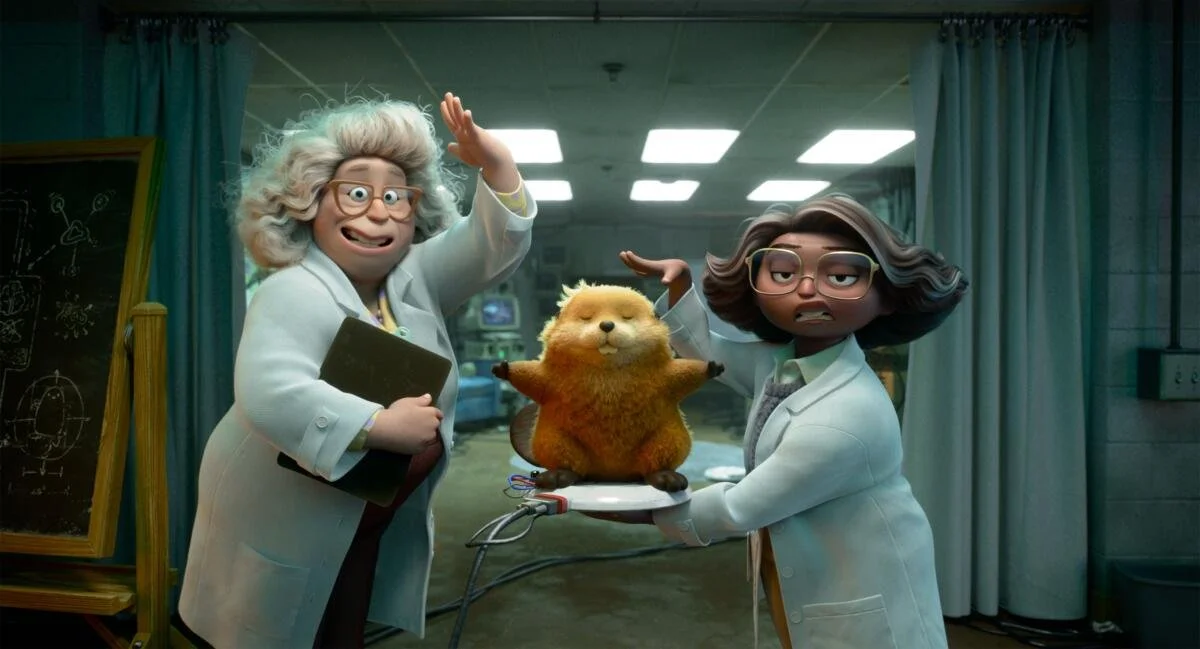
Or the beaver is, I suppose. Because, for reasons that are never made clear (who cares, it’s a cartoon), Dr. Sam and her helpers are doing research on porting their brains into robot animals as a means of communicating with them in their own language—which is somehow the same among all species of animals except human. Mabel, who is desperately trying to save the forest glade where she grew up with her late grandmother in an early sequence reminiscent of (but nowhere near as good as) the growing-old montage at the beginning of Up. The mayor of the nearby city of Beaverton (Jon Hamm) has selfishly dislocated all the animals there in an attempt to make way for a freeway bypass that will save commuters four minutes. Seizing an opportunity, Mabel ports herself into the body of a robot beaver, and then unwittingly ignites an animal uprising against humans.

To call the plot of Hoppers convoluted would be an understatement, and I haven’t even yet mentioned that the animals basically split into different factions, one who take the idea overboard and declare all humans need to be “squished,” and one that understands that’s a little much. Will children even be able to follow this? Probably not. Will they be delighted by a lot of the cute and funny animals? Definitely yes. Will Hoppers enter the echelon of classic Pixar animated feature films, like the original Toy Story or Finding Nemo or The Incredibles or WALL-E? Not likely. This movie will be forgettable to children and grownups alike.

I keep thinking about the 2022 film Lightyear, the first Pixar film I rated as low as a C+. And here we are again. The difference was that was an extension of an already-existing franchise, one that already had four previous installments (the fourth one being the weakest of the bunch—and yet, I’ll come back for #5). Hoppers is easily the most disappointed I have ever been in a wholly original Pixar film. It’s way too busy. It’s overstuffed. It’s convoluted. I don’t get it.

And this is a case where I am in the minority. At least in the case of Lightyear the response was definitively mixed. Hoppers is getting a pretty positive response, and I can only theorize that I am perhaps too whetted to what Pixar once was. Would I feel the same way about Hoppers if all else were the same but it were made by a different animation studio? I think I would, actually.

A lot of Disney properties stand the test of time, and Hoppers will not be one of them. You want to see a movie that examines relationships of substance using wildlife characters? Watch Bambi—which is not even my favorite Disney film, but I can recognize an enduring classic, complete with innovative animation techniques, when I see one. The makers of Hoppers are entertaining us, sure—I got a few good laughs—but they’re phoning it in. Why bother casting the likes of Meryl Streep as a megalomaniacal Insect Queen if you’re not even going to register that it’s her?

Setting all of that side, some wild shit happens in this movie. I probably shouldn’t spoil what happens with a flock of birds and a giant shark voiced by Vanessa Bayer, except to say that it’s ridiculous even by this movie’s standards. Director and co-writer Daniel Chong woke up one day and chose chaos. I was actually kind of locked in with Hoppers in the beginning, even though Mabel as a little girl is far more compelling than Mabel as a 19-year-old college student. I even leaned forward when Mabel found herself following a mysterious beaver into a science and technology lab. But then Mabel ports into a robot beaver, infiltrates a weirdly homogenous animal society, and winds up at a giant mound atop of which is King George the Mammal King beaver (Bobby Moynihan), to whom animals of all other species is bowing, and I’m just thinking, What the fuck is this? I haven’t even mentioned the brown bear (Melissa Villaseñor) who, much like in The Wild Robot, is for some reason everybody’s friend. She does eat a perfectly friendly fish at one point, so, points for that I guess.

I long for the days when Pixar made films that were both wildly entertaining and featured narratives of nuanced substance. In Hoppers, it feels like the relentlessly chaotic action exists to distract us from the fact that it’s all just empty calories for the mind. We might as well be plugging these looney antics right into our eye sockets, entertainment as overstimulating pacification. I want to say that Pixar is still capable of greatness, but it’s been a good five years since they last made something truly great; four since they squandered potential by dumping really good material direct to streaming. But I still believe in you, Pixar! I’m just waiting for you to climb to the top again, because this isn’t it.

Don’t ask.

Overall: C+

HOW TO TRAIN YOUR DRAGON

Directing: B-
Acting: B
Writing: B-
Cinematography: B-
Editing: B-
Special Effects: B+

The burning question right now is this: what was the point of a live-action remake of the Dreamworks Animation hit How to Train Your Dragon, all of fifteen years later? What purpose does it serve, aside from greater box office earnings?

I’m coming up short on an answer. When the original animated film was released in 2010, one of my minor complaints was about its “needlessly breakneck pace from start to finish,” in a film with a runtime of 98 minutes. With this 2025 live-action remake, however, the runtime is 125 minutes—and that feels about 20 minutes too long.

Disney has already cashed in on a string of live-action remakes of classic animated features, which were also mostly pointless but for their box office potential. Dreamworks is apparently eager jump on this bandwagon, even though the animated How to Train Your Dragon already spawned two sequels, the most recent of which was released only six years ago. Sitting through the live-action version today, I found myself struggling to see how it justified its own existence, especially given how similar it is to the original, just fleshed out to a runtime far too long for an ostensibly “family film” one can assume would include children in its audience. Kids were rapt by the 2010 film; they may get bored with this one. For more likely, adults will.

What’s more, “live action” is a term used very loosely here, as all the dragons are rendered with CGI animation. The only difference is the human characters actually acted on camera. The most fun thing, arguably, about this How to Train Your Dragon is that Gerard Butler reprises his role as Stoick, the disconnected father of Hiccup, this story’s hero.

Hiccup was voiced in 2010 by Jay Baruchel, who was 28 at the time but still had his youthful-sounding voice. He’s 43 years old now and clearly can’t play a teenage character onscreen—he wouldn’t even have been able to 15 years ago—so he’s replaced by 17-year old Mason Thames, much more convincing as the scrawny Viking kid who dreams of being a dragon killer but only manages to wreak havoc with his awkward mistakes instead. Thames is well cast as a live-action avatar for how Hiccup was drawn as an animated character, and he holds the screen well too.

On the off chance you don’t already know, the basic premise here is that Hiccup discovers the dragons of this world, of which there are many, are misunderstood animals and not the ruthless killers the Viking villagers have regarded them as for generations. He manages to injure the elusive “Night Fury” dragon, but when he goes to hill the dragon, whom he later names “Toothless,” he befriends him instead. What follows is a struggle for Hiccup to convince his village that the dragons are smarter than they appear and mean them no harm.

Hiccup is very effectively an awkward outsider, which makes for a lot of awkwardness in the first half of this film, which sometimes works and a lot of times doesn’t. A lot of this How to Train Your Dragon is so cutesy and cartoony, it again begs the question: why not just let the animated feature stand on its own? Nothing truly realistic occurs in this “live action” rendering, least of all the way Hiccup eventually figures out how to ride Toothless. And I said this in my review of the 2010 film and it still feels the same now: the creature design of Toothless has an uncanny resemblance to that of Stitch from Lilo & Stitch—and ironically, a live action remake o Lilo & Stitch is also in theaters right now.

To this new How to Train Your Dragon’s credit, it gets better as it goes along—the second half is much better, and certainly more exciting, than the first half. I suppose that’s better than it being the other way around. I eventually found myself invested in the characters and in the story, in ways I wasn’t for some time at the start. And some further fun casting includes Nick Frost as Gobber, the guy who trains upcoming dragon slayers; Julian Dennison (the kid previously seen in Hunt for the Wilderpeople, Deadpool 2, Godzilla vs. Kong, and Y2K) as one of Hiccup’s fellow dragonslayers-in-training; and Nico Parker (Joe’s daughter from the premiere episode of The Last of Us) as Astrid, Hiccup’s eventual love interest.

By the time of How to Train Your Dragon’s conclusion, I had to admit I was pretty entertained. It just had to go through a bit more awkward, cartoony cutesiness to get there than I would have preferred. Entertaining or not, I remain unconvinced there was any great reason to make this movie to begin with, but if it’s the thing on the screen in front of you then it works well enough.

This seems awfully familiar.

Overall: B-

A MINECRAFT MOVIE

Directing: B
Acting: B-
Writing: B
Cinematography: B
Editing: B
Special Effects: B+

I could have had a field day ripping A Minecraft Movie apart—if it weren’t funny. But, the thing is, I laughed a lot. And maybe you won’t. Maybe you will. This movie has a pretty specific and peculiar sensibility, which gets very goofy and dumb, for no other reason that its self-reward. It spoke to me. And I don’t even have the slightest bit of knowledge or familiarity with the 2011 video game on which it’s based, although plenty of the action feels like a video game. Or what I imagine a video game to be like, anyway. What do I know? I played a few video games at a friend’s house in the summer of 1989, decided fairly quickly that it wasn’t for me, and haven’t bothered with it since. Most of this movie’s audience will have been born after that.

How easily I settled into A Minecraft Movie’s delightfully absurdist humor only better serves to recommend it. Anyone open to its brand of humor can enjoy this movie, whether they’re familiar with the video game or not. Granted, the setup a paper thin and utterly stupid, introducing us to Jack Black’s Steve, a doorknob salesman with a lifelong dream of being a miner. He follows his dream, goes down into a mine, and within minutes uncovers an “orb” (it’s actually a cube) that opens a portal into “the Overworld,” a place where creativity knows no bounds—well, except for the unstated fact that apparently everything has to be designed in cubed shapes.

Anyway, everything that so quickly gets Steve to the Overworked is ridiculously convenient and untied to any backstory to give Steve any character dimension whatsoever. I don’t seriously think this is the case, but I suppose you could argue that this setup is itself a meta commentary on the thinly contrived characters in any typical movie of this ilk. There are no intellectual pursuits here—getting right to the delightful absurdities is very much the point.

I could have lived without the way Jack Black’s delivery is far more over the top than it needs to be, every single line he delivers. He’s overly excited about everything he sees onscreen, or even any particular thought he has. It’s on-brand for Jack Black, I guess, and makes him fit better in the Overworld than he does in the real world. The others that find themselves sucked into this world give more naturalistic performances, with the exception of Jason Momoa as Garrett “The Garbage Man” Garrison, a former “Gamer of the Year” in—speak of the devil!—1989.

Not all of the humor in A Minecraft Movie lands. What makes it work is that most contemporary absurdist comedies, especially wide-release big-budget ones, have far more humor that falls flat than that works. A Minecraft Movie is the other way around. For every gag that doesn’t work, there are five that do. I laughed far more consistently at this movie than I expected to.

Not all of the characters really work either, to be fair. Jennifer Coolidge appears as a high school Vice Principal, who invites a Minecraft villager to dinner after he wanders through the portal to the real world and she hits him with her car. Director Jared Hess, working with a script written be a team of six writers, cuts back and forth between the Overworld action and this dinner date, enough times to make you wonder what the point of the dinner scenes even is. In the end, the point seems to be only to get to a bit between Coolidge and the CGI villager during the end credits. Well, the bit is hilarious, one of the funniest things in the movie, so I guess it’s worth it?

Rounding out the principal cast are Sebastian Hansen as Henry, a very creative kid just starting high school in the Idaho town of Chuglass; Emma Myers as Natalie, Henry’s older sister who hardly looks like she should be out of high school herself (Myers is 23) and has been hired as the social media manager for the town’s potato chip factory; and Danielle Brooks as Dawn, the local real estate broker with a mobile zoo as a side hustle. Brooks in particular is a known talent who is somewhat wasted here, as all these characters are easily interchangeable with any serviceable actor, but they’re still all fun enough. Momoa, Coolidge and to a lesser degree Jack Black provide the most color as characters, although only Momoa provides a kind of colorfulness that fits neatly into the video-game-adaptation context.

The bottom line is, none of the plot, such as any plot exists, matters. What matters is a bevy of well-executed, adorably bizarre details, such as the villainous borde of cube-headed “piglins” from another dimension, led by a piglin witch named Malgosha. By and large, there is little to no rhyme or reason to anything that happens in A Minecraft Movie, but it’s the execution that makes it work—humor that works more often than it doesn’t; and more actors with charisma than without. It’s an impressively staged bit of organized chaos, set in a world rendered with surprisingly artful special effects. It’s a movie that is ultimately meaningless but kind of a blast, but sometimes a mindless blast is its own reward.

Which of these characters is the most fun? You get one guess!

Overall: B

MICKEY 17

Directing: B
Acting: A-
Writing: B-
Cinematography: B
Editing: B+
Special Effects: B+

It was always going to be a challenge for Bong Joon Ho to follow up his 2019 film Parasite, which turned out to be a watershed moment in both cinema and Oscar history. This is a guy with a penchant for genre mashing, and actually never more so than in Parasite—but no one would expect him to match that, and it makes sense that he would return to his oddball science fiction sensibilities with Mickey 17, a movie with neither hopes nor aspirations for Oscar glory. This is a movie just made by a bunch of people who are clearly having fun.

None more so than its star, Robert Pattinson, who plays two parts: Mickey 17 and Mickey 18. Technically he plays 18 parts, all of them the same person: Mickey has signed up to be an “expendable,” offering his body for fatal research on a planet marked for colonization, his body “reprinted” every time he dies, each time with his memory restored. Bong, who co-wrote the script, wisely doesn’t even try to explain what kind of science could make this possible, because it doesn’t matter, not pertinent to the story being told. This is just used as a tool for exploring other things that are on his mind.

In this future world, it has been declared unethical to allow “multiples” to exist at the same time: a person can only be reprinted after death. After we are taken through a pre-credits montage of Mickey’s first through 16th bodies, an unexpected twist of fate has 17 surviving when everyone assumes he has died, thereby printing 18 without realizing 17 is not really dead. These two characters are the leads in Mickey 17, and Pattison gives a performance that is unique, delightful, and illustrative of a breadth of talent wider than many realize.

Pattinson and Kristen Stewart have followed similar career paths after the Twilight series made them young movie stars—ironically, in both cases with objectively unremarkable performances (in Stewart’s case, that’s putting it diplomatically) in that subpar vampire fantasy series. In the years since, both of them have taken on far more interesting roles that have revealed surprising depths of talent. It would be fascinating to see them paired in a film again, but in a film that was actually good.

In the meantime, we can get a kick out of Mickey 17 in Mickey 17, a copy of a copy of a copy who is somehow frightened and insecure. When he meets Mickey 18, he discovers 18 to be very much over it, much more aggressive and even prone to revenge. You might even say nihilistic. I thought a lot about what might account for such drastic change in personality in the exact same person, and could never quite come up with anything. Mickey 17 is clearly fatigued by the memory of 16 different deaths. There is a fascinating thing to think about, though: with Mickey 17 still alive, presumably Mickey 18 can only be revived with the memories of Mickey 16, which means this is the first point at which two different versions of Mickey’s experience diverge.

This is much different from playing twins, and is more akin to playing clones, who are produced as people of the exact same age. It’s a deeply fascinating premise that Bong really doesn’t dig into deeply enough. The closest is when Mickey’s girlfriend, Nasha (Naomi Ackie), delights in the attempt at sleeping with two Mickeys at once. Mickey 17 is understandably baffled, and Mickey 18 is into it—even at one point running his fingers through 17’s hair. The scene gets interrupted, but I found myself relating to all three people involved. Who wouldn’t want to sleep with two Robert Pattinsons at once? And even though he’s not so much “hunky” as possessing a kind of stringy handsomeness, if I had Pattinson’s body I’d sleep with myself too.

But I haven’t even gotten to the “creepers,” the alien life on this planet so named by the very Trumpian character Kenneth Marshall (Mark Ruffalo, mugging in oversized teeth) and his wife, Ylfa (Toni Collette, stealing scenes as usual). These creatures have a vague resemblance to the “super pigs” in Bong’s 2017 film Ojka, only this time they’re closer to a cross between a muskox and a giant caterpillar. One of several nitpicky criticisms I have of Mickey 17 is how the “creepers” are the single form of life we see on the planet Niflheim. What sustains them? What do they eat? How do they thrive in a vacuum devoid of biodiversity? So far as we can tell, Nilfheim features only ice, and these creepers.

They do prove to be surprisingly intelligent, and a “translation device” gets introduced that, plot-wise, is a little too easy and convenient. Still, Bong manages to shoehorn in a lot of undeniably liberal talking points about colonization, and who is really an “alien.” And don’t get me wrong, of course I appreciate that, but much of it is a bit too on the nose.

Mickey 17 is undeniably entertaining, but also a bit too simple in its storytelling given the premise and its setting. The creepers are all impressively rendered, but I would have liked a bit more of the dazzle promised by this film’s marketing—either in terms of the visual effects, which lack color with its endless focus on white ice and snow contrasted with the metal and browns of the spaceship or the creeper creatures, or in terms of its plot turns. There’s not even as much action in this movie as you might expect. To be fair, it still has oddball sensibility to spare, which at the very least we can always expect of a Bong Joon Ho film. This is a movie that did not quite meet the excitement of my expectations, but the more I think about it, the more I think it will likely work well on rewatch.

Robert Pattinson doubles our pleasure in Mickey 17.

Overall: B

GLADIATOR II

Directing: B
Acting: B+
Writing: C+
Cinematography: B
Editing: B-
Special Effects: C

Protip: don’t rewatch the original film just days before seeing its “legacyquel” that’s being released decades later. I keep making this mistake. I watched Twister right before seeing Twisters; I watched Beetlejuice right before seeing Beetlejuice Beetlejuice; I watched Gladiator right before seeing Gladiator II. The only consistent purpose this seems to serve is how the new film definitively fails to live up to the first.

You see where I’m going with this. Even more than the other examples, Gladiator II follows all the same basic story beats as its far superior, Best Picture-winning predecessor from 2000. The comparisons to The Force Awakens and Top Gun Maverick are apt—and I’d throw in Alien: Romulus as well, given how its story directly mirrors the original Alien from 1979. These movies do what they do with varying success, although it should be noted that Gladiator II does it with the least success.

Does this mean I wasn’t entertained? Absolutely not. My answer to Russell Crowe’s Maximus from the original film, when he asks the immortal line “Are you not entertained!” is an emphatic, I am. Granted, in this film Paul Mescal’s Lucius asks a question with similar delivery from the middle of an arena when he asks, “Is this how Rome treats its heroes!” It doesn’t land with quite the same import but I guess you can’t have everything.

Gladiator II is, overall . . . fine. But this is its greatest weakness, because the original Gladiator was so much better than that. It had an iconic hero in Russell Crowe’s Maximus; it had an iconic villain in Joaquin Phoenix’s Commodus. It also had an undeniable movie star at its center, and the closest to that we get in Gladiator II is Denzel Washington—as the most notable scheming villain, among several. It should be noted that Washington is the best thing and most fun person to watch in this movie. Paul Mescal as Lucius the conquered and enslaved gladiator, and Pedro Pascal as the Roman General who is the target of Lucius’s vengeance, are both capable and talented actors but neither quite rise to what director Ridley Scott is clearly aiming to replicate with them. I hesitate to say it’s their fault, given that the script is one of the weakest elements of this film.

One might be tempted to celebrate the amount of queerness thrown into Gladiator II—until you realize it is exclusive to queer-coding villainous characters. Washington’s Macrinus, who is clawing his own way from a distant past in slavery with eyes on the throne, reveals himself to be bisexual, wears gold earrings, and always wears colorful, flowing robes. Joseph Quinn and Fred Hechinger play twin Emperors Geta and Caracalla, both of them presented as effete, one of them with a clingy male concubinus. And again, this young emperors are both villainous as well, but neither comes across so much as formidable as like a couple of fickle little dipshits.

These details are all unfortunate but relatively subtle; I was entertained enough not to be too bothered by it, at least until I had more time to reflect on it once the film ended. There’s a lot of gladiatorial combat, of course, and several large-scale battle sequences, and if there is any place where Ridley Scott shines, it is here. And if you can watch this without a vivid recollection of its better predecessor, the performances are compelling, especially among the three leads, as well as that of Connie Nielsen as Lucilla, one of three characters (and two actors) who return here from the first film.

The Colosseum gladiator scenes, however, must be called out in their ridiculousness. Ridley Scott used real tigers in one of the gladiator battle scenes in the 2000 film, and apparently felt it was important to “up the ante” this time—over and over again—but never with anything real. We get to see baboons, a rhinoceros, and even sharks, all of them transparent CGI. It’s difficult to care about the supposed danger characters face if they are effectively battling a cartoon. The sharks, for instance, dart around the water like they’re in a video game. The Colosseum apparently really did get filled with water to host mock naval battles as entertainment, but that’s the extent of the realism here. How the hell could the Romans ever have transport all these giant sharks to the Colosseum anyway, let alone captured them live in the open ocean?

Yeah, yeah: it’s just a movie, right? Suspension of disbelief still has its own boundaries, and those boundaries can be strained. Still, most of the time I watched Gladiator II, I adopted that very frame of mind: it’s just a movie, and in spite of all these details I can easily pick apart, I’m having a good time. I can’t say I was disappointed in it, mostly because I enjoy the actors, they play well off each other, and their performances do manage to elevate the lesser material, at least to a degree. The script lacks the tightness of the 2000 film, doubly unfortunate give the degree to which it simply attempts to replicate it—but, it was still compelling enough to follow. This is a 148-minute film and I never got bored. Will I ever go out of my way to watch it again, or recommend it to anyone else? Not likely.

Gladiator II was an adequate way to spend a Saturday afternoon. It wasn’t terrible, it wasn’t great. The key point here is that simply re-watching the original Gladiator was time much better spent.

Not a fully accurate representation of The Colosseum.

Overall: B-

TWISTERS

Directing: B
Acting: B
Writing: B-
Cinematography: B+
Editing: B
Special Effects: B

It was a somewhat surprising experience watching Twisters in the theater last night, a 6:15 p.m. showing with perhaps ten other people in the theater—from what I could tell, all of them young. And I did not survey them, but it seemed likely that many, if not all, of them had never seen the original 1996 film, Twister—which, I really have to say up top: was much better. After re-watching that film only a couple of weeks ago and being genuinely impressed by how well it stands up, particularly in terms of its special effects, I could not help but be just slightly disappointed by this new one. I found myself envying those kids: they were clearly having a great time, while I was over here, nitpicking.

And in so doing, I am going against what I have long stated I stood for: which was that films should be judged on their own merits. The problem is that, in creating a “legasequel” such as this, the filmmakers are openly inviting comparison. And when you do the comparison: Twisters falls short. Not by a wide margin, but it falls short nonetheless.

And there’s a bit of a double-edged sword to this comparison. The 1996 Twister knows exactly what it is: a blockbuster disaster movie showcasing special effects (many of them shockingly practical) that does not pretend to be anything else. The premise being preposterous is incidental; the stock characters elevated by broadly charismatic performers. It had two teams of scientists chasing tornadoes in Oklahoma in pursuit of new data they can get from a new device they called “Dorothy,” which they hope will help extend advanced warning times by launching sensors up a tornado funnel from its base. One of the groups is the clearly villainouse one because their leader is ”in it for the money, not the science.”

The 1996 Twister was also a product of its time, its shamelessly knowing execution, of a dumb plot in the name of thrilling sequences, being something that would just never play the same way today. The unfortunate result is that the 2024 Twisters infuses an element of self-seriousness not present in the previous film, which really doesn’t work either. Which begs the question: Why make this movie at all? Box office would have to be the only answer. I’m sure the relative disinclination of young moviegoers to rewatch “old movies” (Twister came out 28 years ago) has not changed and never will.

So why not just make a new movie about tornado chasers? What purpose does it serve to ride the coattails of a movie from three decades back whose coattails petered out long ago? Especially when this movie’s connection to Twister is tenuous at best? I actually found this point lacking in clarity, the only “character” in this film that was actually seen in the first being “Dorothy” herself, the contraption that releases sensors . The young scientists in pursuit of grant money even make derisive references to how old she is. This is never stated explicitly, but Dorothy must have just been handed down by their scientific forebears and that’s it; there is no other narrative reference to the first film at all.

There is a meta connection, however, when James Paxton, the late Bill Paxton’s son, appears briefly as an aggressive customer trying to check into a hotel while he and his girlfriend willfully ignore a gigantic tornado approaching. There are also other subtle references, such as when the film’s primary protagonist, Kate (Daisy Edgar-Jones), visiting to assist an old friend for a week to get new data, responds to someone saying “Welcome back!” with “I’m not back!”—the latter being an exact line Bill Paxton delivers in the first film. Also, this movie’s story beats are nearly identical: opening flashback of a traumatic event in the midst of a tornado; survivor later pursues an understanding of this enigmatic force of nature; two teams of people compete with each other to catch up to multiple tornadoes in a single day of several tornado outbreaks.

All of this is to say: the script here did very little for me, it’s such a rehash of the first film, which itself took no pains to be any work of staggering genius. This time around, director Lee Isaac Chung (pivoting rather hard after the quietly wonderful 2021 film Minari) and co-writers Mark L. Smith (The Revenant) and Joseph Kosinski (who directed Top Gun: Maverick) introduce a character named Tyler (Glen Powell, by far the most charismatic presence in this movie—the man is a star) who we are clearly meant to read as an analog to Carey Elwes’s pompous character from the first film. Kate’s old friend Javi (Anthony Ramos, whose ample talents are criminally wasted here) has been employed by a guy with real estate connections, and between Tyler and Javi, Twisters ultimately “flips the script” from the first film that is clearly meant as a “twist” from initial expectations. But, it never amounts to much.

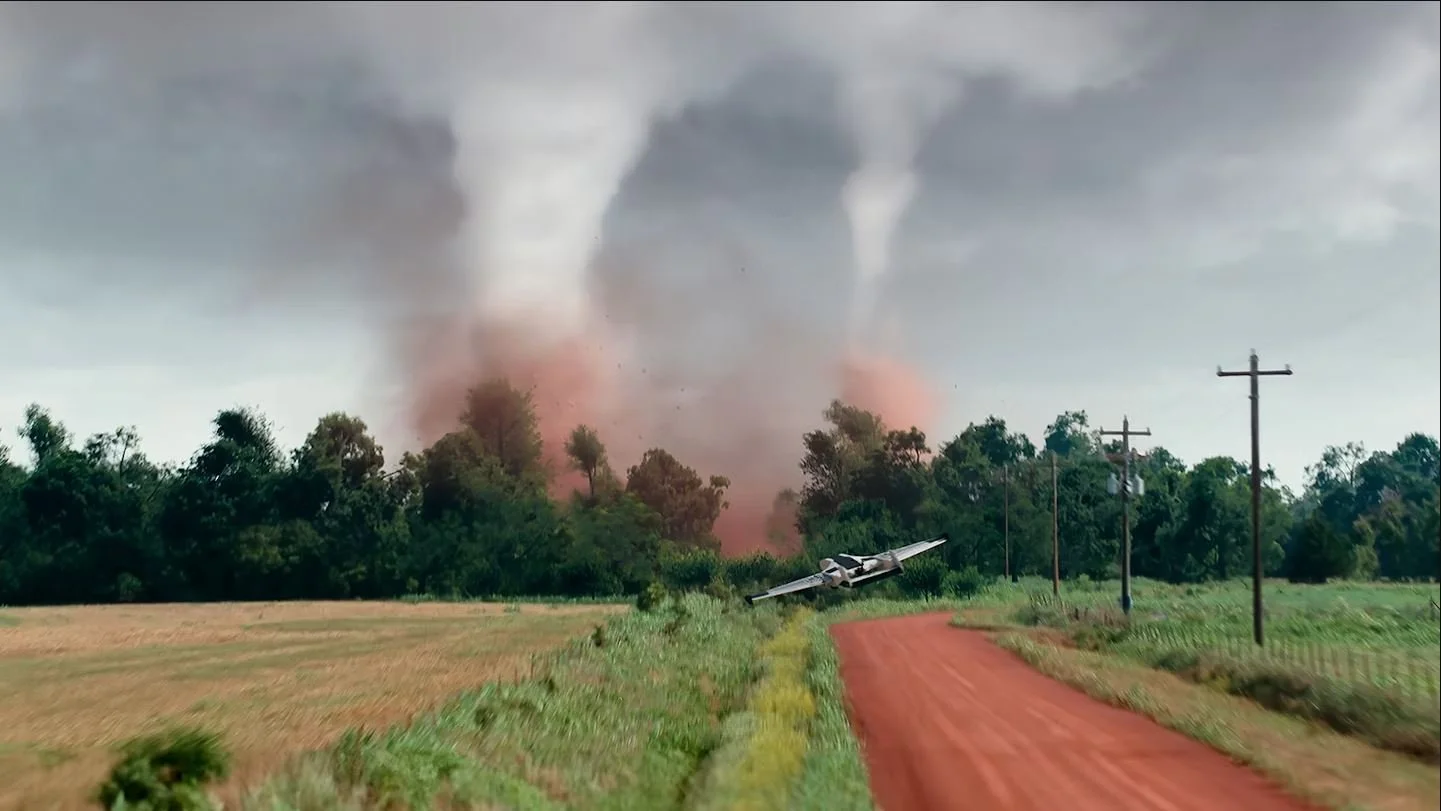
So what does that leave? Tornadoes, of course! This would be the whole reason I’m not sorry I saw Twisters, because it still features countless tornado sequences that are genuinely thrilling, and what else is anybody going to this movie for? Plus, in spite of this movie’s characters on average not being half as compelling as those from the first film, even with the down-time, “character” scenes, the run time is a perfectly decent 122 minutes, keeping it from overstaying its welcome or feeling bloated.

Still, this does feel worth mentioning: the effects in the 1996 Twister hold up surprisingly well after 28 years. The effects in Twisters hold up about as well as you would expect: they aren’t bad but they don’t push anything forward; they aren’t any more impressive than they were in the first film, although there are several shots with more comprehensive composition. This movie isn’t going to continue impressing thirty years from now in the same way, though. Not that it appears to have any intention to; it only exists to entertain us all in the present moment, and on that point it succeeds.

And that brings us back to the cast, and specifically Glen Powell, without whom Twisters would not be nearly as good as the just-fine movie it is. Here he plays a storm chaser with a whole crew who post videos to a YouTube channel with a following of 1 million, who at first seems like an arrogant ass but of course (spoiler alert!) turns out to have a heart of gold. I would argue that, on a character level, Powell is the single person who makes Twisters worth seeing. He actually manages to elevate his contrived material with a performance that is as nuanced as it is undeniably charming. (Admittedly, some viewers don’t find his character so charming; this is not a universal response. But, the critical and box office success of his most recent four films in only the past two years speaks for itself.)

There is plenty of talent elsewhere in the cast, mind you; they just aren’t given enough to do. Besides Ramos in a fairly thankless role, Tyler’s crew also includes critical darling Sasha Lane (American Honey, How to Blow Up a Pipeline), whose career trajectory never quite went where it should have. Here the most interesting thing she’s given to do is remote pilot a drone for aerial shots of the tornadoes.

As always, though, here is the bottom line: is Twisters entertaining? Yes. Does it give you what you come to see? Absolutely yes. No one’s coming to these movies for dimensional character portraits, they’re coming for the thrills, of which Twisters has countless. I’m just nitpicking because it’s what I’m here to do. Granted, the 1996 Twisters has thrills that are just as good, with a better cast, and more successful wit in its dialogue. But even then it was only the thrills that mattered, and it’s really all that matters here. I didn’t quite get everything I wanted out of this movie but I certainly got what I came for.

The two leads in this picture are ready for their close-up.

Overall: B