THE RUNNING MAN

Directing: C
Acting: C
Writing: D+
Cinematography: B
Editing: C+
Special Effects: B-

Edgar Wright has directed and co-written so many delightful movies—Shaun of the Dead (2004), Hot Fuzz (2007), Scott Pilgrim vs. the World (2010)—it’s easy to expect, or at least hope, that a new one will at least be really fun. Baby Driver (2017) was fun but did not quite reach the heights of his earlier work; and Last Night in Soho (2021) was . . . fine. You can perhaps detect a shift here, and I suppose every good director, if prolific enough, will inevitably product an outright dud.

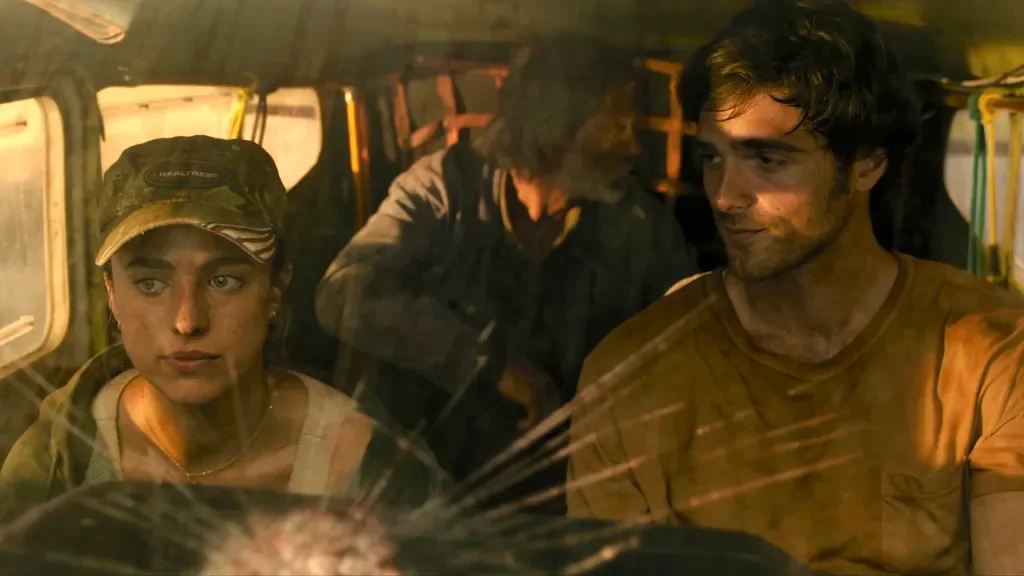
Enter The Running Man, an exercise in squandered potential if ever there was one. Wright also has a co-writing credit here, alongside Michael Bacall, who previously collaborated with Wright on Scott Pilgrim vs. the World—a movie which, by the way, holds up surprisingly well. So what the hell happened? This The Running Man, the second adaptation of the Stephen King novel by the same name (the first having starred Arnold Schwarzenegger, in 1987), is badly written, phoned in by the actors, looks ugly, and is overlong. What person in their right mind thinks 133 minutes is a reasonable runtime for a movie like this? I saw that runtime before seeing the movie and immediately knew it didn’t bode well. A perfect runtime for a movie like this is, say, an hour and 45 minutes. (The 1987 film was an hour and 41.)

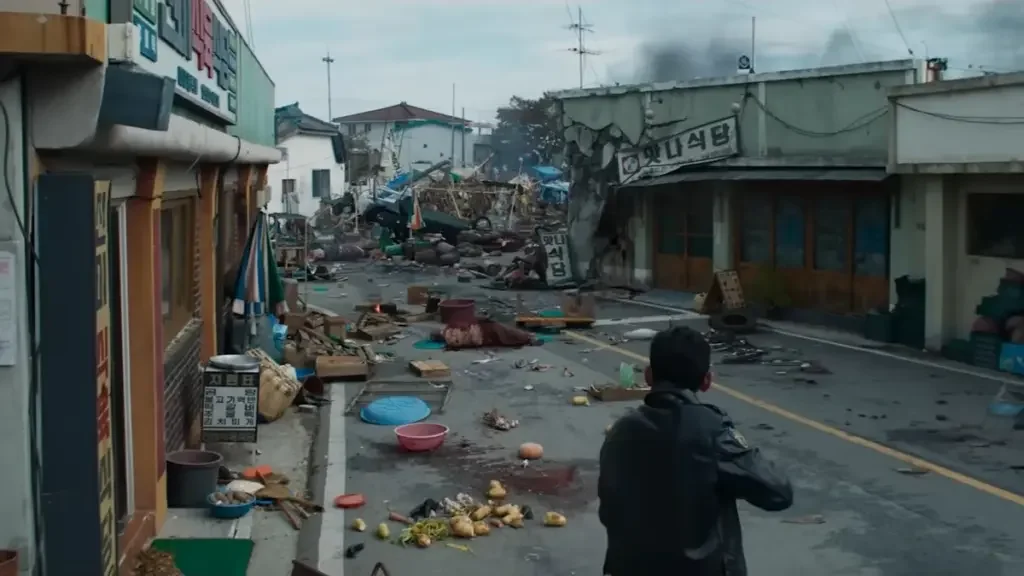
I never expected greatness from this movie, but I thought it would at least be dumb fun. It was dumb all right, though in a particularly unexpected way: this movie thinks it’s way smarter than it actually is. This is a dystopian future in which the divide between wealthy and poor is massive; “megacorps” own everything including government and law enforcement; and mass entertainment caters to the lowest denominators of profanity and dehumanizing violence—all the same beats we have seen time and time again in dystopian movies. The Running Man goes further with characters regularly ranting about the state of inequality, in ways that thoroughly ignore subtlety and never sound like anything but platitudes.

All of this shit is going in one ear and out the other of anyone watching, who are just there for escapist entertainment in an American cultural hellscape. The very existence of this film is the product of what it’s pretending to be preaching against. It’s worth noting that the one thing this movie does that we haven’t seen much of before is use AI as a plot point, with The Running Man’s gameshow manufacturing footage that isn’t real in an effort to keep the audience against the contestant—except it’s never addressed as “AI” and only ever declared “not real” in ways, again, we’ve already heard a thousand times. The only thing that could make this entire production—with a budget of $110 million—more perfectly cynical would be to learn that AI was actually used in the making of it.

I do try to find redeeming qualities, and I found a couple, though they hardly make up for what makes this movie suck. The cinematography isn’t bad, but that doesn’t mean much when the production design is so dingy and drab. Ben Richards (Glen Powell) spends a lot of time running around cities with crumbling infrastructure and complacent bureaucracy. The special effects aren’t terrible, but none of what’s decently rendered looks very good. There is evident skill but a fundamental lack of imagination. Even when we first meet Ben and his wife, Sheila (Jayme Lawson, given a truly nothing part to work with), we learn of their desperation to find medication for their young child with the flu. This is set in their tiny closet of a home surrounded by concrete walls, and the entire sequence is a deeply clunky exposition dump through their dialogue. This, along with Ben pleading with his shitty boss to get his job back, is how the film opens.

The Running Man reveals itself to be in trouble as soon as characters open their mouths. Glen Powell must be noted here, as deeply miscast in the role of a deeply disenfranchised, constantly furious man. After many roles as a romantic charmer of a leading man, I suppose it’s understandable that he’d want to be cast against type, except that he works well in those other roles and just isn’t believable here. He doesn’t feel genuine.

Naturally, as Ben spends a lot of time on the run, he crosses paths with an ensemble cast of supporting characters, including Scott Pilgrim star Michael Cera, here a surprisingly credible underground revolutionary who offers Ben aid. He’s booby trapped his large house so he can have fun with the “goons” (what everyone calls the police in this film, right down to the brief sighting of graffiti that reads AGAB) once they inevitably catch up with them. This is one of the more engaging action set pieces in the film, but for the fact that it comes along way too late and has no critical need to be included in the plot whatsoever.

The first helper Ben comes to is his old friend Molie, played by the always dependable William H. Macy, who is given far too little screen time—he’s in maybe two scenes. Sean Hayes makes a single appearance as the host of another dehumanizing gameshow called Speed the Wheel, in which we see an overweight man literally run to death on a human-sized hamster wheel. Lee Pace plays the leading “Hunter” among those professionally hired to chase down The Running Man. Pace spends most of the movie with a mask over his face, and it’s eventually taken off like a big reveal, only to show a guy whose biggest part to date has been as Brother Day on the Apple TV series Foundation.

The Running Man is just a series of misguided choices at every turn. Very late in the film, Ben takes a woman hostage played by Emilia Jones, who was previously seen as the hearing daughter of deaf parents in the 2021 Best Picture winning CODA, and much more recently as Maeve, the antagoinist’s niece in the HBO limited series Task. This resume reveals a very talented young actor who can disappear into different parts, but the only explanation I can come up with this one was that she wanted to be part of an action blockbuster.

I think I can say with confidence that The Running Man is not fated to be a blockbuster, especially once regular audiences start to see it, and do not rave about it. The closest thing to a saving grace this movie has is several fairly exciting action set pieces; once the clunky exposition was out of the way and Ben was on the run, I found myself more engaged, and thought maybe that would turn me around on the thud of a note the movie starts on. This sensation was short lived, as the writing is so inexcusably rote. Characters don’t make logical choices, but rather make dumb moves transparently designed to keep the action going. This gets ratcheted up to such ridiculousness that there’s even a gun battle in an airplane cockpit.

And all this time The Running Man is presented as though it’s confidently entertaining us, while also being thematically provocative. It definitively fails on both those fronts, ultimately serving up only rehashed ideas and recycled platitudes.

Is he angry or confused? After seeing this movie, you’ll be both!

Overall: C

FRANKENSTEIN

Directing: B-
Acting: B
Writing: B
Cinematography: B
Editing: B-
Special Effects: C-

We need to start by discussing how terribly miscast Jacob Elordi is as “The Creature” in Guillermo del Toro’s Frankenstein. Not because he’s bad—he’s actually a talented actor. But, and stay with me here, because he’s too hot. I’m not sure what del Toro was thinking. Did he think that just because Elordi is 6’5”, that would make him a frightening and imposing figure? Hardly. He’s far too youthful, too healthy looking, too strapping—and more than anything, too thin. This movie should have been called Frankentwink.

Indeed, once The Creature is brought to life, by this story’s namesake, Victor Frankenstein (Oscar Isaac), we are treated to a memorably large number of shots of Hot Creature in little more than what looks like a sort of mummy-loincloth. I found this distracting enough to hope there is a costume design featurette somewhere called “Frankenstein’s Bulge.”

If you have been living under a rock for the past 207 years and don’t know this, The Creature is made up of the body parts of many different cadavers, assembled into a new being. Whenever injured, his wounds heal with magical swiftness—in this film it’s nearly instant, as opposed to the weeks it takes in Mary Shelley’s original 1818 novel. So, I suppose we’re not meant to think of his flesh as rotting. The Creature is not a zombie. He just can’t die. I still can’t imagine he smells great. He’s too hot in this movie for that to matter, Elordi’s whole body made up to look unsettlingly like an assemblage of disparate body parts. Except that Dr. Frankenstein finds all these different body parts from recently killed soldiers in battle. How did he get them all so perfectly proportioned?

Frankenstein does direct his assistance in the search to find larger bodies, “for scale.” Perhaps you could argue that most such men would indeed be young. This is a change from the novel, in which the body parts are found in charnel houses, slaughterhouses, and graves. I just keep thinking about the idea of The Creature being terrifying. You’d expect such a being to be both tall and thick. I saw Jacob Elordi’s Creature character and I just wanted him to spoon me.

He does have superhuman strength, so I guess I’d have to concede that can be scary, even if it’s an adorable 6’5” 28-year-old. Del Toro is far too indulgent with a lot of these details in this adaptation, however—at one point, The Creature single-handedly frees a dutch sailing ship from the clutches of arctic ice.

And this is where we must move on to the other marks against del Toro’s Frankenstein—namely, how indulgent it is, but also its truly terrible special effects. It does have impressively detailed period production design, but it’s also packed with truly subpar CGI. Fire in particular looks terrible in this movie, whether it’s from a giant explosion or just flames on candles. It practically looks animated. This film had a budget of $120 million; did they spend it only on production design and cast salaries?

It’s also too long, clocking in at two and a half hours. Ten minutes of this are the end credits; another ten are the “Prelude” We otherwise get “Part 1,” which lasts about 80 minutes and is narrated by Dr. Frankenstein; “Part 2” makes up the remaining 49 minutes and is narrated by The Creature. Jacob Elordi’s distracting hotness aside, The Creature’s section is by far the most compelling, as written by del Toro himself in his singlehanded script adaptation. I just wish it wasn’t so often bogged down by such bad special effects, as in one scene in which The Creature is attacked by a pack of wolves who might as well have been pixelated, they are so obviously not real. What the hell are we watching here, The Twilight Saga: New Moon?

I don’t know why it’s so hard for anyone to make a decent modern cinematic adaptation of Frankenstein. Kenneth Branagh’s 1994 film Mary Shelley’s Frankenstein is so awful that I have never been able to tolerate more than half of it before turning it off to end my misery. To Guillermo del Toro’s credit, this 2025 Frankenstein is far better than that, but that bar is in the basement. At least I was still relatively entertained by this movie, my many complaints about it notwithstanding. Some trimming, particularly of the overlong Part 1 from Dr. Frankenstein’s perspective, would have improved it. I did like that, when the perspective switches, it still continues The Creature’s story right where Dr. Frankenstein’s left off, rather than rehashing anything we’ve already seen.

This film does waste some other major talent, though. Christoph Waltz plays Harlander, Dr. Frankenstein’s benefactor, but he’s just never a very compelling character. Mia Goth is cast as Elizabeth, Harlander’s niece who is also engaged to Dr. Frankenstein’s younger brother William (Felix Kammerer), but all she ever does is dote over The Creature as the only character who ever has any fully informed empathy for him. Goth has made a career of playing fantastic freaks, and this character is just too normal for her. We even get Charles Dance, gone after just a few scenes as Victor and William’s authoritarian father; and Lars Mikkelsen (Mads’s brother) as the captain of the aforementioned Dutch ship. The most interesting of these older character actors in the film is David Bradley (best known as Argust Filch in the Harry Potter films), as the blind man who treats The Creature with kindness and no judgment because he cannot see him.

Finally, and this is where I get a little more nitpicky, there are the lapses in logic, such as when The Creature, in pursuit of revenge against Dr. Frankenstein, allows a stick of dynamite to blow up in his hands. The resulting explosion is huge, the shockwave alone hurling Dr. Frankenstein’s body like a rag doll, and yet The Creature remains standing, unbroken. This would not have at least dismembered him? I suppose I can’t expect a story that ignores science to pay attention to simple physics.

Frankenstein is now streaming on Netflix, and there are multiple reasons why this is a huge part of what kept the film from realizing the potential it clearly had. Netflix has a reputation for allowing auteurs to realize their full vision, and on the one hand that is to be commended. On the other hand, it also means that filmmakers don’t get any notes when maybe they needed some. Had this film gotten a full theatrical release, it might just have gotten some much-needed guardrails. Would The Creature still have been played by Jacob Elordi? Probably, just because he’s a hot young star. The Creature should be a genuinely grotesque being with heart, though—not a young hunk cosplaying as a loinclothed monster like some dude at the West Hollywood Halloween parade. Frankenstein’s monster should elicit pity, not lechery.

Choke me Frankendaddy

Overall: B-

PREDATOR: BADLANDS

Directing: B
Acting: B+
Writing: B
Cinematography: B+
Editing: B
Special Effects: B

I would not likely have had much interest in Predator: Badlands based on its own premise alone, if not for the fact that it was directed and co-written by Dan Trachtenberg, who directed and co-wrote the quite pleasantly surprising Prey (2022)—easily the best film in the Predator franchise. Okay, fine: full disclosure, Prey was only the second straight-up Predator film I ever saw, and I saw the original, 1987 Arnold Schwarzenegger film so long ago I don’t even really remember it. But, I feel confident of this perspective based on critical consensus on al these films, which is generally a reliable barometer of quality. I guess I should say that “by all accounts” Prey was the best film in the franchise. It’s certainly remains the best of those I have seen.

The definition of which “Predator” films I have seen is a little murky, however, as is the degree to which Predator: Badlands should be regarded as a crossover with the (far superior) Alien franchise. The two Alien vs. Predator films are widely not regarded as canon in either franchise, the first of those being the sort of so-bad-it’s-good that I still never bothered to see its 2007 follow-up, which thus makes that one to date the only major film featuring a xenomorph that I have never seen.

Predator: Badlands has no further connection to the Alien vs. Predator films, however, beyond its inclusion of “synthetics” manufactured by the Weyland-Yutani corporation, two of which are played by Elle Fanning, without whom this film would not have worked at all. There are no xenomorphs in this film, but Weyland-Yutani and its synthetics are very overt pulls from the Alien universe, and I remain unconvinced that it was necessary. Certainly plenty of other science fiction franchises have their own forms of robot characters; why not Predator? Trachtenberg goes one step further by making the Kalisk, the impossible-to-kill monster on Genna, the planet on which most of the action takes place, the “specimen” that Weyland-Yutani is seeking to capture and bring home for its bioweapons division—just as had been the xenomorphs before it, though they get no mention here.

I did enjoy Predator: Badlands, and the critical response to it has been roughly equivalent to Prey, but I very much prefer Prey. That one had a far more efficient self-containment, within only the Predator franchise, but with what I found to be a far more novel premise: the earliest Predator sent to Earth, who winds up doing battle with North American Indigenous people of the early 18th-century—and specifically, a young woman. Predator: Badlands does a lot that has never been done in a previous Predator movie, but it’s all stuff that has already been done in other film sequels: turning the villain into the hero (which we’ve now seen in many films, from Terminator 2: Judgment Day to M3GAN 2.0); giving robots human feelings; turning a dangerous creature into something merely misunderstood. Even the manner in which the villain is destroyed in Terminator 2 has a very direct echo in this film.

Which is to say: Predator: Badlands is plenty entertaining, but lacks the cultural depth of its predecessor, and is certainly less rewatchable. There is a great deal of action in Badlands, which was a big selling point—for a film like this, I will go the uncharacteristic route of saying it could have used more relentless action, based on how it’s being sold to audiences. This film also features the first Predator ever to be given a name: Dek (Dimitrius Schuster-Koloamatangi), who is immediately emblematic of the “weakness” the must be “culled” from a “Yautja” clan (Yautja being the name given to the Predator species). He is much smaller in stature than others of his kind, and when his older brother protects him from being killed by their father, their father kills the brother instead. Dek then goes on to Genna, seeking the apex predator no one has ever captured on the widely lethal planet, and planning to bring it back home as a trophy to prove his worth, and also seek revenge against his father.

It’s a lot of detail, much of which is revealed in the cold open before the opening title. All this “honor” talk among the Yautja is just another form of machoism that I have little interest in, the rest of the film slowly inching Dek away from that mindset notwithstanding. But if he returns with an even slightly altered idea of honorable behavior, to a fictional culture created specifically to be loyal to such ideas to the death, what then? Badlands doesn’t really bother with these questions. Perhaps another film in the Predator universe will, but I’m not sure how interested I’ll be.

All the Weyland-Yutani stuff aside, it’s when Dek discovers the synth Thia (Elle Fanning) that Badlands gets really interesting. This film actually has no human characters at all, as the Earth mission to Genna is comprised entirely of synths (all played by only two people: Fanning, or Cameron Brown, who plays all the “drone synths” who ultimately serve as this film’s version of Star Trek “red shirts”—nameless and easily destroyed). Thia has had a run-in with the Kalisk, and her body from the waist down is missing. Dek spends much of the film carrying Thia’s upper half on his back (this also being a clear reference to C3PO in The Empire Strikes Back). One of the better parts of Badlands is when Thia’s upper half and her lower half, still separated, work as a team fighting off the aforementioned drone synths.

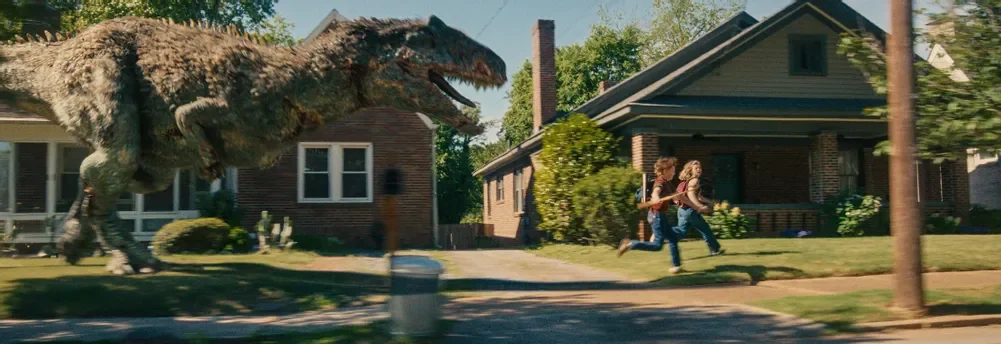
Perhaps the biggest selling point of Predator: Badlands is the creature design—not so much that of Dek, who looks basically like the many other Yautja we’ve already seen, but that of the many alien species on the planet Genna, from carnivorous plants to animals, to even razor sharp blades of grass. This film is also packed with visual effects, and while I can’t say the CGI particularly wowed me, it was pretty decent. At the very least, unlike far too many other CGI-heavy films, it doesn’t look distractingly artificial.

Badlands has further twists that are not necessarily had to see coming, but at least it’s an exciting ride while it’s in motion. Dek and Thia befriend a small, monkey-like creature that later proves to be an important detail on which the plot turns; Thia names him “Bud” and he’s weirdly cute, like a cross between a chimp and a bulldog. To Badland’s credit, a great deal of impressive work went into its production, from the creation of an entire language for the Yautja by linguist Britton Watkins, to very believable animal behaviors specific to different fictional species. I’d have liked a bit more originality in the story beyond “twists” that are just rearrangements of well-trodden ideas from other films, but anyone with a thing for sci-fi action films with detailed world building is going to have a good time here.

Teamwork makes the dream work in Predator: Badlands.

Overall: B

BUGONIA

Directing: B+
Acting: A-
Writing: B
Cinematography: B+
Editing: A-

If director Yorgos Lanthimos can be counted on anything, it’s that he’ll make a film with something in it that is very, very weird. It can be an actor, it can be a peculiar performance, it can be the entire story, or it can be a specific turn of the story. In Bugonia, it is very much the entire story, and a specific turn of the story.

In fact, Bugonia takes a turn toward the end that is truly wild, even by Lanthimos’s standard. It’s very easy to feel ambivalent about, the way the script suddenly leans into it, in a narrative space that many will quite reasonably declare is either corny or outright dumb—or at the very least, somewhere in the space between the two. There are some costume designs that are definitely . . . a choice. I found myself with a strange sort of appreciation for it, at least for the huge swing of it all, but I’d also have to admit the movie might have been elevated with this particular sequence removed entirely. That said, there follows a kind of montage that is both beautifully executed and deeply unsettling.

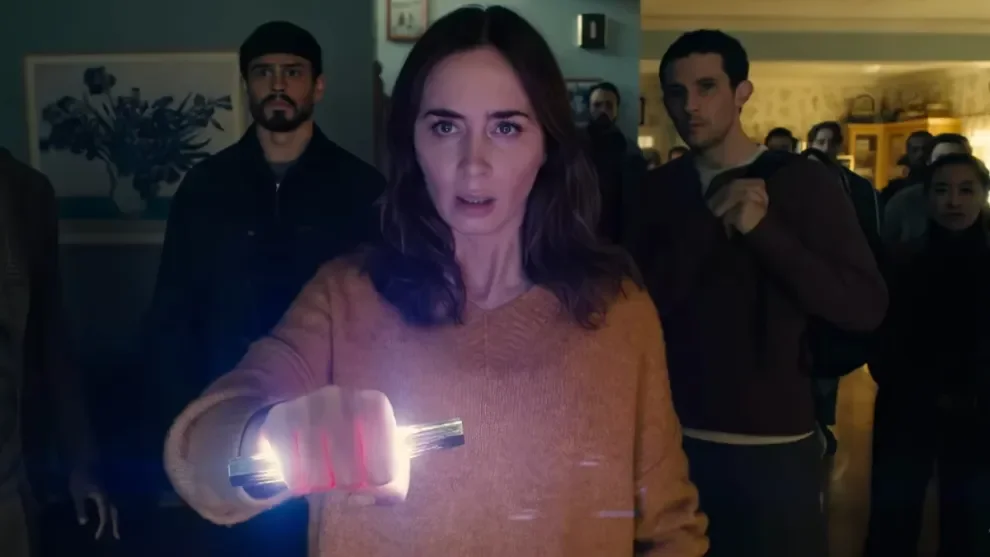
Emma Stone, now having starred in the last four Yorgos Lanthimos films in a row, plays Michelle, the CEO of a pharmaceutical company. Emma is abducted by Teddy (a stellar Jesse Plemons) and his intellectually disabled cousin, Don (Aidan Delbis), who are convinced Michelle is a disguised alien intent on destroying the planet. Very much to put a finer point on it, the pharmaceutical company Michelle runs is very much an active part of destroying the planet—not to mention a key part of treating Teddy’s ill mother (Alicia Silverstone, a strange casting choice considering the character is almost never conscious). Teddy also keeps bees, and we get many discussions about collapsing bee colonies while Michelle is tied to a bed in Teddy’s basement.

I can’t decide how I feel about the choice to make Don an intellectually disable character. I still can’t see the point of it, except maybe that it makes him easily manipulated by Teddy. Aiden Delbis, in a strong feature film debut, is reportedly on the autism spectrum, which at least lends the performance some authenticity. Somewhat ironically, Delbis apparently has no strong feeling about whether autistic characters should be played by autistic actors. None of this provides any answer as to what the purpose of making Don intellectually disabled was, but at least it gave an actor with some similarities to the character some work, I guess.

I went into Bugonia eager to find out whether Michelle really turns out to be an alien or not, which I suspect was the intent. Given Lanthimos’s history of wildly unpredictable films, it was clear he could go either way with this—or even end it with pointed ambiguity. He does make a choice about this, and the surprise about it is how hard he leans into that choice once it’s made clear. You might even leave the theater thinking: Okay, that was a little much.

One of Lanthimos’s many talents is to present a film with no particularly sympathetic characters and still make it compelling. Michelle, human or not, embodies the soullessness of a pharmaceutical CEO with subtle precision. Teddy is a grubby-looking conspiracy theorist few people would take seriously, which of course can be a huge mistake, given the circumstance—for instance, if he has you tied up in his basement. Michelle spends a lot of time trying to reason with him, and it’s clear very quickly that this is not a winning approach. All that said, Don is the one character who is sympathetic, and who even has any clarity of conscience—again, a dubious use of a character who is intellectually challenged.

In spite of all that, I was locked in with Bugonia, thanks to performances that very much elevate the material, which itself isn’t particularly bad either—it’s just not up to Lanthimos’s highest standards. It’s worth noting that Lanthimos did not write this script, which was written by Will Tracy (The Menu), based on the 2003 South Korean comedy horror-thriller Save the Green Planet!, written by Jang Joon-hwan. I can’t say there’s a huge amount of comedy in Bugonia; there are some funny moments, and a couple of laughs that are elicited by chock more than humor. This film is certainly twisted in a recognizably Lanthimosian way, which is something I can always appreciate.

To be sure, Yorgos Lanthimos is not for everyone. His films can be very entertaining, or they can be memorably unsettling. Until the very last scenes in Bugonia, it’s more tense than anything, with the anticipation of potential violence at all times—which sometimes happens, and sometimes doesn’t. In the end this script gets into the violent and self-destructive nature of humanity that’s pretty on the nose, so again, your mileage may vary. I have a lot of love or Lanthimos, so in spite of some clear flaws, I got a lot of mileage out of it.

Is she or isn’t she? That is the question.

Overall: B+

THE FANTASTIC FOUR: FIRST STEPS

Directing: B-
Acting: B
Writing: C+
Cinematography: B
Editing: B
Special Effects: B-

The Marvel Cinematic Universe has clearly aged past its prime. It feels a little like the “cinematic universe” equivalent of a middle-aged guy prone to reminiscing about his glory days as a high school football star.

To be fair, I never fully locked into the “MCU” project the way millions of fans did. I am a fan of movies, not of genre, which means I can appreciate the special ones that break the mold (Black Panther, Logan, even Thor: Ragnarok) but can easily forget about the rest—and there is a lot of the rest. This new Fantastic Four movie isn’t seriously bad, even if it is still definitively dumb; it’s merely average at best, which makes it slip right into that same steady stream of superhero mediocrity.

I can’t help but compare this film to Superman, the DC competitor also currently in theaters, and although I have ultimately decided The Fantastic Four: First Steps is better, the difference is negligible. The thing is, there were things I hated more about Superman (it’s mind-numbingly stupid script) but there were also things liked a lot more about Superman (its far better casting; Krypto the Superdog, overused as he was). Its worse qualities tip the scale, which is perhaps ironic because at least Superman kept me awake. I nodded off multiple times during The Fantastic Four.

Some of my issues with this movie, admittedly, are fully justifiable inclusions in a movie based on a superhero comic book—I’m just not into these things, this idea that the heroes are for all intents and purposes gods, and therefore any presentation of stakes is fully an illusion. This is the case whether it’s in a comic book or a movie, and is perhaps a big reason I never got into comic books. I never get invested in the heroes’ success because their success is guaranteed—particularly in the first in an expected line of sequels.

I am also aware that The Fantastic Four is a bit notorious as a franchise, in that this film is the fourth—nice coincidence there—attempt at cinematic adaptation, at least if you count the 1994 production that never got released theatrically but can now be found online. A second attempt that did get theatrical release, and even did well at the box office (to the tune of $333 million worldwide), came out in 2005, with a nearly-as successful sequel in 2007. The second reboot, starring Miles Teller, Michael B. Jordan, Kate Mara, and Jamie Bell, tanked both critically (27 out of 100 on MetaCritic) and commercially ($56 million domestic). I never saw any one of these movies because I couldn’t be bothered to care, but I certainly know that none of them were regarded as a particularly good adaptation.

All that is to say: there was a lot riding on The Fantastic Four: First Steps, both with fans of this particular group of superheroes and with the future of Marvel Studios broadly. This is film is performing relatively well, although that success is mitigated by a $200 million budget—and this, frankly, is one of my problems with the movie. Why am I not actually seeing that money put to use, or at least put to use well, onscreen? James Cameron spent $400 million to make Avatar: The Way of Water, but that was money well spent, with visual effects so astonishing they largely made up for a frustratingly simpleminded script. The problem with movies like both Superman 2025 and The Fantastic Four: First Steps is that they have both the money and the means, and it still feels like everyone is phoning it in.

This is nitpicky, but I don’t care: the Fantastic Four have a car that flies. There is a scene in this movie where a couple of them rush in this car to the scene of some mayhem, and the car quickly stops in the air in time to skid on the ground a couple of feet, and the occupants pop right out and just keep walking like the badasses they think they are. There’s no fumbling, no recalibrating their balance, no visual acknowledgement of the physics of sudden changes in velocity—in short, it looks unnatural, because it is: bodies would never move this way, except in the results of rushed VFX. And it’s distracting when, even in a fantastical world like this, something looks straight up fake when it is clearly not meant to. There are so many things that look like this in effects-heavy movies these days, and within ten years people will rewatch this stuff and feel the same effects as we do today when watching stop-motion effects in 1930s films. Except in this case, it’s not because of any limitation of technology—it’s because people can’t be bothered to take the time to get it right.

Granted, The Fantastic Four: First Steps would not be much improved even if the effects were perfected. I found Julia Garner as the Silver Surfer to be the most compelling character—also referred to as “the herald of Galactus,” she scouts planets for the godlike Galactus (Ralph Ineson) to consume, in exchange for him sparing her home planet. Garner does a lot with a part that is limited both in screen time and in physicality: the Silver Surfer sports a body encased in silver, making her look rather like the villain from Terminator 2: Judgment Day (this may be a reference lost on you if you are younger than 30). The entire plot surrounds the Fantastic Four’s efforts to stop Galactus, and get the Silver Surfer out of their way of doing so, but in broad execution it’s all packed with so many lapses in logic that I lost count.

There’s also a subplot involving “Mole Man,” as played by Paul Walter Hauser, a talented actor who is wasted in this bit part about a rival to the Fantastic Four who ultimately comes to their aid by allowing all of New York City to evacuate—not to some area outside the city, that would make too much sense, but to his underground city of “Subterranea.” This happens after all but one of the “bridges” to another dimension around the world are destroyed, which is why Galactus must be lured to the only one still standing, conveniently for this plot, right in Times Square. And this is the only reason “Subterranea” factors into the plot at all.

As for the Fantastic Four themselves, and the actors who play them, this is a bit of a mixed bag. The overexposure of Pedro Pascal continues, as he is cast as Reed Richards, “Mister Fantastic,” clearly coded as the “head of the family,” and meant to be some wild genius, as he writes equations on chalkboards that I am sure look like gibberish to any actual genius. Also, for a genius, he sure spends a lot of the movie befuddled about what to do. I can’t say he has the greatest chemistry with Vanessa Kirby, who shines as rival to Ethan Hunt in the Mission: Impossible movies, but here adopts an American accent for Sue Storm, the “Invisible Woman,” a part that basically exists so she can give birth in space, to a baby with as-yet-unknown superpowers (but Galactus sure wants him!). Joseph Quinn has arguably the most charisma out of the bunch, as Sue’s brother, Johnny Storm, “The Human Torch.” And Ebon Moss-Bachrach all but disappears as a personality inside the CGI suit of Reed’s best friend Ben Grimm, “The Thing.”

Much is made of Reed’s genius invention of teleportation, which he demonstrates successfully with an egg and then explains doing the same with Planet Earth should be just as easy because the difference is just “a matter of scale.” The problem is, even though it’s immediately made clear that this cast of characters exist in a different universe than ours, Reed’s teleportation scheme never explains exactly where he’ll teleport Earth to, and spoiler alert, Earth never gets teleported at all by the end of this movie. And let’s not even get started on this movie’s countless inconsistencies of scale. Except, perhaps, for this question: if Galactus is meant to consume an entire planet, why is he the size of a skyscraper?

Much like Krypto from Superman, I did enjoy H.E.R.B.I.E. (“Humanoid Experimental Robot B-Type Integrated Electronics”), Reed’s lovable robot assistant. And unlike Krypto, H.E.R.B.I.E. is not overused. Indeed, one of the better things about The Fantastic Four: First Steps is its successful sidestepping of self-indulgence: mercifully, this film doesn’t even clock in at a full two hours (its runtime is 114 minutes). Just because it’s not overstuffed doesn’t mean it’s not still a bit of a mess—a judgement I make fully aware that it’s largely informed by how tired I am of superhero-movie tropes. There have just been so many of these superhero moves over so many decades now, I truly long to see ones that stand apart with narrative innovation. Pinning any hopes for such a thing with this movie would be a mistake.

I don’t know, maybe try stepping in a different direction.

Overall: B-

SUPERMAN

Directing: C+
Acting: B
Writing: C
Cinematography: B-
Editing: C+
Special Effects: C+

About three quarters of the way through James Gunn’s Superman, I could no longer think of anything but this: Oh my god, this movie is dumb. But I am trying to lead with positivity!

There’s a few things I enjoyed about Superman, the seventh live action film with Superman as the top-billed character since 1978 (and I’m not even counting Batman v Superman: Dawn of Justice—because Batman got top billing). David Corenswet is well cast as the title character this time out, and when Gunn actually slows down long enough for us to get real character moments, the man is brimming with charisma and screen presence. He also has chemistry with Rachel Brosnahan (The Marvelous Mrs. Maisel), who works well as the scrappy reporter from the Daily Planet, because even in Gunn’s universe people apparently still care about journalism.

This many movies in—indeed, this many reboots in (I suppose this would make the third?)—it’s commendable that the story here doesn’t bother with Superman’s origin story. A series of opening titles inform us of the state of the world we are entering into, which includes “metahumans”—other people with superpowers, though Superman is the most powerful among them. I wasn’t crazy about yet another superhero movie with a supporting cast of second-tier superheroes, especially given that we never get any real chance to know “Mister Terrific” (Edi Gathegi), Green Lantern (Nathan Fillion), Hawkgirl (Isabela Merced), or Metamorpho (Anthony Carrigan) as characters. I understand these are all actual characters from DC Comics, but do we need to overstuff a 129-minute feature film with them? But! I did kind of love that, in this Superman movie, Lois Lane has full knowledge that Clark Kent is Superman, they are actively dating, and they even have some minor relationship problems. That is a refreshing change from how we usually see their relationship in these movies.

On the short list of things I actually liked about this movie, I have saved the best for last: Superman’s superdog, Krypto, gets extensive screen time. In fact, we meet him in the opening sequence, right after the title cards have informed us that Superman has just lost a battle for the first time. We already saw this in the very well-cut teaser trailer, in which Krypto drags Superman through the Antarctic snow back to his Fortress of Solitude. And I will say this to the dog lovers out there: if you love dogs, you are going to love Krypto.

Now, it should also be noted that Krypto is mostly an obvious CGI dog, something that is a bit of a pet peeve of mine. CGI doesn’t have to be obvious and it never has—Jurassic Park taught us that 32 years ago. You have the tools and you clearly have the budget. Maybe do it right? On the other hand, obvious or not, Krypto is adorable as hell, and possibly the best thing in Superman, which is otherwise far too busy and overstuffed, stupidly convoluted, and exhaustingly ridiculous, even by regular Superman standards.

Here’s where the casting wasn’t as inspired as I thought it was: Nicholas Hoult clearly wants to be an iconic villain as Lex Luthor, but, much like this film overall, he takes a giant swing—and then misses by a wide margin. This is hardly entirely Hoult’s fault, as he’s largely shackled by how bonkers-stupid James Gunn’s script is. Lex Luthor is supposed to be a mad genius, fine. But apparently this movie has to up the ante on that idea to such a degree that Luthor has managed to invent a means for traveling in and out of a “pocket universe” of his own creation. What? If I never hear that phrase again it'll be too soon. This level of idiocy leaves me feeling deeply wistful for the days of Gene Hackman, whose Lex Luthor had a delicious understanding of sarcasm and wit. Nicholas Hoult’s Lex Luthor only understands cartoonish obsession.

I hate to give a piece of shit like Kevin Spacey any credit, but he was the only other Lex Luthor to come close to the spirit of Gene Hackman, when he appeared as the character in Superman Returns in 2006. That film remains the only halfway decent Superman movie since the first two Christopher Reeve films, and that one was released 19 years ago. In my review of that film, I wrote about the awkward challenge of marrying Superman’s old-school wholesome sensibility with the cynical sensibility of the 21st Century. In this new Superman, Gunn tries hard to update these characters for the current era, but sometimes it just doesn’t work. This film is rated PG-13, probably exclusively because of how frequently characters are swearing, but in a DC universe dominated by Superman, they just come across like people swearing to sound cool, which of course falls flat.

I wish I could say that at least this Superman is better than Zack Snyder’s 2016 film Man of Steel, but alas, it is not. These films just have different reasons for being cinematic beacons of big-budget mediocrity. James Gunn makes an attempt at infusing his film with some gravitas, even going so far as designing the credits in the style of those from the Richard Donner films. All this does is remind us how much better those films are—they are now very dated, to be sure, but they still manage to capture a sense of wonder that modern superhero films, and certainly those based on DC comics, lack. The Superman we get in 2025 falls victim to the same claptrap nine out of ten other superhero movies do, sagging under the weight of their own bloat, and throwing in stakes so ridiculous as to become meaningless. Other movies feature sequences wherein the villains threaten the existence of either the entire city or the entire universe—here, we get a “dimensional tear” that threatens both at once! And Lex Luthror is such an evil genius he can stop or start it with a bank of computers!

Why do filmmakers think they can improve overplayed iconic character stories by making them pointlessly convoluted with what amounts to magical nonsense? I’d love to see a new Superman that is simple but clever, inspired but straightforward. Or, I could just go watch the Richard Donner films again. The tagline for the 1978 film, which ushered in the superhero blockbuster era, was You’ll believe a man can fly. Nearly five decades later, we’ve seen so many men fly that our eyes have glazed over. The tagline for this new film might as well have been You won’t believe a man can revive a franchise.

One of the few memorable quotes in this Superman is when a guy on the news says, “The one thing liberals and conservatives can agree on is that Lex Luthor sucks.” I wish I could say that we can all agree that this Superman sucks, but conservatives are already priming liberals to defend it. And to be fair, “sucks” is a bit strong of a word. I suppose I could try to be like the cool kids these days and just say that James Gunn’s Superman is “mid.” It’s only David Corenswet, Rachel Brosnahan, and Krypto that even raise it to that level.

If there is any reason to see Superman it’s Krypto the superdog. And I still don’t particularly recommend it.

Overall: C+

THUNDERBOLTS*

Directing: B
Acting: B+
Writing: B
Cinematography: B+
Editing: B
Special Effects: B

Thunderbolts*, like countless other Marvel Studios films before it, is both overlong and overstuffed, trying to do too much, because even after years of being exhausted by it, these movies still expect to trade on audiences’ intricate knowledge of every other wild thing that has ever happened in now-33 films in the Marvel Cinematic Universe. Who has time for that shit?

Furthermore, there are no aliens in this movie. I only mention this because there are aliens in other MCU movies, and this one has a very brief, single line that references “when the aliens came.” But what if you’re watching this movie and you’ve never seen any of those other, “alien” ones? You’d just be left thinking: Huh?

None of the original Avengers are in Thunderbolts* either (spoiler alert!). What happened to them all, anyway? How many years ago was that? Some sacrificed themselves, I think? Some simply retired, like, to a farm or something? I honestly don’t remember, and it’s because frankly I don’t care. I’m just over here waiting for another one of the rare MCU films that actually manages a successful pivot, like Black Panther or Logan. I even liked Black Widow more than I expected to—even if it’s not quite in the same league as the aforementioned films—which is the very reason I found myself interested in Thunderbolts*, which serves as a quasi-sequel. Florence Pugh and David Harbour both return as Yelena Belva and Alexei Shastakov (“The Red Guardian”), and they are delightful characters.

They do get a bit darker here, as the themes of this film, as directed by Jake Shreier, takes a bit of a left turn into metaphors for mental health and depression. As someone who does not live with depression, I cannot truly speak to how successful the film is at this. It’s easy to imagine some people feeling like it trivializes their experiences and their struggles. Others might find it makes them feel seen. The inevitable climactic battle here takes place inside the mind of a supervillain who is a huge danger to himself and the world, but is also deeply empathetic—an unusual choice that I appreciate. Even when it doesn’t fully work, I can always respect a big swing.

Of course, the plotting also gets unnecessarily convoluted. But, if it results in by far the biggest role in an MCU film by Julia Louis-Dreyfus as the perennially dubious CIA Director Valentina Allegra de Fontaine, I’m all for it. Thunderbolts* could have taken a few action sequence cuts and added more of Valentina. Nobody would have complained.

Not that I have any major complaints about Thunderbolts* as it stands. This ragtag team of misfit criminals-turned-heroes, which along with Yelena and Alexei, includes Bucky Barnes (Sebastian Stan), John Walker (Wyatt Russell), Antonia Dreykov (Olga Kurylenko), Ava Starr (Hannah John-Kamen), and maybe also Robert Reynolds (Lewis Pullman), have chemistry. They get conveniently thrown together when Valentina sends them all to assassinate each other in a giant vault on top of a mountain where she plans to incinerate all the evidence of a shady operation which, naturally, ultimately produces our supervillain.

As for the supervillain, comic book readers will likely recall why he is referred to as both “Sentry” and “The Void.” It’s easy to feel ambivalent about this character, and it’s difficult to gauge how deliberately Schreier makes that part of the point. I will say this: after countless superhero movies following the exact same beats over and over, in which a CGI-laden mega-battle occurs to save the entire planet or the entire galaxy or hell, even the universe (how about multiverses!), it’s refreshing to see one of these movies dial back the stakes and ground them, even if in this case they are largely wrapped in uncertainly executed metaphorical psychology.

Whatever turns it takes, Thunderbolts* is consistently and undeniably fun. It’s a bit drab visually, lots of shades of grey in its color palate (perhaps a deliberate choice for characters who struggle between inner light and inner darkness), and the visual effects are serviceable. Black Widow was a better movie, and the absence of Scarlett Johansson is keenly felt, but it’s also nice to spend more time with a couple of other great characters is introduced to us. The new characters feel a bit expendable overall, really, but it’s the presence of the special ones that at least slightly tips the scales in its favor.

*Made you look!

Overall: B

THE ASSESSMENT

Directing: B+
Acting: B+
Writing: B
Cinematography: B
Editing: B

There is so much to unpack, something so provocative at the core of The Assessment, it’s difficult not to recommend for the conversation potential alone. There’s also something in the execution, however; something in the details—well: I have notes.

In the world of this film, the focus is on a married couple, Mia and Aaryan (Elizabeth Olsen and Himesh Patel), living in a near-future society preserved under a climate controlled dome (rendered only in subtle ripples briefly shown in the daylight sky, a clever effect). This society is a deeply oppressive one, with strict laws of population control. The inference here is that these are citizens giving up freedoms in exchange for living well—a theme well mined in cinema, but here in a hyperspecific context. Mia and Aaryan are visited by Virginia, an “Assessor” (Alicia Vikander), who stays with them for seven days to determine whether they are fit to have a child.

This is very much the focus of The Assessment, the future world in which they live simply being the context. Virginia is an uncomfortable presence from the start, assessing “all aspects” of their relationship, including hovering outside their open bedroom door during oral sex. Mia and Aaryan are so desperate to have a child, they suck it up (so to speak) and perform their sex acts even with the knowledge of a stern observor.

By the next day, Virginia wakes up, sits at the breakfast table, and is immediately acting like a child. It becomes instantly clear that Virginia is testing Mia and Aaryan’s parenting skills by doing this—breaking her plastic spoon on the table, flinging food from her spoon onto the would-be parents. The behavior, in this context, occupies a nebulous space between rational and psychotic. And with only a couple of pointed exceptions, Virginia behaves like a small child for the rest of the week, testing how the would-be parents handle it.

I was pretty locked in with The Assessment until this turn, which happens fairly early on—day two of the Assessment, to be exact. I pretty quickly lost my own patience with Virginia and her antics, especially as they became increasingly bizarre, reckless, and dangerous—even to herself, that being very much the point notwithstanding. Mia and Aaryan are so nervous about behaving correctly in the presence of the Assessor, this being the one chance “The State” will give them for this, that they rarely question the lapses in logic, and do even less as the week wears on.

On the one hand, there could be much discussion among viewers of how fit Mia and Aaryan are as parents regardless: psychotic or not, Virginia gives them multiple chances to make mistakes but then learn from them. On the other hand, the only way to truly test their fitness would be to put an actual child in their care. Virginia herself is a grown woman, merely acting like a child, but it’s not possible to just shut out the fact that she knows better than a child. There are other, far more practical considerations, like the fact that an actual child of which Virginia is ostensibly embodying would weigh far less than her. Aaryan has a bad back, and after an outing to the beach near their house, Virginia insists he give her a piggyback ride, literally until he has to put her down because his back can’t take it anymore. In all likelihood, he’d have managed to carry an actual child the entire way. These sorts of details, which to me were glaringly obvious, are never acknowledged by a single character in the film, which is frustrating.

The Assessment is written by a team of three writers, and if they had really taken the time needed, they would have understood that a premise this specific yet complex needs to account for all potential plot holes. On this particular front, they were apparently not up to the task.

There is still much to make The Assessment worth watching, though. In the film’s best sequence, Mia and Aaryan are cornered into hosting a dinner party. The guests include a man Mia once had an affair with and his current girlfriend; Aaryan’s not-very-maternal mother; a lesbian couple composed of a work friend of Aaryan’s, her wife, and their own adoelscent child; and, mostly delightfully, an older woman named Evie, played by the perennially underrated Minnie Driver. Driver, an undeniably beautiful woman, plays a character who reveals herself to be 153 years old—we learn of a medication all these citizens can take to stop the effects of aging. This detail is part of the giant exposition dump that this dinner party doubles as, but specifically a long monologue by Evie, who shares some of the history of “old world” (later revealed to be any place outside this climate dome) and memory of how people used to tear each other apart “over scraps.”

Evie has no faith whatsoever in the sustainability of this new society, and openly regards it with contempt, even as she sits from an obvious position of privilege borne directly from it. Minnie Driver’s performance is incredible in this sequence, easily the best thing in the movie, both because of her innate talents as an entertainer—and her performance is very entertaining, offering most of what little humor this film contains—and because of how deftly she executes such exposition while we barely recognize that as her character’s sole purpose.

As for Mia and Aaryan, Elizabeth Olsen and Hamish Patel are also great, and provide nuanced explorations of the many ways the Assessment quite deliberately tests the limits of their relationship. Mia tends to many beloved species of plants in a greenhouse; Aaryan is a designer of AI “virtual pets” so advanced that he’s working on textured surfaces that can actually be felt to the touch. The latter stuff brings up a whole lot about the potentials and dangers of AI that The Assessment never fully explores—it is far more interested in the concept of regulated procreation in a bleak future—but also provides some pretty indelible imagery. Only this movie could depict something shocking with a human baby, I won’t spoil exactly what, and have it still be okay—because even the characters understand it to be a digital construction.

Aside from Minnie Driver, Alicia Vikander is ultimately the MVP of The Assessment, both in spite of and because of how contemptible Virginia is as a character. I spent most of the movie hoping Mia and Aaryan would be pushed to their breaking point, and they straight up murder her. On the other hand, a twist comes near the end that, while fundamentally disappointing on a narrative level, also manages to cultivate some empathy for Virginia. Empathizing with her did not make her less intolerable to me overall, however.

The Assessment is both imperfect and deliciously provocative, the kind of movie you love to talk about. It has some potential that it doesn’t quite realize, but there’s still something deeply satisfying about having seen it.

Hey maybe they do deserve to be judged.

Overall: B

MICKEY 17

Directing: B
Acting: A-
Writing: B-
Cinematography: B
Editing: B+
Special Effects: B+

It was always going to be a challenge for Bong Joon Ho to follow up his 2019 film Parasite, which turned out to be a watershed moment in both cinema and Oscar history. This is a guy with a penchant for genre mashing, and actually never more so than in Parasite—but no one would expect him to match that, and it makes sense that he would return to his oddball science fiction sensibilities with Mickey 17, a movie with neither hopes nor aspirations for Oscar glory. This is a movie just made by a bunch of people who are clearly having fun.

None more so than its star, Robert Pattinson, who plays two parts: Mickey 17 and Mickey 18. Technically he plays 18 parts, all of them the same person: Mickey has signed up to be an “expendable,” offering his body for fatal research on a planet marked for colonization, his body “reprinted” every time he dies, each time with his memory restored. Bong, who co-wrote the script, wisely doesn’t even try to explain what kind of science could make this possible, because it doesn’t matter, not pertinent to the story being told. This is just used as a tool for exploring other things that are on his mind.

In this future world, it has been declared unethical to allow “multiples” to exist at the same time: a person can only be reprinted after death. After we are taken through a pre-credits montage of Mickey’s first through 16th bodies, an unexpected twist of fate has 17 surviving when everyone assumes he has died, thereby printing 18 without realizing 17 is not really dead. These two characters are the leads in Mickey 17, and Pattison gives a performance that is unique, delightful, and illustrative of a breadth of talent wider than many realize.

Pattinson and Kristen Stewart have followed similar career paths after the Twilight series made them young movie stars—ironically, in both cases with objectively unremarkable performances (in Stewart’s case, that’s putting it diplomatically) in that subpar vampire fantasy series. In the years since, both of them have taken on far more interesting roles that have revealed surprising depths of talent. It would be fascinating to see them paired in a film again, but in a film that was actually good.

In the meantime, we can get a kick out of Mickey 17 in Mickey 17, a copy of a copy of a copy who is somehow frightened and insecure. When he meets Mickey 18, he discovers 18 to be very much over it, much more aggressive and even prone to revenge. You might even say nihilistic. I thought a lot about what might account for such drastic change in personality in the exact same person, and could never quite come up with anything. Mickey 17 is clearly fatigued by the memory of 16 different deaths. There is a fascinating thing to think about, though: with Mickey 17 still alive, presumably Mickey 18 can only be revived with the memories of Mickey 16, which means this is the first point at which two different versions of Mickey’s experience diverge.

This is much different from playing twins, and is more akin to playing clones, who are produced as people of the exact same age. It’s a deeply fascinating premise that Bong really doesn’t dig into deeply enough. The closest is when Mickey’s girlfriend, Nasha (Naomi Ackie), delights in the attempt at sleeping with two Mickeys at once. Mickey 17 is understandably baffled, and Mickey 18 is into it—even at one point running his fingers through 17’s hair. The scene gets interrupted, but I found myself relating to all three people involved. Who wouldn’t want to sleep with two Robert Pattinsons at once? And even though he’s not so much “hunky” as possessing a kind of stringy handsomeness, if I had Pattinson’s body I’d sleep with myself too.

But I haven’t even gotten to the “creepers,” the alien life on this planet so named by the very Trumpian character Kenneth Marshall (Mark Ruffalo, mugging in oversized teeth) and his wife, Ylfa (Toni Collette, stealing scenes as usual). These creatures have a vague resemblance to the “super pigs” in Bong’s 2017 film Ojka, only this time they’re closer to a cross between a muskox and a giant caterpillar. One of several nitpicky criticisms I have of Mickey 17 is how the “creepers” are the single form of life we see on the planet Niflheim. What sustains them? What do they eat? How do they thrive in a vacuum devoid of biodiversity? So far as we can tell, Nilfheim features only ice, and these creepers.

They do prove to be surprisingly intelligent, and a “translation device” gets introduced that, plot-wise, is a little too easy and convenient. Still, Bong manages to shoehorn in a lot of undeniably liberal talking points about colonization, and who is really an “alien.” And don’t get me wrong, of course I appreciate that, but much of it is a bit too on the nose.

Mickey 17 is undeniably entertaining, but also a bit too simple in its storytelling given the premise and its setting. The creepers are all impressively rendered, but I would have liked a bit more of the dazzle promised by this film’s marketing—either in terms of the visual effects, which lack color with its endless focus on white ice and snow contrasted with the metal and browns of the spaceship or the creeper creatures, or in terms of its plot turns. There’s not even as much action in this movie as you might expect. To be fair, it still has oddball sensibility to spare, which at the very least we can always expect of a Bong Joon Ho film. This is a movie that did not quite meet the excitement of my expectations, but the more I think about it, the more I think it will likely work well on rewatch.

Robert Pattinson doubles our pleasure in Mickey 17.

Overall: B

COMPANION

Directing: B
Acting: B
Writing: B
Cinematography: B
Editing: B

Companion is nothing if not consistent. Everything about it comes together at the same frequency, which I suppose might be best characterized as adequate fun. It’s better than average, but I’d hardly call it exceptional. It’s a science fiction thriller with nothing original to say but with a satisfying economy of storytelling. Writer-director Drew Hancock can be credited with at least that much.

If you want to keep your film budget capped at $10 million, just set the story in a secluded mansion in the woods, limiting the primary characters to five. There’s a few interactions with extraneous minor characters, but in this entire film, we only ever see ten people onscreen. A good majority of the 97-minute runtime is focused on the five people staying for the weekend in the house: the rich Russian who owns the place, Sergey (Rupert Friend, really laying on the Russian accent thick); his young trophy wife, Kat (Megan Sure); and the two couples visiting: Josh and Iris (Jack Quaid and Sophie Thatcher), and Eli and Patrick (Harvey Guillén and Lukas Gage). Side note: Guillén and Gage are both gay, and both have been cast in multiple roles as gay characters, which is a nice bit of consistent representation.

As for the story in Companion, here lies a dilemma. This is the kind of movie that is very difficult to market in a way that both gets people to buy tickets and avoids revealing too much. Ditto writing a review about it. I go to the movies multiple times a week, which means I sat through the initial cut of Companion’s trailer, with its caginess and vague hints at what’s going on in the story, countless times—never feeling especially compelled to go see it. Then a second cut of the trailer was released, and suddenly I thought: oh, I do want to see that. And yet, the details revealed in the new trailer certainly robbed me of some of the joy I’d have gotten had I come into it knowing far less.

It does make me wonder if I’d have been more immediately impressed with Companion had I known less about it going in. This film is written and cut in such a way that, for the first quarter or so of its runtime, all you know is this small group of people has come to spend a weekend together—and, for some reason, Josh’s friends all regard Iris with an odd reticence and borderline suspicion. Something’s up, but we’re not meant to know what, until the inevitable turn that reveals what’s really going on—and then the story can unfold from there.

The script is arguably fairly predictable either way, but it is especially so when you go in knowing what the basic premise is. I’m not certain I would have thought this movie was better had I not known, but I almost certainly would have had more fun. And I did find this movie pretty fun regardless.

With all that in mind, I am taking great pains not to reveal much about this movie at all, even though there’s a lot more I could say about it if I did. I will say that the casting is interesting, for different reasons all around, but especially Sophie Thatcher, an undeniably beautiful young woman with minor physical imperfections that get underscored by the nature of the character she’s playing. Also, Companion has a moment or two of suspense but is never particularly scary, but has a couple moments of graphic violence. And the sparing use of such moments does increase their inpact.

So here’s what it all comes down to: Companion is a fun diversion, if not one you absolutely need to see in theaters. I would recommend watching it on whatever streamer it later winds up on, though (it’s a Warner Bros. Pictures film, so, probably on Max). Just make a note of this title, don’t learn anything more about the story, and watch it blind when you get the chance. You’ll have a good time.

It’s unexceptional but fun!

Overall: B