TOY STORY 5

Directing: B
Acting: B+
Writing: B
Cinematography: B+
Editing: B
Special Effects: B+

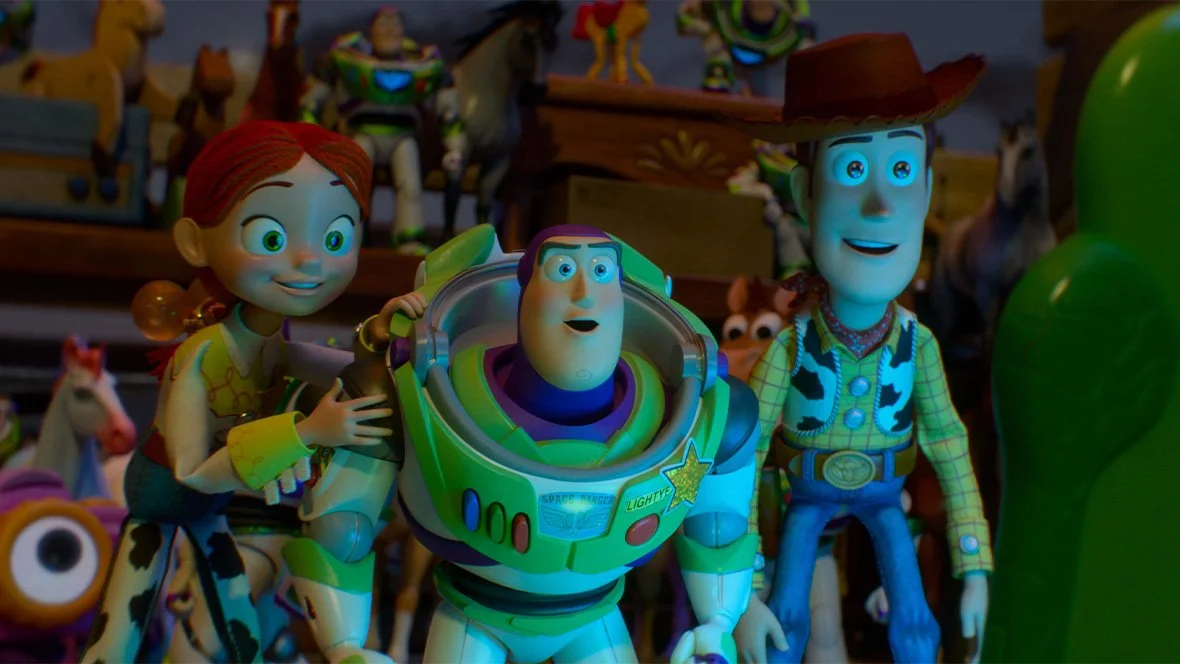
Do we really need five of these Toy Story movies? I suppose you could say Disney and Pixar Animation Studios has made each one for a different generation—at least since Toy Story 2, which came out four years after the 1995 original that ushered in a new era of computer-animated movies that changed animated feature filmmaking forever. The thing is, though, that movie was also incredibly inventive on visual, stylistic and narrative levels, and it set the bar incredibly high for Pixar, which it met for nearly two decades thereafter. Toy Story 2 in 1999 was shockingly on par with its predecessor, and then, eleven years later, Toy Story 3 was the first and only film I’ve ever reviewed that was both the third in a series and the best film in the year it was released (2010). It was yet another nine years later when Toy Story 4 (2019) was released, and although it was highly acclaimed, I found it to be fun but slightly overrated, the first in this franchise not quite up to the task of justifying its own existence.

But, let’s say you were 5 years old when the first Toy Story came out. (Oh me? I was 19.) You would have been 9 when Toy Story 2 was released; 20 when Toy Story 3 was released; 29 with Toy Story 4; and now 36 with Toy Story 5. Kids have literally grown up with these movies, are are old enough now to have children of their own with the ability to understand some of the in-jokes. Toy Story, along with Pixar Animation Studios itself, has a history spanning over three decades. And while I can’t say it’s a bad thing per se that they keep returning to this particular well, I do find myself wishing they would get back to more original material, like they did far more consistently in their first couple of decades. (I can tell you this much: all of these movies are far better than the 2022 misfire Lightyear.)

Each Toy Story movie adds new toy characters to its cast, while struggling to retain the core cast from every movie since the others were introduced, always running the risk of being overstuffed. It’s been so long now since the first installment that some of the voice actors have died: Jeff Bergman has replaced Don Rickles as Mr. Potato Head; Blake Clark has replaced Jim Varney as Slinky Dog; Anna Vocino has replaced Estelle Harris as Mrs. Potato Head. Some of these iconic voices from the earlier films have been replaced by what sound like generic replacements, and unfortunately that sort of fits into the direction these last couple of films have been leaning.

Does any of that mean I didn’t still enjoy it? Of course not! I might even go so far as to say I liked 5 slightly better than 4, even if I wasn’t quite as impressed with that looks like pretty standard Pixar visual renderings these days. This one features a delightful subplot, which the narrative switches back and forth from, of about 50 Buzz Lightyears spilling from a shipping container crashed on a deserted island—this is, in fact, how the film opens. All of these Lightyears, convinced they are actually Buzz and having no idea they are toys, until they go on a quest across the sea that ultimately has them running across our regular heroes in the middle of their own story.

These movies have always been cram packed with ideas, with a lot to say and with only slightly varying levels of success. They all touch on how our perceptions of prized possessions change as we grow up, and this is a franchise that has always explored the question of how that might affect toys themselves. Toy Story 5, co-directed and co-written by McKenna Harris and Andrew Stanton, is a bit late in the game to bring up the effect of excessive screen time on kids; this is a premise that would have worked even better in 2019 with 4, and could maybe even have worked in 2010 with 3.

This time, little Bonnie (voiced by different actors in each of the three films she’s appeared in, this time by Scarlett Spears) is gifted a new toy that is a tablet for kids, here designed and named as “Lilypad,” or “Lily” (Greta Lee) for short. She serves as the primary antagonist in the story this time around, but not in quite the way you might go in expecting. Instead of being straight up villainous, there’s just a lot of misunderstanding between Lily and the other toys—once again led by Woody and Buzz Lightyear, and I suppose they’ll keep making these movies as long as Tom Hanks and Tim Allen are alive to voice them—as all of them are just taking different approaches to what they sincerely feel is best for the kid who plays with them. Even though we get wide shots of multiple houses in which kids are just sitting looking at screens, it feels as though this movie is raising its hands in surrender to the inevitability of what characters consistently just call “tech,” and ultimately it comes to the conclusion that the best approach is to let a combination of electronic and analog objects work together to ignite a child’s imagination.

The most significant new characters this time around are all older versions of electronic devices themselves: Shelby Rabara as Snappy the toy camera; Craig Robinson as Atlas the GPS hippo; and most delightful of all, Conan O'Brien as Smarty Pants, the electronic toilet training device. Smarty Pants gets all the biggest laugh lines in this movie, and I have to hand it to them, they could have run with truly cheap humor here but the literal toilet humor involved here is consistently clever and surprisingly subtle at times.

And that’s the thing with Toy Story 5, which invites you back into a comfortable world you love to return to, with all the old friends you love (Joan Cusack as Jessie—she might even have the most screen time—and Kristen Schaal as Trixie and Wallace Shawn as Rex and Annie Potts as Bo Peep and Tony Hale as Forky and many many more) and yet even more new friends you’re delighted to meet. But as much fun as I had watching this movie, and as easily as it affected me emotionally, often to the point of misty eyes, it is also by definition fundamentally unoriginal, which makes the script, arguably the most important part of a movie, its weakest link. And while it’s not extremely weak, it’s still easier to clock the contrivances with each one of these outings, taking us another step closer to boredom with each journey. There comes a point where it starts to feel a bit repetitive.

But, much like a TV show that loses its way but I keep watching because I love the characters, the winning characters and voice performances still keep me entertained. This is a franchise that achieved the unthinkable with three classic installments, and you could argue they should have stopped there. But this is clearly a well that Pixar will keep returning to as long as there is anything to pull out of it, and I suppose I’ll keep letting them take me to it as long as I’m having a good time.

It’s more of the same, but it’s so fun to return to

Overall: B+

THE SHEEP DETECTIVES

Directing: B
Acting: B
Writing: B+
Cinematography: B
Editing: B+
Special Effects: B+

If you were one to judge a film by its title, you’d probably think The Sheep Detectives sounds pretty stupid, right? Well, slap that idea right out of your own face, because it’s not! This might be the sweetest, most pure of heart, live-action talking animal movie since Babe. That movie came out 31 years ago, for anyone who’s counting. Indeed, a lot of young people smitten with The Sheep Detectives likely don’t even know about Babe. Look it up! And then look up its 1998 sequel, Babe: Pig in the City—directed by George Miller—which I think is even better, but then I have a thing for children’s movies that go weird and dark. Which the original Babe absolutely did not do, and neither does The Sheep Detectives. Even though there’s literally a murder in it.

When I first saw the poster for The Sheep Detectives, I was like: Whaaaat? And then I saw the trailer, and was shocked by how delighted I was by it. Might this movie actually be hilarious? Well, I am here to tell you that “hilarious” is a strong word; it provides regular chuckles at best. But, that kind of misses the point. The Sheep Detectives is so sweet you might leave the theater with two new cavities, but it’s also got a rare kind of genuine sincerity to it. It’ll charm the hell out of you.

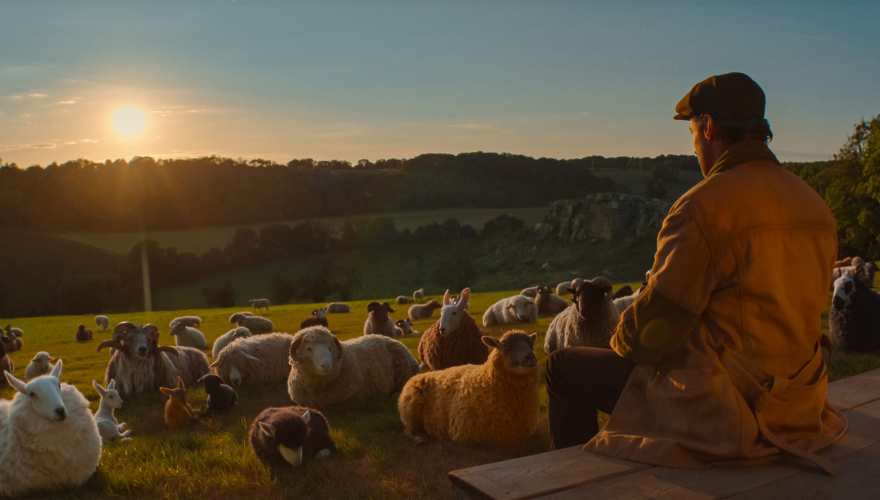
A big part of that charm is the comfortable ease into which it settles into the story, directed by Kyle Balda (Minions) and written by Craig Mazin (The Last of Us), adapting from the 2005 novel Three Bags Full by Leonie Swann. This is quite the mix of people, or at least resumes, but collectively they clearly understand the best sensibility for a story about a murder mystery in a sleepy town, where the sheep on the farm where a farmer is killed set about solving the mystery. Why? Because George Hardy (Hugh Jackman, still handsome but for once actually looking like he’s in his late fifties) reads to them every evening, from murder mystery novels. Not only do the sheep love this, but when George turns up dead, they know all the rules of what they call their “nighttime stories,” and use that to help them figure out what happened.

The rest of the cast is a stacked ensemble, comprising of both the townspeople and voice work for the fairly impressively rendered CGI sheep. These voices include Julia Louis-Dreyfus as Lily, the sheep who is always able to solve the murders in the books and so leads the charge in solving George’s murder; Bryan Cranston as Sebastian, a loner sheep with a tragic backstory of his own; Game of Thrones’s Bella Ramsey as Zora, a perpetually curious sheep constantly asking questions; Ted Lasso’s Brett Goldstein as two bothers with the same voice with an affinity for ramming things; Patrick Stewart as Sir Richfield, a sort of elder statesman among the sheep; Regina Hall as the “diva,” Cloud; Rhys Darby as Wool-Eyes, so named because his long hair largely blinds him; and Chris O’Dowd as Mopple, the one sheep who is unable to forget things at will.

This ability to control memory figures significantly into the plot, and is how The Sheep Detectives smuggles a surprising earnestness into the proceedings. This is a story about how sheep are smarter than we are, and capable of more than they give themselves credit for. They engage in a kind of willful ignorance, choosing to forget unpleasant experiences, but at the expense of the good ones too. These are all pretty simple themes, but perfect for a young audience, all the while entertaining a more adult audience with its overtly knowing uses of murder mystery tropes. Except in this universe, farm sheep gradually reveal themselves to certain townspeople as having surprisingly complex intelligence. Not a lot of made of this, which is right for a movie of this sort. Mostly it’s played for humor, and done very effectively.

A significant subplot involves how a flock will reject a “winter lamb,” which is how this flock perceives Molly Gordon (Rebecca Hampstead), the daughter George put up for adoption but who is recently in town, rendering herself one of the suspects. Often in movies like this the animal characters are far more interesting than the human ones, but the people here offer plenty color of their own, including Succession’s Nicholas Braun as bumbling Officer Tim Derry, the town’s one-man police force (and here putting on a very convincing English accent); Emma Thompson as Lydia Harbottle, George’s lawyer; and Hong Chau as Innkeeper Beth Pennock (also adopting a convincing accent), among others.

Also worth noting is Nicholas Galitzine as as ambitious reporter Elliot Matthews, here in town to cover a “cultural festival” he finds disappointingly tiny. Galitzine also played Prince Henry in the 2023 Amazon Prime Video original gay romantic comedy Red, White & Royal Blue, which I only mention because Galitzine immediately struck me as being entirely too pretty to be convincing in this part. But in the end, what we learn about him makes his beauty make a little more sense.

It’s often the case that a movie can get weighed down by having too many stars in its cast, where the long list of names is attempted to make up for what’s lacking in the story. But miraculously, The Sheep Detectives works almost shockingly well, even if it isn’t quite a laugh riot. The trailer was a bit misleading on that front, but that’s not the movie’s fault—and that’s why I think Babe is a good comp. That movie was very funny as well, but also had a charming innocence to its sensibility and to its characters. The Sheep Detectives, which also revolves around animals on a farm, is a refreshing throwback in this way, in that it has no cynicism to it whatsoever, and proves that such movies can still be well-rounded entertainment. That includes genuinely moving moments that mean you might want to have tissues handy. Yes, with talking sheep. Ultimately, The Sheep Detectives is the perfect mix, of human and animal, of heart and humor.

These sheep have no idea what they’re in for.

Overall: B+

HOPPERS

Directing: C
Acting: B
Writing: C-
Cinematography: B
Editing: C
Animation: B+

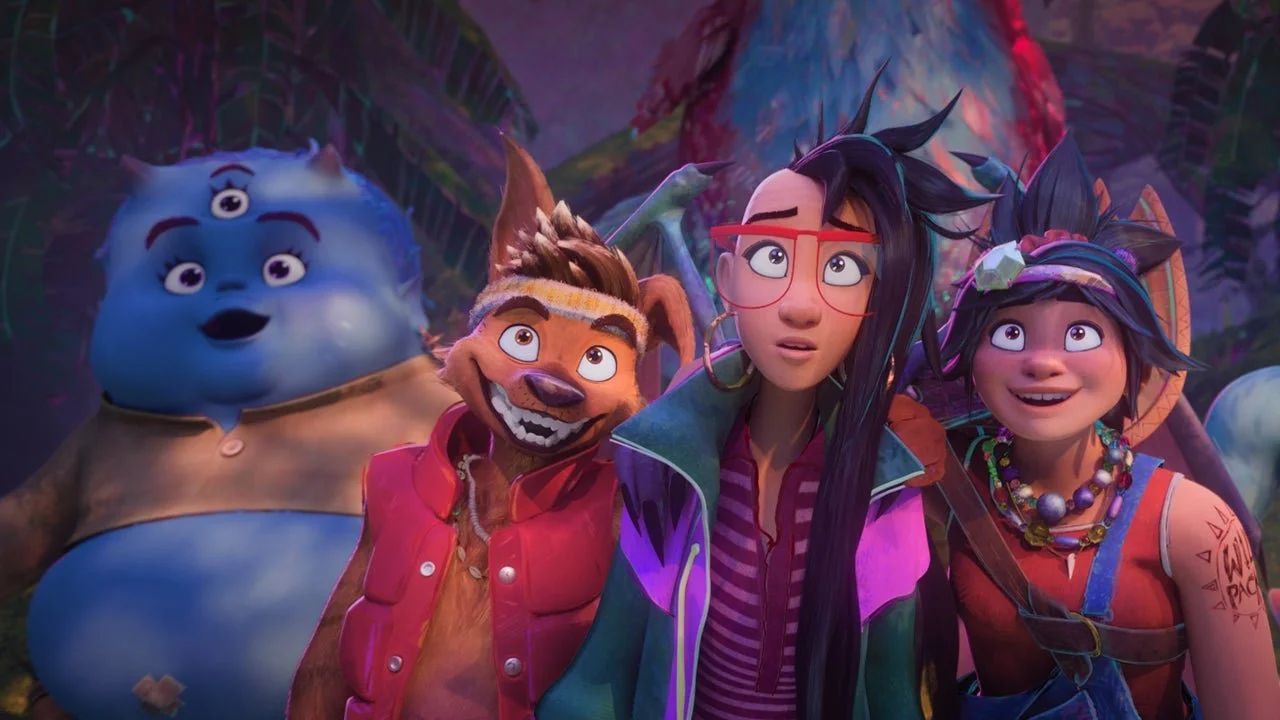
Has it finally happened? Have I become a contrarian crank? The old man who just doesn’t get it, who says Pixar movies were so much better back in my day? They just don’t make Pixar movies like they used to anymore! This is objectively true, actually, but does that matter to younger audiences? It’s certainly not going to matter to children, who will be perfectly entertained by Hoppers while I found it dumb as hell.

It’s a common refrain for me now, to say that Pixar once reliably made films that worked just as well for grownups as they did for children. They had a sophisticated sense of humor that made them stand apart from other animation studios. Those days began to end roughly a decade ago. Now the people at Pixar keep themselves afloat by riding their own coattails with endless sequels, interspersed with overstuffed nonsense like this.

I am reminded of The Wild Robot—a far superior film—and my one real complaint about it: that it depicts a wild animal world in which predators and prey become friends for the greater good. The same thing happens in Hoppers, they just don’t even do that as well. And Hoppers is a wildly derivative work of cinema. Its premise is so similar to that of Avatar, in fact, that the main character, Mabel (Piper Curda), literally says “This is like Avatar!” Mabel’s college professor mentor, Dr. Sam (Kathy Najimy), immediately retorts, “It’s not like Avatar!” but the cat’s out of the bag.

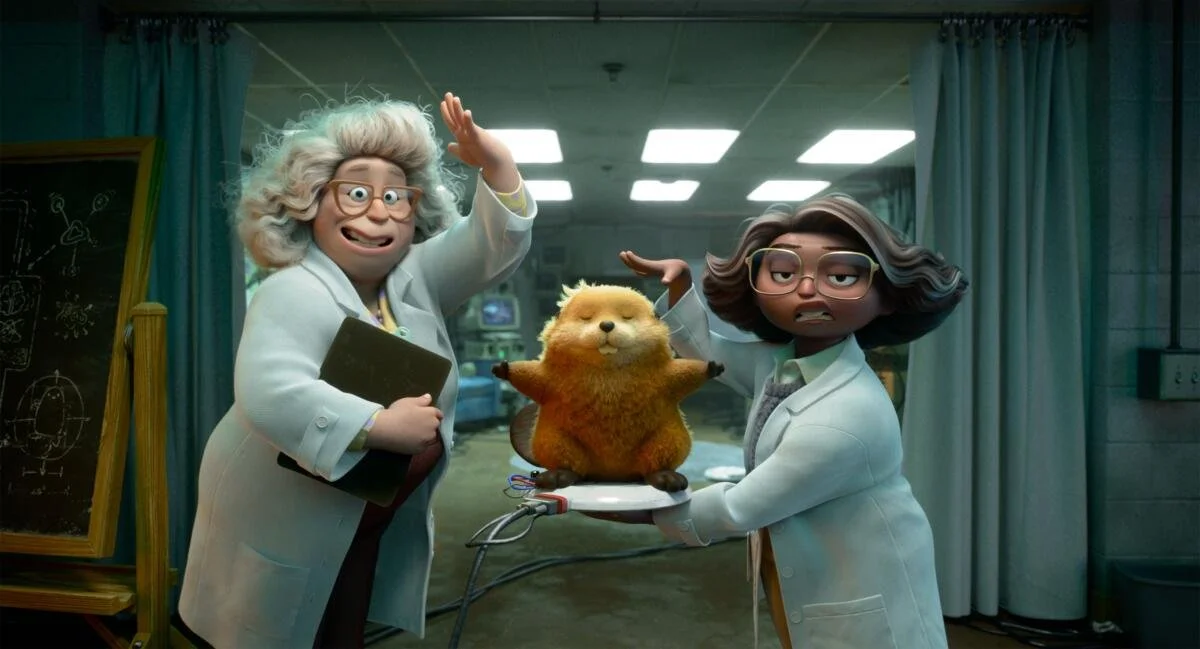
Or the beaver is, I suppose. Because, for reasons that are never made clear (who cares, it’s a cartoon), Dr. Sam and her helpers are doing research on porting their brains into robot animals as a means of communicating with them in their own language—which is somehow the same among all species of animals except human. Mabel, who is desperately trying to save the forest glade where she grew up with her late grandmother in an early sequence reminiscent of (but nowhere near as good as) the growing-old montage at the beginning of Up. The mayor of the nearby city of Beaverton (Jon Hamm) has selfishly dislocated all the animals there in an attempt to make way for a freeway bypass that will save commuters four minutes. Seizing an opportunity, Mabel ports herself into the body of a robot beaver, and then unwittingly ignites an animal uprising against humans.

To call the plot of Hoppers convoluted would be an understatement, and I haven’t even yet mentioned that the animals basically split into different factions, one who take the idea overboard and declare all humans need to be “squished,” and one that understands that’s a little much. Will children even be able to follow this? Probably not. Will they be delighted by a lot of the cute and funny animals? Definitely yes. Will Hoppers enter the echelon of classic Pixar animated feature films, like the original Toy Story or Finding Nemo or The Incredibles or WALL-E? Not likely. This movie will be forgettable to children and grownups alike.

I keep thinking about the 2022 film Lightyear, the first Pixar film I rated as low as a C+. And here we are again. The difference was that was an extension of an already-existing franchise, one that already had four previous installments (the fourth one being the weakest of the bunch—and yet, I’ll come back for #5). Hoppers is easily the most disappointed I have ever been in a wholly original Pixar film. It’s way too busy. It’s overstuffed. It’s convoluted. I don’t get it.

And this is a case where I am in the minority. At least in the case of Lightyear the response was definitively mixed. Hoppers is getting a pretty positive response, and I can only theorize that I am perhaps too whetted to what Pixar once was. Would I feel the same way about Hoppers if all else were the same but it were made by a different animation studio? I think I would, actually.

A lot of Disney properties stand the test of time, and Hoppers will not be one of them. You want to see a movie that examines relationships of substance using wildlife characters? Watch Bambi—which is not even my favorite Disney film, but I can recognize an enduring classic, complete with innovative animation techniques, when I see one. The makers of Hoppers are entertaining us, sure—I got a few good laughs—but they’re phoning it in. Why bother casting the likes of Meryl Streep as a megalomaniacal Insect Queen if you’re not even going to register that it’s her?

Setting all of that side, some wild shit happens in this movie. I probably shouldn’t spoil what happens with a flock of birds and a giant shark voiced by Vanessa Bayer, except to say that it’s ridiculous even by this movie’s standards. Director and co-writer Daniel Chong woke up one day and chose chaos. I was actually kind of locked in with Hoppers in the beginning, even though Mabel as a little girl is far more compelling than Mabel as a 19-year-old college student. I even leaned forward when Mabel found herself following a mysterious beaver into a science and technology lab. But then Mabel ports into a robot beaver, infiltrates a weirdly homogenous animal society, and winds up at a giant mound atop of which is King George the Mammal King beaver (Bobby Moynihan), to whom animals of all other species is bowing, and I’m just thinking, What the fuck is this? I haven’t even mentioned the brown bear (Melissa Villaseñor) who, much like in The Wild Robot, is for some reason everybody’s friend. She does eat a perfectly friendly fish at one point, so, points for that I guess.

I long for the days when Pixar made films that were both wildly entertaining and featured narratives of nuanced substance. In Hoppers, it feels like the relentlessly chaotic action exists to distract us from the fact that it’s all just empty calories for the mind. We might as well be plugging these looney antics right into our eye sockets, entertainment as overstimulating pacification. I want to say that Pixar is still capable of greatness, but it’s been a good five years since they last made something truly great; four since they squandered potential by dumping really good material direct to streaming. But I still believe in you, Pixar! I’m just waiting for you to climb to the top again, because this isn’t it.

Don’t ask.

Overall: C+

ELIO

Directing: B-
Acting: B
Writing: B-
Cinematography: B
Editing: B-
Animation: B+

Elio had its hooks into me from the very beginning. I really thought, until all the alien stuff started happening, that I might love this movie in a way I haven’t loved a Pixar film in a while, since their early days of one animated feature masterpiece after the other.

In retrospect, that was kind of the point. After thirty years of cinema history, Pixar has a playbook, and Elio very much follows it. I could mention who wrote the script, but who has time for that? This movie has nine credited writers. It feels a little like an advanced AI was prompted to “write a Pixar movie.” Opening sequence with overtones of incongruous sadness? Check! Lonely child protagonist who has lost either one or both parents? Check! Eventual non-human buddy for said child designed or optimum merchandising potential? Check!

Maybe I’ve just gotten old and cynical, but unfortunately, Pixar is feeling its age a bit as well. I was charmed well enough by Elio, but I could also see that it worked because of a well-worn and successful formula. The story is permeated by layers of familiarity. Pixar is supposed to be pushing the boundaries of the form, but Elio often feels like a cross between E.T. and Finding Nemo, at least in terms of its world-building.

Don’t get me wrong. Small children will almost certainly love this movie. Not that small children have standards. I long for the days of Pixar’s revolutionary depth of sophistication, both visual and thematic. WALL-E (2008) or Inside Out (2015), this is not. This is more on par with Onward (2020) or Luca (2021), more recent titles that push Pixar closer to the realm of “generic.” Elio is certainly flashier than those other recent films, and as such will probably dazzle kids more successfully, with its alien characters that are wildly varied, in both physical form and personality.

There’s still something missing, though, a certain depth of imagination. The visuals here are rendered well, but they take sometimes surprisingly rudimentary form. When Elio is sucked through a portal from earth by the aliens he so desperately wants to be abducted by, the tunnel of shifting lights and forms he glides through are patterns of simple goemetric shapes.

Elio begins with a huge amount of potential—even as it recognizably tugs at our heartstrings, introducing us to his aunt, Olga (Zoe Saldaña), who is still getting used to taking care of Elio (Yonas Kibreab) after the death of his parents. Olga being too busy with work to pay enough attention to him, and Elio’s deep loneliness and difficulty connecting, is all very familiar territory. But then we find out he is obsessed with connecting with life on other planets, and in particular the Voyager 1, which was launched in 1977 and equipped with a “Golden Record,” pressed with greetings in many languages from Earth.

Both Voyager 1 and the Golden Record figure prominently in the plot of Elio, which is easy to imagine catching the attention of anyone with an obsession with the intersection of science and history. Elio lends these artifacts appropriate thematic weight—until it doesn’t. In the end, these things are just used as plot devices for something . . . cute. If it ignites interest in any other kids in these artifacts, I suppose that’s a plus. But the story of Elio takes everything predictably back to themes of familial connection, using alien characters, half of which look like exotic sea creatures and half of which look like robots, as the vessel.

Elio himself is a delightful, charming, and deeply empathetic character, voiced well by Yonas Kibreab and rendered with visual nuance. The same goes for Olga, and the arc of these two, disconnected and then finding each other, was indeed something that moved me. I even got teary-eyed a couple of times. A formula that works is still a formula, and it’s the trappings that really make all the difference in greatness. Once aliens hear Elio’s call to come and get him, Elio spends much more time on standard cuteness than on anything truly meaningful.

Perhaps I ask too much of this movie. Indeed, not every movie has to mean something. My issue here is that Pixar spent years setting an industry standard, and now other studios are meeting that standard more than they do. It makes me sad. For the most part, Elio works—but, it works as a fairly generic entertainment, one that no one will be talking about generations from now, certainly not like they do with Toy Story or Finding Nemo or even Inside Out (all of which got boosts from sequels, granted—but good ones, all of them better than Elio).

I am constantly saying a movie should be judged on its own terms. That’s just the trouble with Elio, though: none of its terms are really its own. It’s a Frankenstein of Pixar films, stitched from previously used elements that saw better days in their previous lives. I had a pretty good time watching it, I smiled a lot, I suppose that counts for something. I’m also going to post this review and then get on with my life without ever really thinking about this movie again.

We know how to have fun, right?

Overall: B-

HOW TO TRAIN YOUR DRAGON

Directing: B-
Acting: B
Writing: B-
Cinematography: B-
Editing: B-
Special Effects: B+

The burning question right now is this: what was the point of a live-action remake of the Dreamworks Animation hit How to Train Your Dragon, all of fifteen years later? What purpose does it serve, aside from greater box office earnings?

I’m coming up short on an answer. When the original animated film was released in 2010, one of my minor complaints was about its “needlessly breakneck pace from start to finish,” in a film with a runtime of 98 minutes. With this 2025 live-action remake, however, the runtime is 125 minutes—and that feels about 20 minutes too long.

Disney has already cashed in on a string of live-action remakes of classic animated features, which were also mostly pointless but for their box office potential. Dreamworks is apparently eager jump on this bandwagon, even though the animated How to Train Your Dragon already spawned two sequels, the most recent of which was released only six years ago. Sitting through the live-action version today, I found myself struggling to see how it justified its own existence, especially given how similar it is to the original, just fleshed out to a runtime far too long for an ostensibly “family film” one can assume would include children in its audience. Kids were rapt by the 2010 film; they may get bored with this one. For more likely, adults will.

What’s more, “live action” is a term used very loosely here, as all the dragons are rendered with CGI animation. The only difference is the human characters actually acted on camera. The most fun thing, arguably, about this How to Train Your Dragon is that Gerard Butler reprises his role as Stoick, the disconnected father of Hiccup, this story’s hero.

Hiccup was voiced in 2010 by Jay Baruchel, who was 28 at the time but still had his youthful-sounding voice. He’s 43 years old now and clearly can’t play a teenage character onscreen—he wouldn’t even have been able to 15 years ago—so he’s replaced by 17-year old Mason Thames, much more convincing as the scrawny Viking kid who dreams of being a dragon killer but only manages to wreak havoc with his awkward mistakes instead. Thames is well cast as a live-action avatar for how Hiccup was drawn as an animated character, and he holds the screen well too.

On the off chance you don’t already know, the basic premise here is that Hiccup discovers the dragons of this world, of which there are many, are misunderstood animals and not the ruthless killers the Viking villagers have regarded them as for generations. He manages to injure the elusive “Night Fury” dragon, but when he goes to hill the dragon, whom he later names “Toothless,” he befriends him instead. What follows is a struggle for Hiccup to convince his village that the dragons are smarter than they appear and mean them no harm.

Hiccup is very effectively an awkward outsider, which makes for a lot of awkwardness in the first half of this film, which sometimes works and a lot of times doesn’t. A lot of this How to Train Your Dragon is so cutesy and cartoony, it again begs the question: why not just let the animated feature stand on its own? Nothing truly realistic occurs in this “live action” rendering, least of all the way Hiccup eventually figures out how to ride Toothless. And I said this in my review of the 2010 film and it still feels the same now: the creature design of Toothless has an uncanny resemblance to that of Stitch from Lilo & Stitch—and ironically, a live action remake o Lilo & Stitch is also in theaters right now.

To this new How to Train Your Dragon’s credit, it gets better as it goes along—the second half is much better, and certainly more exciting, than the first half. I suppose that’s better than it being the other way around. I eventually found myself invested in the characters and in the story, in ways I wasn’t for some time at the start. And some further fun casting includes Nick Frost as Gobber, the guy who trains upcoming dragon slayers; Julian Dennison (the kid previously seen in Hunt for the Wilderpeople, Deadpool 2, Godzilla vs. Kong, and Y2K) as one of Hiccup’s fellow dragonslayers-in-training; and Nico Parker (Joe’s daughter from the premiere episode of The Last of Us) as Astrid, Hiccup’s eventual love interest.

By the time of How to Train Your Dragon’s conclusion, I had to admit I was pretty entertained. It just had to go through a bit more awkward, cartoony cutesiness to get there than I would have preferred. Entertaining or not, I remain unconvinced there was any great reason to make this movie to begin with, but if it’s the thing on the screen in front of you then it works well enough.

This seems awfully familiar.

Overall: B-

A MINECRAFT MOVIE

Directing: B
Acting: B-
Writing: B
Cinematography: B
Editing: B
Special Effects: B+

I could have had a field day ripping A Minecraft Movie apart—if it weren’t funny. But, the thing is, I laughed a lot. And maybe you won’t. Maybe you will. This movie has a pretty specific and peculiar sensibility, which gets very goofy and dumb, for no other reason that its self-reward. It spoke to me. And I don’t even have the slightest bit of knowledge or familiarity with the 2011 video game on which it’s based, although plenty of the action feels like a video game. Or what I imagine a video game to be like, anyway. What do I know? I played a few video games at a friend’s house in the summer of 1989, decided fairly quickly that it wasn’t for me, and haven’t bothered with it since. Most of this movie’s audience will have been born after that.

How easily I settled into A Minecraft Movie’s delightfully absurdist humor only better serves to recommend it. Anyone open to its brand of humor can enjoy this movie, whether they’re familiar with the video game or not. Granted, the setup a paper thin and utterly stupid, introducing us to Jack Black’s Steve, a doorknob salesman with a lifelong dream of being a miner. He follows his dream, goes down into a mine, and within minutes uncovers an “orb” (it’s actually a cube) that opens a portal into “the Overworld,” a place where creativity knows no bounds—well, except for the unstated fact that apparently everything has to be designed in cubed shapes.

Anyway, everything that so quickly gets Steve to the Overworked is ridiculously convenient and untied to any backstory to give Steve any character dimension whatsoever. I don’t seriously think this is the case, but I suppose you could argue that this setup is itself a meta commentary on the thinly contrived characters in any typical movie of this ilk. There are no intellectual pursuits here—getting right to the delightful absurdities is very much the point.

I could have lived without the way Jack Black’s delivery is far more over the top than it needs to be, every single line he delivers. He’s overly excited about everything he sees onscreen, or even any particular thought he has. It’s on-brand for Jack Black, I guess, and makes him fit better in the Overworld than he does in the real world. The others that find themselves sucked into this world give more naturalistic performances, with the exception of Jason Momoa as Garrett “The Garbage Man” Garrison, a former “Gamer of the Year” in—speak of the devil!—1989.

Not all of the humor in A Minecraft Movie lands. What makes it work is that most contemporary absurdist comedies, especially wide-release big-budget ones, have far more humor that falls flat than that works. A Minecraft Movie is the other way around. For every gag that doesn’t work, there are five that do. I laughed far more consistently at this movie than I expected to.

Not all of the characters really work either, to be fair. Jennifer Coolidge appears as a high school Vice Principal, who invites a Minecraft villager to dinner after he wanders through the portal to the real world and she hits him with her car. Director Jared Hess, working with a script written be a team of six writers, cuts back and forth between the Overworld action and this dinner date, enough times to make you wonder what the point of the dinner scenes even is. In the end, the point seems to be only to get to a bit between Coolidge and the CGI villager during the end credits. Well, the bit is hilarious, one of the funniest things in the movie, so I guess it’s worth it?

Rounding out the principal cast are Sebastian Hansen as Henry, a very creative kid just starting high school in the Idaho town of Chuglass; Emma Myers as Natalie, Henry’s older sister who hardly looks like she should be out of high school herself (Myers is 23) and has been hired as the social media manager for the town’s potato chip factory; and Danielle Brooks as Dawn, the local real estate broker with a mobile zoo as a side hustle. Brooks in particular is a known talent who is somewhat wasted here, as all these characters are easily interchangeable with any serviceable actor, but they’re still all fun enough. Momoa, Coolidge and to a lesser degree Jack Black provide the most color as characters, although only Momoa provides a kind of colorfulness that fits neatly into the video-game-adaptation context.

The bottom line is, none of the plot, such as any plot exists, matters. What matters is a bevy of well-executed, adorably bizarre details, such as the villainous borde of cube-headed “piglins” from another dimension, led by a piglin witch named Malgosha. By and large, there is little to no rhyme or reason to anything that happens in A Minecraft Movie, but it’s the execution that makes it work—humor that works more often than it doesn’t; and more actors with charisma than without. It’s an impressively staged bit of organized chaos, set in a world rendered with surprisingly artful special effects. It’s a movie that is ultimately meaningless but kind of a blast, but sometimes a mindless blast is its own reward.

Which of these characters is the most fun? You get one guess!

Overall: B

PADDINGTON IN PERU

Directing: B
Acting: B
Writing: B-
Cinematography: B
Editing: B
Special Effects: A-

With two preceding films that have long been beloved and arguably became instant classics in their time, Paddington in Peru has a lot to live up to. I’ll get right to the point there: it doesn’t quite make it.

Paddington in Peru is fine. But, you want these movies to be better than fine. I suppose I should confess I really missed the boat—two boats, actually—with both Paddington and Paddington 2. Having been released in 2014 and 2017, respectively, I had already been reviewing movies for years by the time they came out, but I did not see either of them in theaters, I guess because I thought they looked too corny and cutesy. Little did I know! I finally watched them both in 2018 and was utterly—and predictably—charmed by them, although I seem to be in the minority position that the first is actually the better of the two. I have now seen them both three times, the third time in anticipation of Paddington in Peru—this practice often being a mistake. Indeed, I don’t recommend it. If it’s been a while since you saw either of the previous two films, do not rewatch them shortly before seeing this new one. You might actually enjoy it more.

And don’t get me wrong, I still enjoyed Paddington in Peru, in a whimsically nostalgic way that director Dougal Wilson clearly intended. This is Wilson’s debut feature film, after a long career directing music videos and film shorts, and the absence of Paul King, who directed the previous two films, is keenly felt. Granted, King went on to direct Wonka, which was definitively worse than this movie, so I’m not sure where that leaves us. In Wilson’s hands, while changing the setting away from London to Paddington’s country of origin is quite compelling, much of the film just feels like a franchise running out of steam.

This time out, we get new characters played by both Antonio Banderas and Olivia Colman, both apparently jumping at the chance to be in a Paddington movie in spite of their characters being undercooked. Banderas makes the best of a character haunted by generations of ancestors looking for treasure in Peru, a boat captain named Huner Cabot, but as written, he never fully clicks into the story. Colman certainly fares better as the “Reverend Mother” who turns out to be a villain a step slightly back in the direction of Nicole Kidman from the first film. This is not really a spoiler, as Colman only stops short of literally winking at the camera, in a way that’s one of the most endearing elements of the film. She lets the word “suspicious” slip out in amusingly suspicious ways.

The entire Brown family is also back, cast with mostly the same actors, which is comforting—once again we get Hugh Bonneville as Henry; and Madeleine Harris and Samuel Joslin as the kids, Judy and Jonathan, now seven years older than they were in Paddington 2. Julie Walters also returns as Mrs. Bird, but for reasons apparently unknown, Emily Mortimer replaces Salley Hawkins as May Brown. It’s an okay replacement, I guess, as I didn’t even realize the actor had been replaced until I looked at IMDb. In any case, it’s nice to see the whole family again, but as they all take a family trip to Peru with Paddington to help him find his Aunt Lucy who has gone missing from the Home for Retired Bears, they seldom serve any purpose besides fitting into slots of obligation.

In the early scenes, when Paddington gets photos taken for his passport now that he’s become a British citizen, it’s easy to be charmed. When the Browns travel to Peru, the momentum peters out a bit, the deceptively hilarious whimsey of the previous films largely absent. Boat captain Hunter Cabot shows up with his concerned daughter Gina (Carla Tous), and the vibe is a bit incongruous. Olivia Colman’s Reverend Mother isn’t a perfect character either, but Colman is clearly having such a great time, I couldn’t help but have fun watching her.

Of course things do come full circle in a way with Paddington in Peru, the third film set in the country he came from, and the action picks up in the last act in a fairly satisfying way. The story closes in a way that really tugs on our nostalgia strings, and I was not immune to it. In spite of the story sagging a bit prior to that, I got a little teary eyed. This movie works as a coda of sorts to the Paddington franchise, even if it’s undeniably inferior to what came before it—an all-too common turn in the third part of a film series.

I will say this: Paddington in Peru looks spectacular. The visual effects are top notch, especially in the Peru sequences, where the detail in the rendering of Paddington bear is incredible. I won’t say it makes up for a relatively mediocre plot, but this movie is visually dazzling, and that’s still something. And of course, Paddington himself—especially as voiced by the delightful Ben Wishaw—is as lovable as ever. This one may not be an instant classic, but it still invites us back into a world we know and love, still a warm and cozy place to visit.

Not as great as we wanted, but we can make the most of it: maybe use Paddington’s approach to all things when watching this movie.

Overall: B

DOG MAN

Directing: B
Acting: B
Writing: B
Cinematography: B
Editing: B-
Animation: B

Dog Man is a cute, sweet, sporadically very funny movie, based on a series of graphic novels of the same name by Dav Pilkey, which were themselves a spinoff of Pilkey’s original Captain Underpants illustrated novel series. Dog Man is also overstuffed with antic plotting, and feels a bit overlong even at an 89-minute runtime. Surely young kids will love it; they don’t care about nuances of criticism. As for how the adults will like it when they take children to see it? Well, they won’t likely hate it, at least.

On the topic of animated feature films that manage to reach both children and adults at their own levels simultaneously, Dog Man is impressive in how often it manages this, even without particularly sophisticated or subversively “adult” humor. This movie is wholesome top to bottom, and is only rated PG, I would assume, because of the cartoon violence in it. The protagonist is a loyal dog’s head transplanted onto the body of his beloved police officer master, after all, and director and co-writer Peter Hastings (collaborating with Pilkey on the script) somewhat pointedly skirts past the darker implications there. This means Officer Knight is effectively dead, right? Someone tell all the children in the screenings so they understand! Actually, I’d have more respect for this film if it found some way to say Officer Knight—or his head, anyway—had gone to live on a farm.

Indeed, there is a vibe of some missed opportunity with Dog Man, a film that is filled with self-awareness and packed with jokes and sight gags—I enjoyed the gag where two characters argued on opposite sides of a split screen and one of them literally grabbed the line splitting the image. It’s that kind of subtly meta stuff that really works in this movie. Unfortunately, while many of the jokes land, plenty of them don’t, and the latter happen when the story sags under the weight of its own bloat.

I keep thinking of the halcyon days of the 75-minute animated feature film, something that was far more common roughly thirty years ago and earlier. This is much more appropriate to the attention span of young child audiences, and many animated features in the past decade—specifically those meant for kids—have leaned closer to an hour and 45 minutes. Given the desire for theaters to maximize showtimes and therefore ticket sales, I’m at a loss as to what the endgame is there, unless the skill of the storytelling justifies the length, which is rare. And getting to Dog Man, this is a film that would land far more effectively for adults and children alike with a runtime closer to 75 minutes, but for some reason filmmakers seem to think they need to “flesh out” these stories.

But Dog Man is exceedingly simple: once Dog and Man combine, they become a “Supa Cop,” easily capturing OK City’s biggest villain, Petey the (of course) evil cat—voiced pretty entertainingly by Pete Davidson. He plots to take over the world and rid it of all “do-gooders,” going so far as to clone himself, not realizing the clone will appear as a kitten who won’t grow up for 18 years. “Li’l Petey” (voiced adorably by Lucas Hopkins Calderon) comes out of the clone machine—easily ordered by mail by Petey—with an innocence that, naturally, brings everyone together in the end. Spoilers!

Anyway, Petey is just as good at escaping prison—in an admittedly delightful montage—as Dog Man is at catching him, so this just becomes a cycle until Petey ups the ante with all manner of wild inventions, including my favorite: a robot he calls “80-Hexatron Droidformigon,” or “80-HD.” The robot becomes a quasi-character in its own right, although the rest of the cast is much more amusing, including Lil Red Howery as Dog Man’s bumbling police Chief; Cheri Oteri as OK City’s comically corrupt Mayor; Isla Fisher as ambitious TV reporter Sarah Hatoff; Stephen Root as Petey’s deadbeat dad; and Ricky Gervais as the movie’s most baffling character, an evil fish villain named Flippy. (Look for the obvious Aliens reference when Flippy goes after Li’l Petey and Petey shouts, “Get away from him you fish!”)

Flippy makes a nice segue into what doesn’t work all that well in Dog Man. Flippy serves as a villain to unite all the others against, but the plot mechanics are unnecessarily convoluted, and the “climactic” sequence this ushers in is less exciting than it is baffling. Literal buildings are brought to life as sort of building-monsters that wreak havoc, almost Gozilla-style. Dog Man winds up operating a giant “Mecha Mail Man” to battle them with. It’s all very: what? Although it still gets a few funny gags, none of it really works as well as the rest of the movie does.

Ultimately, Dog Man falls into the same trap nearly every other superhero movie does, predictably ending in a massive, ridiculously high-stakes battle blowout. Who the hell created the rule that every superhero movie has to end this way? Peter Hastings does smuggle in a subtle (and very brief) commentary on this very trope, but while also fully participating in it. I’d have much preferred a resolution only between Dog Man, Petey and Li’l Petey without any involvement with a supervillain fish and monster buildings. And haven’t we had enough of Ricky Gervais anyway? There’s a man who started off strong and then long outlasted his welcome.

To be fair, as “superhero movies” go, Dog Man is unlike any other. It just would have been far more successful, even on its own terms, with some script polishing and tightening of the editing. It wasn’t what I wanted nor what it could have been, but to its credit, I still had a good time. And none of my criticisms will mean anything whatsoever to a seven-year-old who will certainly have a blast watching it.

Just do your job Dog Man!

Overall: B

THE WILD ROBOT

Directing: B+
Acting: B+
Writing: B
Cinematography: B+
Editing: B
Animation: A

If you are partial to unusually beautiful animated features, then look no further than The Wild Robot. It has a subtly unique and warm animation style, and every frame is gorgeous.

I also find myself interested, for the first time, in the 2016 middle grade novel of the same name by Peter Brown. Brown both wrote and illustrated a series of books about this character, and if you look them up, you’ll see that the illustrations are much different from the film adaptation—far simpler, less detail, harder lines, black and white. The visual palate gets quite a transformation via DreamWorks Animation, which makes sense when shifting from the more imaginative medium of novels to the visual medium of film. It works incredibly well.

How closely is the story adapted, I wonder? I might just have to check out these books. The film, directed and co-written by Chris Sanders (Lilo & Stitch, How to Train Your Dragon), whose historic penchant for visual style over narrative consistency continues here. To be fair, all of his films are easily compelling to kids, with a delightful undercurrent of slightly bent humor. The Wild Robot, for instance, acknowledges death consistently and in a variety of ways—sometimes sad, sometimes with deliciously dark humor. A wonderful group of supporting characters is a mother possum (Catherine O’Hara) and her rotating litter, who practice playing dead. One of the kids, when taken to task by a sibling for not becoming “dead” fast enough, counters that he’s dying of meningitis. “It takes a while!”

The Wild Robot’s frankness about death is surely a big part of the reason it is rated PG: parents with small children may want to wait to show them this one, which veers a bit into Bambi territory. The story begins with a very clever introduction to Roz the robot (Lupita Nyong’o), who has crashed on an island in transport during a storm. She is clearly programmed to serve humans, but here only encounters animals, and struggles to communicate with them—starting with an adorable family of otters. After a series of harrowing experiences in the forest, Roz crushes a goose’s nest after a fall, leaving the one unharmed egg orphaned. Sanders does have a sensitively artistic eye for how to convey such things: Roz lifts a limp feathery wing from the ground for a brief moment, and we understand what has happened. Within minutes, the egg hatches, and the gosling imprints on the first thing it sees: Roz the robot.

The Wild Robot is a little bit scattered in its depiction of a robot adapting to an unfamiliar environment based on programming. Not that any kids will care: this is where I, the geezer, get pointlessly nitpicky about a cartoon. This, however, is where I would be particularly interested in how similarly the source material treats these ideas. The broader message of this film is personal growth, and becoming something “better than what you are programmed to be.” This makes sense for human characters, of which there are none in this movie (save for a few brief shots of programmers in the place from which the robots come). Using an AI robot as well as wild animals who grow beyond their instincts as metaphors is, by contrast, a little messy. How are all the animals of an island wilderness really going to survive if predator and prey have chosen instead to become friends? What happens to the food chain?

I know, I know: no nine-year-old is going to be asking these questions. Just me! I should stress that I really enjoyed The Wild Robot; it just doesn’t quite match the success of early Pixar films, as some of suggested. Those are movies that work equally well for both child and adult viewers, finding ways to speak to them simultaneously at their separate levels. This is something The Wild Robot, which is incredibly successful as a kids’ movie, does not quite manage. I wouldn’t nitpick about it, except that it does feel a bit like it’s trying to speak to adult viewers as well.

A particularly fascinating element of the story here is its setting, in a future where robots this advanced are possible. It might have made more sense to leave more of Roz’s backstory out of it, keep her origins more of a mystery, and focus on a robot character adapting to the wilderness. But the story briefly takes us off the island, both when the geese leave for migration and when Roz is finally located for retrieval. There are very brief shots that offer some surprisingly global context to the story: twice we see the Golden Gate Bridge from the clouds, amongst the countless migrating geese, the road portion of the bridge submerged in water, whales swimming by above it. In another we see the tops of buildings poking out of the water.

I suppose more light could be shed on this in potential sequels, and admittedly I will be very interested in it. For now, there’s a lot hinted at in The Wild Robot that does not get fully explained, and over time, what starts as a pointed focus on Roz as a robot who can only understand things based on programming evolves into a story of self-actualization. Perhaps this movie is Trojan-horsing a story about the singularity.

In the meantime, we are treated to many delightful details, and wonderful voice work by many great actors (Pedro Pascal as a Fink the fox; Bill Nighy as Longneck the grizzled old goose; Mark Hamill as Thorn the bear; Heartstopper’s Kit Connor as Brightbill the young goose; and more). When Roz wakes up with the rest of the animals who hybernated through the winter, spring now upon them, she is half covered in moss. When the migrating geese stop for rest in a kind of biome city, we see giant machines engaged in automated agriculture. There’s also a bunch of robots of the same model as Roz, though it’s not clear what purpose they serve milling about in fields of corn.

All that matters, really, is that this is a story of both robot and animals who learn how to be friends and support each other. To a degree, the relationship between Roz and Brightbill serves as an allegory for the way parenting never comes with a training manual—something the script could have leaned a bit more into. If nothing else, The Wild Robot elicits a lot of questions, but of the sort that aren’t frustrating so much as creating a desire for learning more: about the characters, about the world. This feels like something that can be expanded on in ways that will engender much interest, with the hope that DreamWorks will eventually do just that. Or I suppose I could just read the books.

Logic is beside the point when a benevolent robot goes wild.

Overall: B+

ROBOT DREAMS

Directing: A
Acting: B
Writing: A
Cinematography: A
Editing: A
Animation: A-

Robot Dreams is an utterly delightful, adorable animated feature without any dialogue and with an undercurrent of melancholy. It’s about friendship, love, and a meditation on the transient nature of relationships. It’s uniquely lush in spite of being almost exclusively set in cityscapes, with dark lines around rounded shapes filled with vividly solid colors that somehow combine to create a visual warmth.

Everything about it invites and envelopes you, even as the story takes unexpected turns. This is a universe filled with anthropomorphized animal characters, packed with endlessly charming visual details. “Dog,” the protagonist, wags his little tail any time something makes him happy or excited. He reads a copy of Stephen King’s Pet Sematary when he crawls into bed at night, making us wonder what a society of animals keeps as pets (which we never do actually see).

I am certain I could watch this movie again and discover many charming details I missed the first time around. One of my favorites is when Dog and Robot take a row boat ride in a lake, amongst many others doing the same. One other boat with two companions contains an elephant and a mouse, the elephant weighing down one end of the boat so heavily that the mouse is pushed high into the air at the other end.

But I’m getting ahead of myself. “Robot” is our other main character, a companion Dog has ordered through the mail via a number provided in a television ad. “Are you alone?” the ad copy onscreen reads, and we have already gleaned that Dog is lonely. This was where I first noticed the penchant for background detail in Robot Dreams, actually: as Dog eats his TV dinner alone in his apartment, we can see through his window and again through the window of an apartment across the street, an affectionate couple (a cow and a giraffe, if I remember right) snuggling on a couch in front of their own TV, feeding each other popcorn.

These are details we, as viewers of the movie, notice first. But then Dog notices, and he longs for something of the same in his own life. Enter Robot, who never exists as a character to provoke any thoughts about robotics or AI or anything particularly science-fiction in tone or theme. He’s more like a platonic mail-order bride, and in the end he doesn’t even have any particular personality defects that might cause tension in Dog and Robot’s relationsip. In the end, it’s more about how things can change even between people who never love each other less, but due to circumstances beyond their control. It’s the unhappy accidents of life itself that get in the way.

Robot Dreams is an unrated film, but if it were to get an MPA rating, logically it would get at least PG—not because of vulgarity or violence, which this film really has none of whatsoever, but just because it could be a bit sad for small children. There’s a moment in Robot’s journey, something that happens to him, that broke my heart. And I’m 48 years old.

Well before that, though, we just watch an extended sequence of scenes with Dog and Robot’s blossoming relationship. They walk to the park, go roller skating, and go to the beach. This goes on long enough that I found myself wondering how and when some kind of conflict will enter the story, as there is no story without one. And this is one of the many great things about Robot Dreams: it checks off the obligatory story beats, but always in unexpected ways. In this instance, Dog and Robot get separated at the beach because neither of them realized Robot would rust if he went swimming. He is rusted frozen on the sand, too heavy for Dog to drag away after they have napped clear through evening, and the door through the fence barrier to the beach not only closes at the end of the day, but until the next spring! Dog is dragged away by a cop for trespassing, given no chance to try and repair and retrieve Robot, who then spends the entire winter under snow and ice, quite literally dreaming of ways he might get reunited with Dog (hence the film’s title).

Dog marks the date he can go back (June 1), but in the meantime is forced to go on with his life. He’s still lonely, he tries to make friends, with varying but never complete success. By the time June 1 actually comes around, circumstances have changed significantly for both of them. I won’t spoil it except to assure that Robot does not stay stuck in the sand forever, and this is actually part of their diverging fates that take Robot Dreams to its surprisingly bittersweet conclusion. It’s not often that a film ends with its characters not unhappy, but perhaps fated with a lifetime of wistful yearning for what could have been.

Through all of it, the story is told almost exclusively in a visual manner, the closest to any dialogue being characters snickering or hollering out, “Hey!” I suppose you could say Robot Dreams thus features “voice acting,” although not in a way that particularly showcases anyone’s talent. The story and the animation are what make this the wonderful movie that it is, along with the soundtrack: the only time we hear actual words being vocalized is in song, tunes played on the soundtrack or from a character playing a cassette tape.

Director and co-writer Pablo Berger sets the story in 1980s New York, a plainly deliberate choice that adds to the nostalgic tone. Everything seen onscreen is a celebration of what we see, right down to the teenage animal punks who flip off Robot as he walks by them (oh wait, I guess that one moment could be seen as a “vulgarity,” even though even that plays with charm). Many shots feature the twin towers of the old World Trade Center in the background, always lovingly rendered, just like everything else we see onscreen. This is a movie that loves New York, and all of the characters in it. It loves Dog and it loves Robot, and it loves all the characters they meet along their respective journeys. It loves the art of storytelling and it loves animation in all its forms, and perhaps most of all, it loves us: the people watching the movie.

Robot and Dog swim in a sea of innovative storytelling devices.

Overall: A