
EBENEZER
Directing: C
Acting: C+
Writing: C-
Cinematography: B
Editing: B-
Special Effects: B
There is a metatextual element to Ebenezer that is thoroughly transparent bullshit. Ebenezer Scrooge spends roughly the third quarter of the film begging for a chance at redemption, and in playing the part, Johnny Depp quite clearly asks the same of us. “I’m not the man I was!” he pleads, multiple times, inevitably making us think of the controversies that have plagued his life and career over the past half decade. I wouldn’t be surprised if this was literally how the part was pitched: Scrooge gets a comeback in the end, and so will you!
So: does it work? Not on me, it doesn’t. The whole enterprise smacks of desperation. Why did I see it then, you might ask? The simple truth is that the trailer made it look fun. I have a monthly AMC subscription, so my booking a seat at this movie gives it no more money than it would get otherwise. Or so I thought—I guess I should have looked this up before going: AMC A-List and other movie subscription bookings still result in theaters paying a portion of the value of the ticket to studios, and therefore contribute to box office earnings. If Ebenezer proves to be a success, then I guess I helped it get more than I thought I would.
Depp was already paid $5 million to play the title part in Ebenezer, but that’s sort of beside the point: do we want to create the perception that Johnny Depp, who is reportedly a piece of shit, is still a bankable star? It’s looking already like that ship may have sailed—though I must say, after actually having seen Ebenezer and being ablen to judge the overall film for myself, I can’t say I understand why.
There’s a bit of irony in that, if not for Depp’s recently-revealed history, we might all have been saying Ebenezer was a part Depp was destined to play. The thing is, he leans into it so hard that his is the one performance in the film that brushes the edges of cartoonish. Now, I have seen his performance described as “obnoxious,” but I have to be fair and say that’s an exaggeration. But only a slight one. The longer I watched him onscreen in this movie, the more I thought about its existence as an exercise in getting alienated audiences back in his good graces. Its obvious is practically reaching off the screen to punch us in the face.
I’m not even sure what other purpose this film is meant to serve. Who was asking for yet another adaptation of A Christmas Carol? There have been literally hundreds. Director Ti West (MaXXXine), working from a script by Nathaniel Halpern in his feature film debut, attempts to give A Christmas Carol a new twist by leaning into its horror elements. The trailer leaned more into the comedy, and this movie is never particularly scary nor is it particularly funny. I got one good chuckle out of it, during Ebenezer’s post-haunting Christmas morning tour of righting all his wrongs. That was thanks to Daisy Ridley, who deserves far better than the small part she has here. In any case, the horror elements, with plenty of ghosts roaming the streets in a pointless flourish, do nothing to make this Victorian-era story feel fresh.
One thing for which any adaptation of A Christmas Carol can be counted on is its spirit characters as a showcase for an ensemble of performers. Here we get Ian McKellen as Jacob Marley; Andrea Riseborough as the Ghost of Christmas Past; and Tramell Tillman, in possibly the most charismatic performance in the film, as the Ghost of Christmas Present. Robert Strange is the actor who plays the Ghost of Christmas Future, but as is often the case in these adaptations, he gets no real lines, but instead appears onscreen alongside spooky, alien sound effects. Riseborough’s performance is the one that worked the least for me, with her oddly high-pitched and drawn-out line delivery that makes her sound like she’s on sedatives.
In addition to the spirits, we get Rupert Grint as Bob Cratchit; Charlie Murphy as his wife, Emily; and Sam Claflin as Fred, Ebenezer’s nephew. Freddie Lee-Grey and his studio-standard adorableness is the boy who plays little Tiny Tim. We all know who these characters are, what every single one of the beats of this story are, and Ebenezer hits every one of them. To call this story familiar would be the understatement of the past two centuries. Setting Depp’s aside, the performances overall range from serviceable to pretty good—but Depp is clearly meant to be the draw, and he is present in every scene.
Ebenezer is, in the end, a totem to redundancy and mediocrity. It has production design that is fun to look at, and offers old-school style opening credits that prime you for something more fun than it ends up being. Narratively, it begins with a surprising amount of promise, which it runs out of quickly. Once the movie was in its second half, all I could think was: okay, we know what’s coming, let’s get on with it. This is an adaptation packed with added details that feel designed as filler, just so it can reach a standard two-hour runtime. Even though this is a story with many characters, this could have been about fifteen minutes shorter. Even the 1988 film Scrooged, arguably the best modern reimagining of this story, is all of 111 minutes.
But, evidently Johnny Depp wanted to spend all that extra time convincing us he’s “not the man he was.” This is hammered on so much that you start to forget you’re watching a period film, and all you see is a 63-year old star fallen from great heights, begging to be propped up again. Then you suddenly realize that maybe seeing this movie was a mistake.
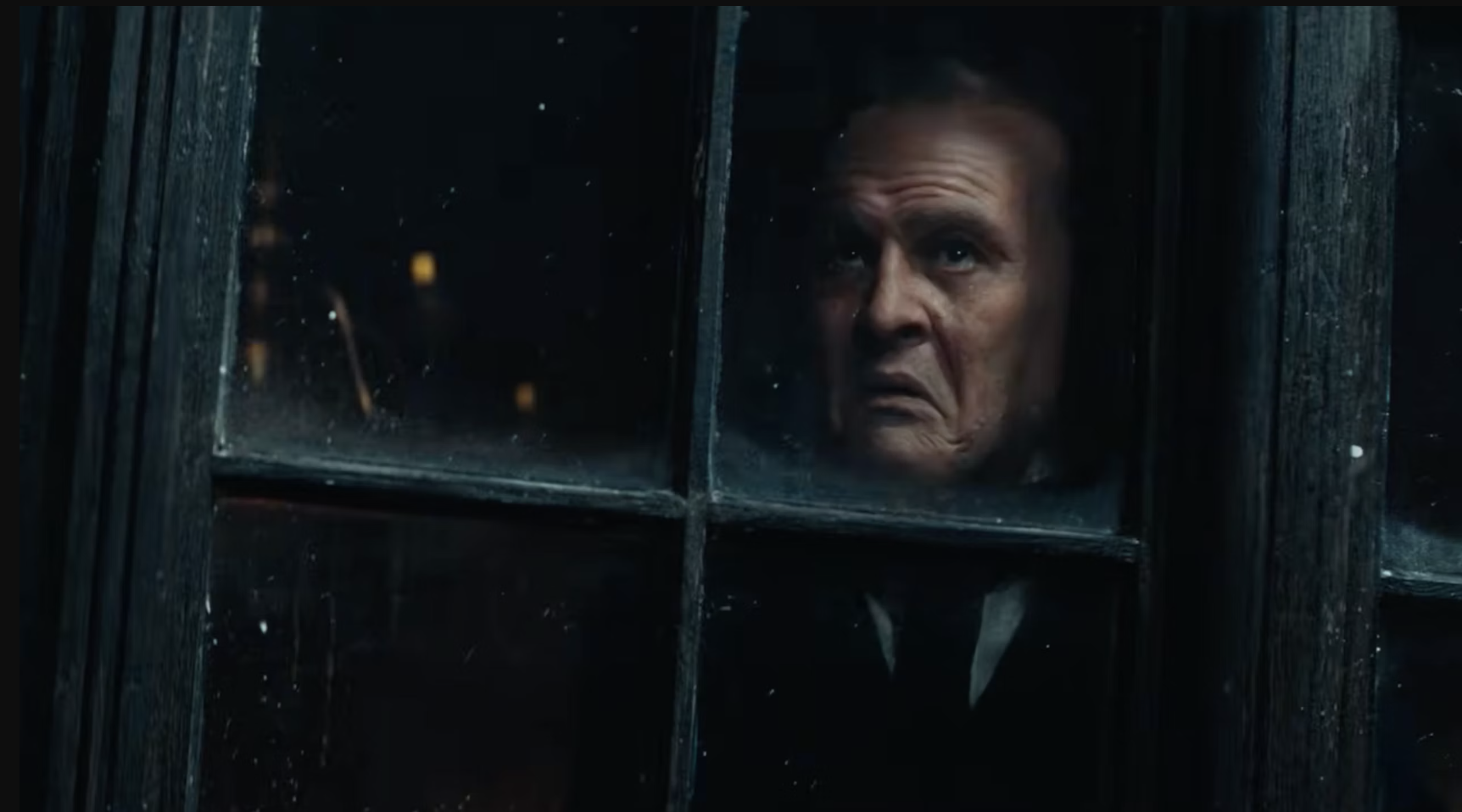
How I looked watching this movie by the time it was over.
Overall: C+