
ELSINORE
Directing: A
Acting: A
Writing: A
Cinematography: B+
Editing: A+
Let’s be upfront about this: Elsinore is a straight-up tearjerker. I had used up four tissues by the time it was over.
There are those who wish to stress: it’s not all sad! A lot of it is really funny!—Don’t listen to any of that bullshit. At best, this is a tragic affirmation of life and living, sprinkled with several moments of moderate levity. The truth is, you will spend far more time crying than laughing. I still want you to take the phrase “at best” literally, however—because this is precisely how Elsinore becomes the best it can be. Trying to sell this story as a comedy would be a mistake.
All the talk about Andrew Scott’s likely Oscar nomination is entirely justified. He’s not likely to win, although among the current frontrunners, he would be the one to get my vote. Too bad I’m not a member of the Motion Picture Academy. To be fair, queer stories have a tendency to hit me in the heart like no other, and coming-out scenes, particularly when done well, can fuck me up. Seeing a grown man apologizing for dishonesty, without any sense of the grand injustice of the cultural necessity of hiding to begin with—depending on the age and region of the audience, some may not relate to this at all, in a world of same-sex marriage taken for granted and the strides taken over many decades. In this case, it’s specifically 1989, the year actor Ian Charleson (Scott) took the part of Halmet at the National Theatre in London, not only closeted but keeping his AIDS diagnosis a secret.
These days, it takes movies like Elsinore—and many, many others—to illustrate the apocalyptic effect HIV and AIDS had on the queer community in the 80s and 90s. There were people who lost literally every friend they had, let alone lovers, partners, family members. Probably the only thing to compare (in the U.S., at least) since then would be nursing home communities at the height of the COVID-19 pandemic.
Andrew Scott is the caliber of actor to take on not just that as a context and backdrop, but a man obsessed with performing in Hamlet (as the title character) before he dies. Playing the part of an actor performing is tricky business indeed, and in Scott’s hands, Ian Charleson could not be more fully realized. That said, a bit of a clarification: this is based on a true story, and Charleson really was a working actor, who tried to make it in movies and was best known as the second-billed actor in the Best Picture-winning 1981 film Chariots of Fire. A bit is made of this in Elsinore, as when a taxi driver recognizes him and hums the famous theme song to that film for a comically long time.
Another pretty infamous incident is depicted in Elsinore, as it was what created the opportunity for Charleson to play Hamlet in the first place: Daniel Day-Lewis was originally cast, but he froze in the middle of a performance, rushed off the stage, and never did live theater again. This, again, is a tricky thing to depict, as Day-Lewis is still with us. One can’t help but wonder if he has any thoughts at all about Elsinore. (He has not given any public statement, but according to Elsinore director Simon Stone, he gave his approval.) Elsinore smartly keeps any characterization of Day-Lewis out of the script; we see him on a stage only briefly, and he is name-checked a few times as other characters, who are more relevant to the story at hand, discuss what at the time was pretty big news.
But whether it’s the Day-Lewis walk-off, or the broader story of Ian Charleson himself, we must also keep in mind that this is still a fictionalized account of a true story, with inevitable artistic license and narrative flourishes. So when I say that Scott’s Charleson could not be more fully realized, I mean that as Scott’s performance of a character, and not as Charleson the actual man, about whom I know nothing beyond what I learned from this film. Who knows whether Charleson’s parents were actually so understanding and brokenhearted? or if Charleson really befriended a 21-year-old fellow AIDS patient at the hospital (played by Heartstopper’s Joe Locke)? I can tell you that Margaret Johnson, here played wonderfully as always by Olivia Colman, really was a pioneer of HIV/AIDS treatment in the UK, specifically at the Royal Free Hospital in London.
What I do know is that Elsinore is one of the most emotionally honest, brilliantly acted films of the year. Any dismissal of it just because there was another Oscar-nominated film largely about Hamlet just last year (Hamnet) is preposterous. That film was about Shakespeare himself and how his personal life informed the writing of the play; this one is about a man obsessed with performing the play 400 years later, before he dies.
Here I must commend the spectacular editing, by Valerio Bonelli (The Martian), who intercuts the final moments of both Ian Charleson’s life and that of Hamlet (as played by Ian Charleson) in a way that is shockingly uncontrived and beautifully done. This was where I used up my fourth and final tissue, and how Elsinore effectively drives home Charleson’s passion for quality over quantity. Taking life by the horns is hardly a novel idea, but this is a film that succeeds brilliantly at showing rather than telling us how it’s done.
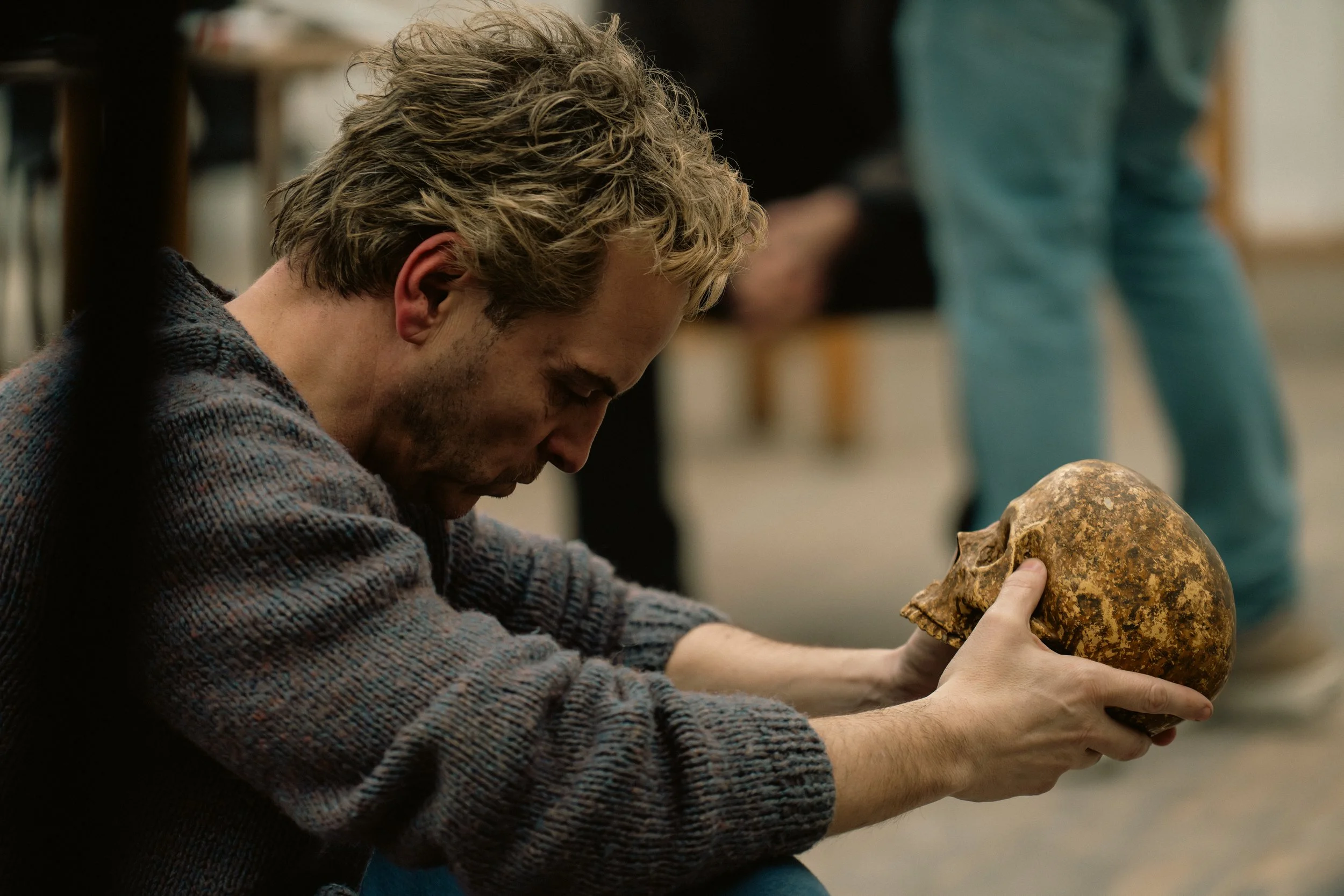
Ian Charleson faces his fate head on.
Overall: A