GIRLS LIKE GIRLS

Directing: B+
Acting: A-
Writing: B
Cinematography: B+
Editing: B+

Between Leviticus and Girls Like Girls, I guess it’s the Month of Good Gay Movies, and I must say I’m delighted. It’s somewhat ironic that Girls Like Girls is set in 2006, because at that time movies about queer people had a pretty reliable, indie-janky vibe to them, some of them more charming than others. These days it’s much easier to find well-produced queer cinema, even if the budget is on the smaller side; I love that both of these movies were released on the same weekend, one week before most major cities have their Pride Weekend, but also simply in the month of June, which is Pride month. I can’t remember the last time I’ve been so satisfied with overtly queer cinema.

That’s not to say that either of these movies is perfect, of course; they are both definitively not—but, they are also both closer to it than they would have been twenty years ago, and for different reasons. Unfortunately I do think the script is Girls Like Girls’s weakest link, albeit not by a very wide margin. And a film need not to be perfect to be effective, and effective might be the best word to describe this film. I’m feeling all sorts of things about this movie, not least of which is that I really should have known to bring tissues into the theater with me.

This is a pretty straightforward love story, which just happens to be about two 17-year-old girls. And unlike Leviticus, which is a horror movie about the insidious influence of religious bigotry, regilion never even really gets mentioned here. The closest we get is Sonya (Myra Molloy) worrying about what her mom and her friends will think, if they find out how she feels about Coley (Maya da Costa), who is actually the film’s protagonist. And rather than struggling with her sexuality herself, Coley’s greatest challenge is with how Sonya expresses affection and then retreats out of fear. There is a heartbreaking, and deeply relatable, moment when Coley says, “Why can’t I be normal?” But that can be relatable whether you are queer, or just a teenager.

And this is the thing I love about Girls Like Girls, which simply illustrates what it’s like to be a teenager, dealing with other teenagers. These kids are all just learning how to be decent human beings through trial and error. But, Colely feels even more alone due to the recent death of her mother, and now living with a dad (Zach Braff) who did not raise her but is now trying his best to get to know her. This is a subplot that is at once an added dimension for Colely and a bit undercooked, but it does provide the context for the one scene in which I was constantly wiping away tears from my sleeve.

I did not know this until researching this movie—well, and director and co-writer Hayley Kiyoko’s recorded introduction to the film—but Girls Like Girls has had a bit of a journey over the past ten years. It began as a music video for the song by the same name, by Kiyoko herself, who began as a singer at the age of 16 and was taking acting roles not long after. The song was on her five-track 2015 EP This Side of Paradise, and it would be another three years before Kiyoko released her debut full-length album, the first of three to date, which I guess I need to check out now. Kiyoko also co-directed the music video, which eleven years later has 163 million views on YouTube. By 2023, Kiyoko had adapted the story from the video into a Young Adult novel, continuing its storyline, and along with co-writers Stefanie Scott and Chloe Okuno, it has now been adapted into a feature film.

It’s a good song, and Girls Like Girls the film follows many of the same beats as Girls Like Girls the music video, with several key scenes mirrored, just with different young actors. There’s a delightfully shocking turn in the video that was omitted from the film, and I can’t decide if that keeps the film on a higher level or if its inclusion would have improved it. It’s a curious thing to travel back in time when regarding all this story’s iterations; apparently the video was incredibly popular with many young queer people, and after the release of the film’s trailer you can find many fun comments on the video’s YouTube page like, “revisiting the ancient texts.” Because of course, something released in 2015 is an ancient text. And seeing a film created as a “period piece” set in 2006, complete with CD storage binders and a lot of scenes with texting over AOL Instant Messenger, makes me feel like I’m from the fucking Stone Age.

Honestly, I can’t decide whether Girls Like Girls overdoes it a bit with the AIM. Was it still that much in use in 2006? I think AIM and I think 90s. Grandpa Matthew went onto the Wikipedia to look into this, and evidently AIM was popular through 2005, at which time its decline began with the advent of SMS text messaging and Gmail. 2006 was pretty soon after that, so I guess I’ll allow it; it appears I didn’t even have my first iPhone until 2008, so for all I know I was still using AIM myself in 2006. I just can’t remember! Because I’m old!

Anyway, “period” details aside, there are moments of dialogue that come across as a little stilted. There are also scenes in which teenagers are socializing and talking about things no human adult would be interested in, and this comes across as authentic; it’s a different thing. The moment when Coley and Sonya have a “meet cute” of sorts didn’t fully work for me, and it was because of the writing. There’s a few scenes that unfold this way, but to Maya de Costa and Myra Molloy’s credit, they really sell it; they have real chemistry and it’s easy to believe they are falling in love with each other, yet being tentative with each other for their own separate, largely unclarified reasons.

When all was said and done, Girls Like Girls left me deeply moved, and I love that it’s part of a lasting legacy of making young queer people feel seen and feel good about themselves. The existence of movies like this makes it just a little bit easier to have hope for humanity.

If this isn’t truth in advertising I don’t know what is.

Overall: B+

LEVITICUS

Directing: B+
Acting: A-
Writing: B+
Cinematography: B+
Editing: A-

Does Leviticus hit different if you grew up closeted and religious, I wonder? Well, I did, and there’s no escaping the very personal way this film unfolded in my eyes. This isn’t just “queer horror” in the metaphorical sense; queerness not only is the text, but it’s about how willfully ignorant people will use our own desires against us—sometimes to deeply effective, and even fatal effect.

Leviticus is very effective just as a straightforward horror movie as well; Australian writer-director Adrian Chiarella understands how to make this movie work on both surface and deeper levels, allowing viewers to wade in as far as they’d like. Teenage friends Naim (Joe Bird) and Ryan (Stacy Clausen) are introduced to us like believably regular buddies, roughhousing until they tumble in each other’s arms, and before they know it they’re kissing. That may sound a little corny, but Bird and Clausen are such gifted, natural performers that it feels totally organic. There aren’t even any tropes of internalized homophobia here; they seem totally comfortable with themselves and each other, and are only wary of the rest of the world.

But then Naim happens upon Ryan in his backyard, with another teenager (Jeremy Blewitt), and they’re doing something rather unsettling: taking turns hurling stones right at each other. We have already seen scenes in the local church by this point, so at first I thought maybe this was some kind of allusion to stoning as punishment. This practice comes up several times more, until the it is finally revealed to be something very different—and desperate—and one of the pieces of the narrative puzzle clicking into place.

Soon enough, Ryan and this other kid are brought by the religious locals to a so-called “Deliverance Healer,” and the boys are openly derisive of the practice—again, comfortable in their own skin, dismissive of what they understandably regard as crackpot ideas. Except in this film, the ritual works, and it cannot be undone: the result is a sort of inner demon that never leaves you, but externalizes and manifests as the person, as another character puts it, “you’re most into.” So, when either Naim or Ryan is alone, they will see the other one, who seduces them, only to physically attack them. Left unchecked, it will literally kill them, as happens to the teen lesbian character in a pool shower in the opening scene.

I never saw the acclaimed 2014 film It Follows—I avoid most horror movies—but I do know Leviticus has invited many comparisons, though by all accounts It Follows is an allegory for sexually transmitted infections. Leviticus also explores a kind of personalized nightmare that never goes away, but its explicit queerness is what sets it apart. And I mean “excplicit” not in a sexual sense (there are two sex scenes, of sorts, and neither is at all explicit), but in the sense that it’s about queerness, with queer protagonists, and the pressures of a world that can’t even be bothered to understand.

The one character I have some ambivalence about is Naim’s mother, played by Mia Wasikowska, who looks strikingly like a young Martha Plimpton. Wasikowska looks so young, in fact, I wondered if she was too young to play Joe Bird’s mother; well, Bird is 19 and Wasikowska is 36. I guess this woman would hardly be the first in the world to have had a baby at 17 (or in the world of the movie, probably more like 19; Bird is clearly playing younger). Maybe it’s just because I have reached the ancient age of 50, but to me they looked so close in age that I really thought at first that she was maybe his much older sister taking care of him after the death of their parents.

Anyway, that’s not even the real source of my ambivalence; it’s the characterization of Naim’s mother, who never engages with him, never truly talks to him, and certainly never listens to him, particularly when he’s trying to explain the extraordinary things going on. She takes him to church, and writer-director Adrian Chiarella imbues her with a kind of prejudice that is unexpected: rather than, say, being disgusted by his sexuality, instead she fears the hatred of others—and uses that as an excuse for bringing the “Deliverance Healer” to him: “I can’t lose you too,” she says, as though curing him of what she sees as an affliction will protect him from outside threats. Instead, she invites one that manifests from within. There may be something to this among those of us with real-world experience in religious intolerance: the backfiring of actions by loved ones who are convinced they mean well.

Still, there is something weirdly repressed about Wasikowska’s mother character, stripping her of dimension even as she’s very effectively used to make the movie’s point. And there’s something very sinister about the effects of treatment like this, a lasting trauma that cannot be undone. There’s also an unsettling irony to the fascinating detail of how this living nightmare works, in that the demon manifestations only appear if you are alone. So as long as you are sure you are with the real version of the person you desire and not the nightmare version, presumably you’re okay? But also you can never, ever let them out of your sight, presumably for the rest of your life? That seems like a kind or forced commitment, a nightmare all its own.

Or maybe these two will inevitably fall out of lust with each other, start having eyes for other people, and then it will be those other people these nightmare entities take the form of when they are alone. Maybe they should just open up the relationship but never be apart? Shared orgies until the end of time!

I digress. I have to hand it to this movie, it really makes you think. It’s also very effective with its horror-movie scares, both in scenes with very successful jump-scares and scenes in which you are simply terrified one is coming. I’ve never been so terrified watching a hand job in my life, I was so convinced it was going to end with a nightmare version of either Naim or Ryan popping up and scaring the shit out of me.

And that’s what it all comes down to: “We need fear,” Naim’s mother says, as justification for what she’s done to him. “It’s how we survive.” That line will stay with me, a haunting idea by virtue of its deeply misguided contextualization. Well, I’m not sure I need the fear Leviticus put in me with effective horror staging, but it offers certain depths that make me very glad I saw it.

Okay but what if a man stands with a man?

Overall: B+

STOP! THAT! TRAIN!

Directing: C
Acting: B-
Writing: C
Cinematography: B-
Editing: C
Special Effects: C+

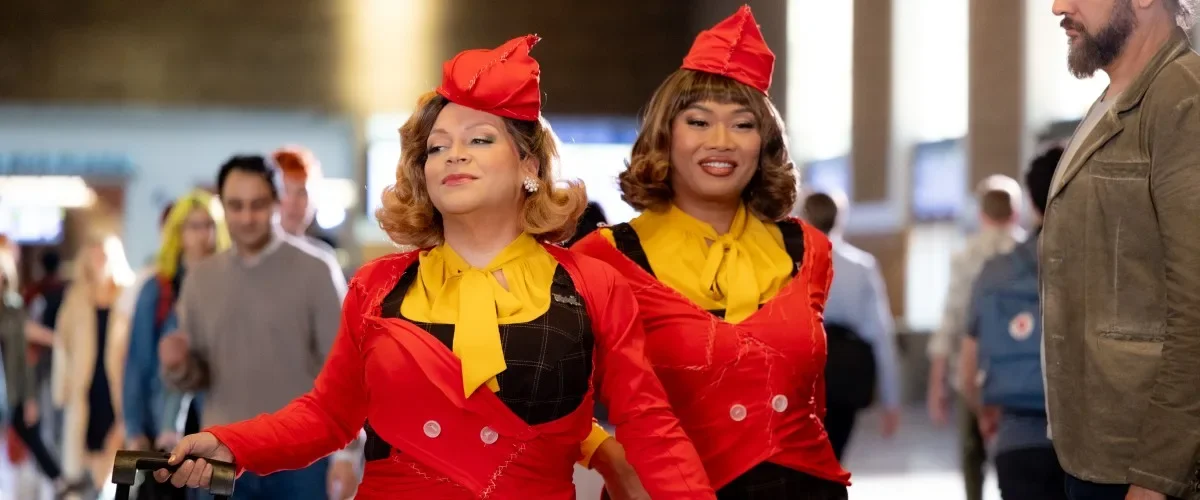
Let me tell you a story, you ones. There once was a movie spoof comedy so hilarious, people went back to see it over and over again, just to catch the wall-to-wall gags they missed while they were too busy laughing the first time. It was a smash at the box office, it could reasonably be called the funniest movie ever made, and it was called Airplane! The thing is, if you are indeed young, you’ve probably never even heard of this movie, let alone the fact that it was sending up the countless, self-serious disaster movies being made at the time. And you certainly won’t understand that Stop! That! Train! clearly thinks its paying homage to it, but instead is straight up ripping it off.

It has the characters regularly returned to as a running gag—in this case, a horny woman (Missi Pyle) coming on to the train conductor (Chris Parnell) she doesn’t realize is dead; or the bitchy businessman (Jesse Tyler Ferguson) yammering to a pregnant woman (Mayan Lopez) about how he only likes babies when they are still inside the womb, or the distracted woman (Natasha Leggero) who can’t stop yakking on her phone. In retrospect, I suppose it actually is kind of hilarious that the woman playing a famous actress constantly thinking people are recognizing her, when really they just wanted to complain about her being in her seat or whatever, was an actually-famous actress I did not recognize, and it turns out she was Sarah Michelle Gellar.

Airplane! didn’t have these exact same scenarios, but it certainly had a number of similar concepts—enough, in fact, that here they play like overused ideas in Airplane IV. What Stop! That! Train! does do is have crew dragging the conductor’s lifeless body down the aisle while passengers fail to notice, and this exactly happens in Airplane!

What I’m saying is, I watched Stop! That! Train! constantly thinking of the far better movie that clearly inspired it but did everything a hundred times better and with actual laughs per minute. I won’t deny that I got a few good chuckles out of this movie, but the frequency was more like a couple laughs per act. I was excited by the thought of a major motion picture presented basically as a spoof but through a pointedly queer lens, but this is an exercise that would have worked far better as a five-minute sketch, or hell, even a thirty-minute short film. Stretching it out even as far as what otherwise should be a tight, ninety minutes, if you’ll pardon the pun, drags it down. Way too much of what’s onscreen just lands with an airless thud.

The opening credits sequence is amusing, as director Adam Shankman (who saw better days directing the 2007 film adaptation of the Hairspray musical—the ensuing two decades have not been kind) cuts back and forth between real footage of impressive high-speed trains zooming through verdant landscapes and shots of obvious model trains and toys. Unfortunately, this is the high point of the film. We then meet Tess and DeeDee (played by drag queens Ginger Minj and Jujubee), on their way to work at Stank Rail, only to find themselves laid off. When two crew members don’t show up for work at competing rail company Glamazonian Express, they quickly whip up disguises to go in their place. Very quickly this luxury train finds itself headed straight into a “Stormaganza,” and hijinks ensues. Shankman, and co-writers Christina Friel and Connor Wright, clearly want you to think that hilarity ensues. It might be more likely for your mind to wander.

If you’re a huge fan of RuPaul’s Drag Race, you might consider this movie star studded. I never got into that show, so while I’m sure plenty of people recognize the plethora of other drag queens in the cast (Brooke Lynn Hytes; Marty Lauter; Symone; Monét X Change; I think I may actually recognize Latrice Royale from somewhere), the only one readily recognizable to me was RuPaul, who plays President Judy Gagwell—part of the “gag” here being, obviously, she’s hardly any more ridiculous than the actual President we have right now, though her winning campaign slogan of “She fun” isn’t that far off from how he got here. Maybe my favorite was Matt Rogers as President Gagwell’s Press Secretary; his reaction after Gagwell says “Give it to me straight” and then “Now give it to me gay” is pretty great. This entire film could have used more of his vibe.

The thing is, I really want a movie like Stop! That! Train! to work, and to succeed. It was made for a paltry $20 million, and the $2.5 million it’s earned in the past five days might as well be regarded as nothing—but, if you watch this movie, you won’t be surprised. The people making this movie seemed to be having a good time, but apparently no one was around to tell them how much of it wasn’t working. The outtakes during the end credits have more energy to them than the entire film that precedes them.

Stop! That! Train! is the kind of project that would have worked far better as a janky live theater production, particularly one that could be workshopped in front of audiences so they could decipher which gags actually work. There’s a smattering of gags in the film that do work, but they are few and far enough between that you might start to get antsy, or downright impatient. The film does have a sort of knowingly low-budget quality, with what appears to be the aim of that being part of the charm. I really like a ton of the people seen in it (there are countless I haven’t even mentioned; I will say that Guy Branum is utterly wasted in it as one of countless idiot guys who won’t listen to the one woman—played by Rachel Bloom—at the United States Train Command Center who is trying to save the runaway train), but none of them get used in a way that comes close to meeting their potential.

This is a movie that actually could have been great, had they just used better writers. This makes it all the more disappointing, and given the hopes I had for it, maybe the most disappointing movie I’ve seen this year. I want to give the cast their due, say they’re doing their best, but that hardly matters in a comedy where most of the comedy doesn’t work.

Stop! That! Movie! and watch Airplane! instead.

Overall: C

SIFF Advance: BODY BLOW

Directing: B-
Acting: B
Writing: B
Cinematography: B+
Editing: B

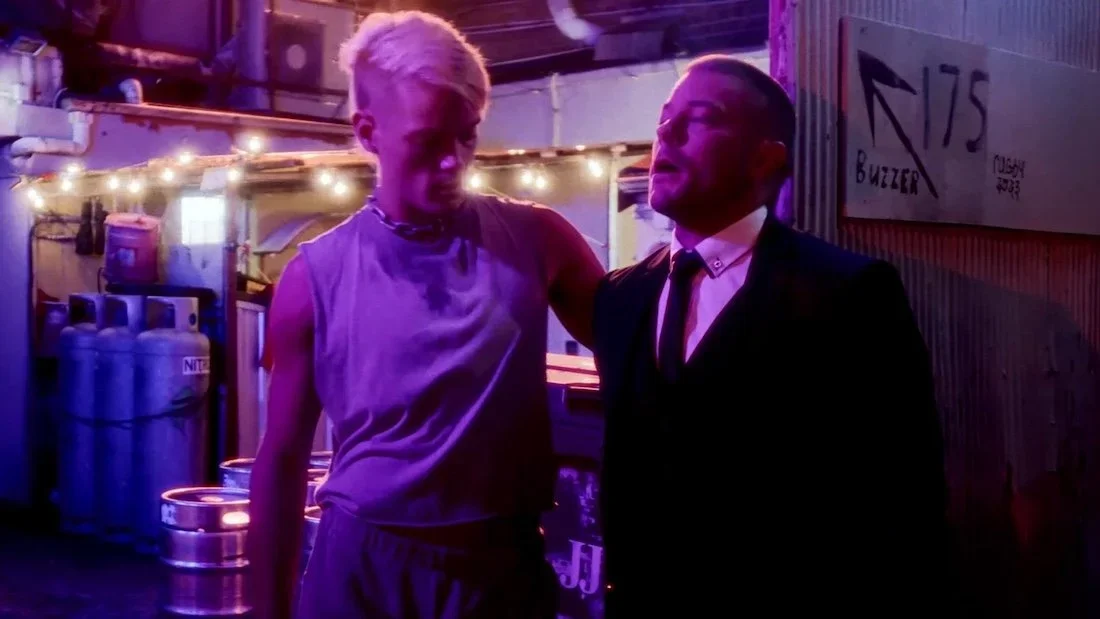
Body Blow is currently merely on the festival circuit, and thus far responses have been pretty mixed. I would argue that it practically invents the “camp noir” genre, though presumably there have already been other films released that fit the genre. Either way, detractors of Body Blow clearly just don’t get what it’s going for. This film is far from perfect, but it does strike the perfect balance in tone, right down to how it might as well have been titled Twink Fatale, except that even for this movie that title would have been a little over the top. Then again, the one onscreen murder scene in this film is the precise moment when Body Blow ascends to the point of high camp. And it’s kind of what made the movie work.

Mind you, this is a movie that falls apart with any close examination. The plot, as written by director Dean Francis, is so convoluted I often found it hard to ascertain why what I saw onscreen was happening. Some of it clicks together by the end, but not everything Francis attempts to wrap up in a bloody bow is quite fully contained in the package.

Speaking of packages—hooray for segues!—lead actor Tim Pocock’s figures prominently, albeit without a great deal of sense. (Side note: I don’t know if that guy’s last name was just a coincidence, but it sure got a smattering of giggles from the audience I was in.) His character, a Sydney cop named Aiden, is obsessed with the idea that not masturbating makes him both stronger and a better cop. In the opening scene, we hear the voiceover of a podcast he’s listening to, a guy with an American accept (also: coincidence?), is extolling the virtues of what we later learn is part of the “no fap” movement. Aiden eventually takes this to the extreme of buying a chastity cage for his penis—something we get several shots of him in, otherwise nude. I found myself wondering how the Motion Picture Association sets parameters for this, because it’s clearly not “full frontal” if we never see his penis, it’s rather unusual to see an actor’s testicles, however smooshed a cock cage might make them. Is this similar to it being okay to see nearly all of a woman’s breasts so long as only the nipple's are covered?

This cock-cage subplot is amusing—as is the fact that Aiden keeps chickens in his backyard, including roosters, even though you don’t need roosters in order for hens to keep laying eggs—but never feels vital to the plot. This involves Aiden’s introduction to Cody (Tom Rodgers), a guy who takes his identity as a twink so seriously that his car’s vanity plate just reads TWINK (the final shot of which is satisfyingly gruesome, incidentally). Cody is sort of a “kept boy” at the drag club run by a villainous drag queen played by Australian cabaret performer Paul Capsis. I don’t know how famous Capsis is in Australia, but this is the kind of part any drag queen worth their salt would love the play, yet Capsis doesn’t quite bite into the role the way you might hope, and his multiple club-host performances in the film fall a little flat.

It’s Tim Pocock and Tom Rodgers who make Body Blow worth watching (though Sacha Horler as Steel, the dirty lesbian cop and Aiden’s superior, has a bit of onscreen charisma of her own). I can’t pretend Body Blow was everything I wanted it to be, but it gave me plenty to work with, in that it features effectively knowing film noir tropes; it has a hot gay 40-year-old cop; it has a hot gay twink; I am also gay; and I have a pulse. That said, it also has a cinematographer (Franc Biffone) who clearly understood what the director was going for, and it has an 80s-synth-style score by a composer (Andreas Dominguez) who gave the vibe something you might find on a sonic highway connecting Priscilla, Queen of the Desert with the original Blade Runner.

Tone can really make or break a film, and this is where Body Blow nails it, staying impressively consistent with its very specific sensibility. The pacing is measured but never completely drags (so to speak), and this is in keeping with neo-noir storytelling. There’s a dangerous attraction between a copy and a young beauty, there are multiple levels of betrayal, and there are backyard cocks. Flaws aside, Body Blow is a film that truly stands apart, which makes it imperfectly exceptional. It’s not for everyone and it’s not meant to be, but I for one sit square in the crosshairs of its target audience, and I do love it for that.

This movie has a lot of entendres.

Overall: B

PILLION

Directing: A-
Acting: A-
Writing: A-
Cinematography: B+
Editing: A

What a time of dualities we live in, where we live in a country under constant attack on progressive values, the embrace of the full spectrum of of queer expression being just one among countless. There’s a strange dissonance to the combination of defiant resistance to the mainstreaming of prejudice and bigotry, and the very existence of a film like Pillion.

Telling stories that feature queer joy, pointedly in the place of an endless parade of queer tragedy in all mediums of storytelling, is a thing these days. Pillion is representative of a deeply specific sort of queer joy, the kind experienced by those who enjoy consensual debasement and dominance, maybe even a bit of pain. This is far more common than many might thing, queer or not. This film, in its way, heralds the broadening of this awareness.

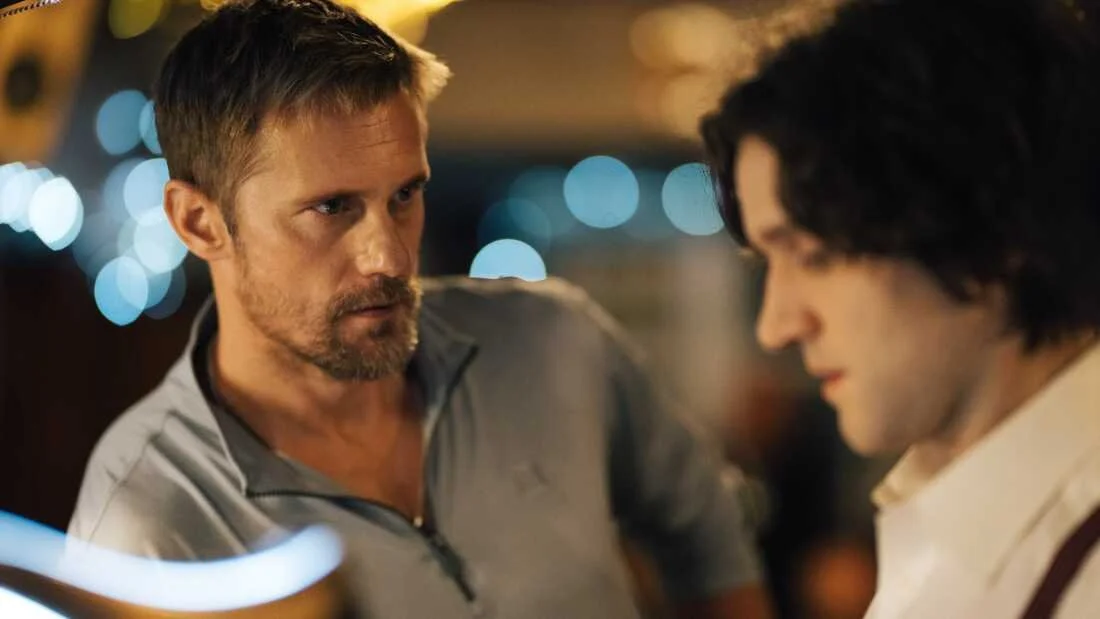
The pairing of Alexander Skarsgård and Harry Melling is a fascinating one. Melling is still most well known as the fat cousin of Harry Potter—something he couldn’t be further from now, a handsome man of 36. Skarsgård, now 49, is still so hot it defies reason. This is only referenced a couple of times in Pillion, though there’s a slightly sad moment when Melling’s character, Colin, is told that Skarsgård’s character, Ray, puts Colin’s features into sharp relief. It’s hard for anyone to compete with Skarsgård on a visual level to be honest. This is a guy who is not only incredibly hot, but knows how to be hot. When Ray sidles up to Colin for the first time at a bar, giving him a hard, smoldering stare, I thought: I would also do whatever he wanted.

One might think that this is an odd pairing for a multitude of reasons, except for the genuine chemistry they have with each other. And one of the many great things about Pillion is how it depicts a BDSM biker community, and it is a “community” in a very real sense of the word, with genuine friendships and emotional connections. There just also happens to be camping trips with communal hard sex acts.

I actually think this is important, the unusual frankness of not just the sex in Pillion, but very specifically the queer sex—and even more specifically, the BDSM sex, among Ray’s biker friends if not necessarily between Ray and Colin, which is much more orientated toward a maste/slave kink (as Colin notes, “I’ve been told I have an aptitude for devotion”). Colin is very naive as he wades into this world, but as the story unfolds, we see subtle but pointed nods to notions of consent and boundaries. When Ray unzips his pants in front of another sub, that sub first looks over to Colin to make sure it’s okay.

And what a great achievement Pillion is, to have such an earnest and sincere love story within this context. Colin’s parents are so on board with his sexuality that, in the opening scene, he’s on a blind date his own mother set up. Eventually Colin’s parents have difficulty understanding him, but it has nothing to do with his gayness and everything to do with the dynamics of his relationship with Ray, and how Colin will drop everything for him, or wait on him hand and foot. But how do you explain this kind of relationship, especially with your parents, and especially if you’re so new at it yourself that you’re learning as you go along?

The story is told from Colin’s perspective, but Alexander Skarsgård’s performance deserves special commendation. We never learn a lot about Ray, except that he evidently has intimacy issues, and as a result he is very resistant to dropping the dom/sub routine. This becomes the source of conflict, as Colin realizes he loves living this way, just not all the time. His request to “take one day off a week” becomes a salient plot point, and turns Pillion into a beautiful meditation on setting boundaries. Colin gets his first taste of this with a fellow sub who observes that Ray doesn’t allow kissing, and the guy says, “I couldn’t handle no kissing.” Indeed, the first time we see that character, he is giving his dom a passionate kiss.

Pillion is a film that could easily be misunderstood by the deeply ignorant, but thankfully not just sex, but kink is now widely regarded as things to be embraced without shame. This film is broadly about the full expression of self and sexuality, and specifically about how to approach it in an emotionally healthy way. It would be accurate to call this a “coming of age” story, even though—thankfully—it’s not about kids. This is about how it’s never to late to discover your full self, even if that self is fulfilled by sleeping on the rug and cooking all the meals.

It does feel worth noting that although Pillion is largely billed as a romantic comedy—albeit a very frankly sexual one—I found it to be much more of a romance than a comedy. I got a few chuckles out of it, but this movie is not particularly funny. It is, however, very sweet—even heartwarming in the end. I found a bit of implausibility in some of Ray’s characterization, but this also added to his mystique. If only Colin had been introduced to a dom top who was more in touch with the separation of role playing with reality, or particularly with more of an intuition for actual guidance in unfamiliar territory—but, that story would perhaps not have been as compelling.

Underneath all the BDSM trappings, Pillion follows pretty familiar beats: a character loses his way a bit and then finds his way back again. All that matters is how pleased and happy we are for him once he gets there. This is a rare case where you can believe the hype, because this is a truly great piece of work by first time feature film director Harry Lighton, and I will be looking forward to what he has to offer next with eager anticipation.

I’m not really into licking boots but for him I get it.

Overall: A-

THE HISTORY OF SOUND

Directing: A-
Acting: A
Writing: B+
Cinematography: A-
Editing: A-
Music: A

Maybe The History of Sound isn’t for everyone, but it’s certainly for me. It’s a moving love story, it’s a period piece, it’s a sad meditation on love and loss in the context of a same-sex relationship but without any gay trauma tropes associated with it. It’s about two men who fall in love who also happen to be incredibly talented musicians with a love of hyper-regional folk music, of which this movie is packed—The History of Sound isn’t quite a musical, but it very much hinges on its musical content. Many, many songs are performed, mostly solo or in a duo and mostly a cappella. Occasionally there is guitar or banjo accompaniment, but only as subtle augmentation to the beautiful, and often haunting, vocals.

It’s been quite a year for movies about folk musicians, from The Ballad of Wallis Island to Sinners, and now The History of Sound. I’m pretty disappointed to discover that although those first two films had soundtrack albums issued, it appears The History of Sound did not; I’d love to listen to it again. It also has a key thing in common with Sinners, in terms of what appears to be authentic history of folk songs.

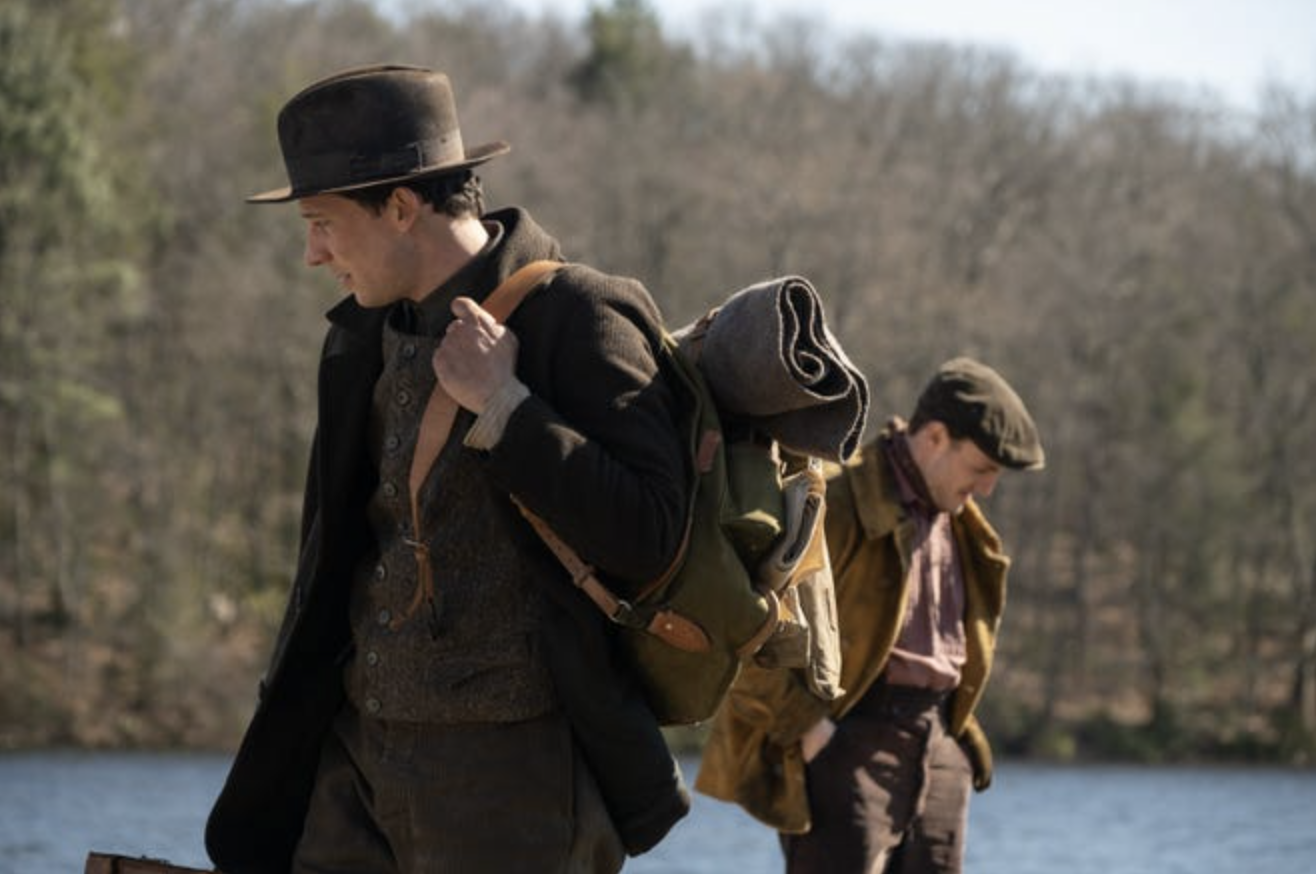
In a pretty long stretch of the film, David (Josh O’Connor) has taken Lionel (Paul Mescal) along with him on a “song collecting” trip, walking from village to village in New England. In one key scene, they visit a village with a high percentage of Black residents, and this is the one time we see them recording a song by a Black singer on the machine they use to record songs on wax cylinders. When they leave the village, they pass a large group of police, clearly preparing to wreak some kind of terror on that community. This is our first glimpse of wildly different approaches or worldviews between David and Lionel. Lionel grew up on a small farm in rural Kentucky and knew a grandfather who was a Confederate soldier in the Civil War. David is American-born but spent a couple of years in England with an uncle, doing a “song collection” project there when he was younger. David, who has been drafted in World War I and only hints at how he’s seen some shit, bristles at Lionel’s suggestion that where you’re from should have any relevance to how you view and understand the world and how it works.

The History of Sound moves at a very slow pace, but is constructed with some expert plotting, bringing some of it full circle in an ending sequence starring Chris Cooper as Lionel as an old man, in a way that will truly pierce your heart. Maybe half of The History of Sound is sort of like Brokeback Mountain if it were quieter, much more concerned with music, and far less tragic. In the other half, we see these men, and particularly Lionel—he’s the one we follow in this story from start to finish—in academia, attending university, in some cases teaching. Lionel eventually sees much of the world just as David suggests, but after multiple reunions and separations, he spends some years writing to David, then finally stops after a lot of time with no responses.

The latter half or so of The History of Sound is more concerned with Lionel and his longing memory of David, as Lionel moves on. He gets into a relationship with and nearly marries a woman (Emma Canning), and he uses the imminent death of his mother (Molly Price) as a means of ending it. One of my favorite things about The History of Sound is Lionel’s relationship with his parents—somewhat complicated with his mother; surprisingly pure with his father (Raphael Sbarge). Lionel shows no guilt about his sexuality, but neither does it ever seem to be a relevant part of any conversations with his parents. Instead, he gets a beautiful memory of his father showing him how to light a tub of thin paper on fire (I think it may be an unfolded tea bag?) in a way so the it burns straight down, and then lifts into the air in its final seconds of burning. You won’t get any of the tropes here about a macho or abusive father to a sensitive gay kid here. Lionel is clearly sensitive and accepted as his whole self; he’s also fully capable of all the things associated with running a farm.

Come to think of it, The History of Sound sidesteps stereotype at every turn, which is a big part of my love for it. There is a flashback, one of many later in the film that goes back to their time hiking and camping through New England, in which David asks Lionel if he worries about “what we’re doing.” Not only does Lionel not worry, it doesn’t even appear to have occurred to him.

This is a film in which two men have fallen in love at a time when such things were not at all understood, often by the men themselves, but it is simple circumstances rather than oppression that keeps them apart. There is a moment when Lionel suggests he could go back with David to help him catalogue his cylinders, and David discourages it. He says to Lionel that he would not be happy there in that small town, and possibly he’s right. David has a much surer sense of the direction of his own life, and he can see the direction of Lionel’s life better than Lionel can.

Much is revealed, much later, that was not at all clear during that time they spent in New England, and I won’t spoil it, except to say that you should keep tissue handy. And, of course, the thing that pierces through the heart is done through song—something that can carry the weight of emotion in ways nothing else can. It’s a callback to the scene of their meeting, and it brings things around to resolution, after years and decades of longing, in a perfect way. I can see how some might lose patience with the pacing in this film, but it would never have worked as well if the plot moved faster. This is the nature of longing, is it not? This is a film that will deeply move those with a mind to be spoken to in the way it’s communicating.

The songs of the countryside provide more than just dialectal history.

Overall: A-

HONEY DON'T

Directing: B-
Acting: B+
Writing: C+
Cinematography: B+
Editing: C+

Honey Don’t is a very peculiar film, in that the mixed-bad reviews are hardly unjustified, and yet I found the experience of watching it to be a surprisingly enjoyable one. It’s the kind of movie that, in another time, could have easily become a gay cult hit—it fits neatly into the “lesbian noir” genre, after all, and has a deeply subtle but pervasive camp sensibility to it. There’s a lot in it that might go over the heads of mainstream audiences but which gay audiences might appreciate. Plus, the lead character, private investigator Honey O’Donahue (a wonderful Margaret Qualley), is gay.

So are multiple other characters: local cop MG Falcone (Aubrey Plaza), with whom Honey has a fling; Mr. Siegfried (Billy Eichner, criminally underused), who has hired Honey to investigate who his boyfriend is having an affair with; and Collegian (Christian Antidormi), Siegfried’s boyfriend who meets a delightfully dark fate that I won’t spoil here. That fate, however, is very directly tied to Hector (Puerto Rican actor and singer Jacnier), who has an illicit sort of employment with local Reverend Drew Devlin (Chris Evans, always fun to see in parts that are not Captain America).

It doesn’t take long for bodies to start piling up, in ways that are both amusing and decidedly Coen-esque—this is another film directed by Joel Coen but without his brother Joel, here co-written by Ethan and his wife Tricia Cooke, and this may be the Coen film made by one without the other that I have enjoyed the most. That doesn’t make it the best, per se; I just enjoyed its oddball mix of noir and queer sensibility. I kept thinking of the 2021 film French Exit, which I enjoyed in a very similar way. That’s a different movie, except that it also has its own (much more overt) camp sensibility, also easy to have a blast with in spite of its obvious flaws.

There’s something to be said for casting. Margaret Qualley has such great onscreen charisma she carries Honey Don’t through what otherwise would be lulls in the plot. Charlie Day plays a local detective who is charming enough to make up for his clueless declarations of “You always say that!” when he hits on Honey and she tells him “I like girls.” Evans hits the perfect notes in his performance of an oversexed minister who keeps doing ministry even in bed.

It’s in the plot threads that Honey Don’t is likely to lose people. This movie is all of 89 minutes long, and is a rare case of one you find yourself wishing had been longer. It ends with multiple narrative threads that neither get any satisfying resolution, nor do they appear to have any connection to one another. It’s difficult to say which does more to make or break a movie, the script or the editing, but it feels a lot like both are at fault with this one.

At least the charismatic actors are also shot well, giving this a slight feel of older, better Coen Brothers movies (and the opening credits have a particularly fun and clever design). As the story goes along, as long as you’re not thinking too hard about what the hell is going on, it’s easy to have a great time. It’s tempting to say Honey Don’t is ultimately a failure, except for the parts I enjoyed so much—the actors, the cinematography, the subtle notes of camp. I would recommend it only to a very particular group—queer people who love a knowingly, esoterically ironic point of view. It’s pretty cool that Ethan Coen went in that direction, if nothing else.

It’s no masterpiece, but it’s fun to watch!

Overall: B

SIFF Advance: TWINLESS

Directing: B+
Acting: A-
Writing: B+
Cinematography: B+
Editing: A-

Twinless is about an unlikely friendship that occurs between two guys, one straight and one gay, after they meet in a support group for people grieving the loss of a twin. That is the log line of the film, and it remains an accurate descriptor from beginning to end, albeit deceptively so: Without spoiling anything, I will say that a major twist occurs in the second act, and it was one I found deeply disappointing. I wanted this to be an exploration of an unlikely friendship under these circumstances, but not only do the circumstances change—we discover them to have been different all along. This allows for some profound conflict between the two lead characters, but does the conflict have to be that profound? I would argue that it doesn’t, and that it changes what makes their connection compelling in the first place.

And yet, here’s the thing: I was utterly charmed, and sometimes deeply moved, by Twinless in spite of this disappointment. It’s a big thing, but it’s still the only thing I didn’t like about this film. And it should be noted that writer-director James Sweeney, who has been developing this script for a solid ten years, has written his characters with such dimension, depth, and authenticity, it goes a long way toward making up for that one disappointment. Sweeney himself plays the gay character, Dennis, and it’s always impressive when a director can star in his own film and actually pull it off. It could be argued that Dennis is borderline psychotic, at least judging by his behavior, and still he’s undeniably empathetic, even when it becomes unclear whether he deserves empathy.

The crucial element of Twinless, however, is Dylan O’Brien, previously best known for Young-Adult roles like Thomas in The Maze Runner or Stiles in the television series Teen Wolf. Now in his early thirties, he’s making a new name for himself in indie cinema, and nowhere more impressively than here in Twinless, as Roman, who is grieving the loss of his identical twin brother, Rocky. O’Brien’s performance is amazing in this movie, the one thing that most recommends it.

There is a relatively short flashback sequence in which O’Brien also plays the twin brother, Rocky—the gay one. This makes the second film in short order featuring a non-twin actor playing twins onscreen, and although the movies share nothing in common otherwise, it still invites mention of Sinners, in which Michael B. Jordan does the same. The key difference is that Jordan plays opposite himself in a great deal of Sinners, in ways that are often disctracting because we know, and can tell, that there were never two of him actually on camera at the same time. Sweeney deftly sidesteps this problem by making Roman and Rocky estranged, and never showing the two characters onscreen at the same time.

There’s also the fact of Roman and Rocky’s diverging sexualities, though—something that becomes a key plot point, and one very well handled. This does mean that O’Brien, a straight man, spends some time playing a gay man, which is something many often argue should not be done. While I agree broadly that gay actors should be given gay parts, I am also not militant about this, and believe context and circumstance always matter. It’s certainly relevant that Sweeney himself is gay, and he was the one giving direction on these performances, reportedly with some reticence on O’Brien’s part to get too far into depicting effeminacy. The minor miracle of Twinless is that O’Brien’s performance is incredible, both as Roman and as Rocky—they may be technically identical, but they have distinct mannerisms and appearances (choice of clothing, facial hair) that make then feel like wholly different people. In the Rocky flashback scenes, it took me a while to realize it was even the same actor.

The central theme of Twinless is loneliness, and though it is contextualized with the specificity of losing a built-in best friend that often comes with being a twin, it also transcends that specificity. Dennis is lonely for different reasons, and these two guys are dealing with their loneliness in very different ways, but have found each other as a means of, if not filling that hole, then covering it up a bit.

Twinless also has great, well-rounded characters, particularly Marcie (Aisling Franciosi), the receptionist at Dennis’s work who Roman starts dating after he accompanies Dennis to her Halloween party. Dennis has spent a lot of time making wildly inaccurate assumptions about Marcie, which makes it easy for us as viewers to do the same, to see her as a sweet but incredibly naive woman. She actually is sweet, but not naive, and it turns out she won’t stand for anyone’s bullshit—certainly not Dennis’s, and not Roman’s either. In addition to Franciosi, Gilmore Girls’s Lauren Graham is a welcome presence in just a few scenes as Roman and Rocky’s mother, playing tensions with Roman as they both navigate the loss of a loved one. In a scene when both Marcie and Dennis go home with Roman for Christmas, Marcie, ever the understanding one, tolerates their inevitable arguing with grace, explaining to the less-understanding Dennis, “I think they’re grieving.”

I haven’t said much yet about how funny Twinless is, with both a unique sensibility and a unique sense of humor. This film is very much a dramedy, and I would indeed recommend having tissues handy. It also has a keen understanding of how people deal with grief in very different ways, and may hit differently if you have lost someone very close to you, twin or not. But it also has some incredibly effective humor, often cutting through the grief in the best way. It’s often uncomfortable, but I hesitate to call Twinless “cringe comedy,” as it rarely truly made me squirm in my seat (not usually my favorite kind of humor). It could also be said that a gay character pining after a straight guy he can’t have is a bit overdone, but again, Sweeney effectively makes it his own, creating a truly singular story. Were it not for the one thing that genuinely disappointed me, I would probably be saying I adored this movie, to a similar degree that I adored films like All of Us Strangers or National Anthem. But, reconciliation through disappointment—also a major theme of Twinless—has its own deep and lasting value.

They don’t have their twins but they have each other: a complicated but compelling story of connection between a straight man and a gay man.

Overall: B+

THINGS LIKE THIS

Directing: C
Acting: C+
Writing: C-
Cinematography: B-
Editing: B

Things Like This is an awfully bland and forgettable title for a movie premise with real promise: it’s a romantic comedy about two young men who fall in love in New York City, and one of them just happens to be fat.

I use the word “happens” loosely, because this is the first of many flaws in the execution of this film. The trailer makes it look like it’s just about two guys who don’t have their lives together, and falling in love with each other eventually helps them figure their shit out. It seemed refreshing to see a fat guy get cast in one of the lead roles, and in the trailer, his fatness is never even mentioned. And here’s the weirdest part: his fatnesss is incidental to the romance int his movie—and yet, in the opening scene, Zack Anthony (Max Talisman) is verbally dressed down by a hookup he’s just had sex with, telling him how he finds him unattractive. Zack’s response is to eat cake frosting straight out of a can. What the hell is this shit? There is almost none of this through the rest of the movie, so why make it a part of setting the stage, in the very first scene?

Things do not exactly get better from there, unless you want to count the few moments of genuine sweetness. Zack meets his love interest at a party, and the other guy’s name is also Zack—Zack Mandel. Mandel is played by Joey Pollari, and I hate that I have to say this since he’s the one “conventionally attractive” major character in the movie, but he’s also the only one with a natural screen presence, the only one with an unforced or unself-conscious delivery. The one critical thing he doesn’t have is chemistry with Talisman as the other Zack. They might have found someone he did have chemistry with had they been able to spend much time on, say, chemistry reads, but this film quite clearly did not have the budget for that.

To be fair, there is a sense that Talisman might have fared better under a different director. But the thing is, he is the star, and the director, and the writer. Which means he made the choice to cast and write himself as the fat guy who not only loves to eat right after sex (that alone isn’t so bad, I guess), but also defiantly eats cake frosting when made to feel bad about himself. These are choices I find frankly baffling.

Beyond that, Things Like This is utterly predictable, in ways that are inherently disappointing, because it didn’t have to be—it being a romantic comedy notwithstanding. Overall, the script has a vibe of being a first draft. (Realistically, it was not the first draft, which means I shudder to think what the actual first draft was like.) There’s a deeply dramatic, emotional scene on Zack Anthony’s apartment building rooftop, where Zack Mandel freaks out and breaks things off because of fear he’ll screw it up. This is a pretty universal feeling, sure, but the way the scene plays, this early in the film as well as this early in their relationship, the clear expectation of our emotional investment as viewers is entirely unearned.

Zack Mandel works for a talent agency where his boss is a complete caricature, where his friend is thinly drawn at best. Zack Anthony is a struggling writer looking to get a book about vampires published. One of Things Like This’s few accomplishments is giving Zack the confidence to say “I’m really good” about his own writing without coming across as insufferable. Nevertheless, there is a scene in which Mandel tells Anthony the plot of his book, and while Mandel says it sounds really cool, I just thought: this book sounds dumb as shit! It would never get published, but in the world of this bizarro movie—spoiler alert!—a book publisher almost immediately offers him what, to Zack Anthony at least, is a shocking amount of money.

There’s a climactic scene in which Zack Anthony sings a song (of course) in order to win over Zack Mandel, and Talisman has some genuine vocal talent. Honestly, even his performance as Zack Anthony might have been honed into something convincing in the hands of a director other than himself. Bringing another writer also wouldn’t have hurt. He must have been desperate to cover many jobs in order to get this movie made, but sadly, the final product just leaves you wondering how this movie got made. Even the outtakes that play during the end credits fall flat, a bunch of clips that make no real impact and simply intensify the mystery of their own existence.

There are many problems with Things Like This, but the fundamental one is the one-dimensional nature of nearly all of its characters. There’s earnestness here, even occasionally effective sweetness (I quite liked the winter scene in the park when they first kiss, albeit after some truly clunky dialogue), but no depth. There is always a sense that there is some depth around, somewhere, but this movie is always out of it.

A deceptively sweet image of characters who have no idea how contrived they are.

Overall: C

QUEER

Directing: B+
Acting: A
Writing: B-
Cinematography: B+
Editing: A-
Special Effects: B-

I’m not sure I can fully explain what the hell is going on in Queer, which starts of relatively normal and progressively moves into a definitively wackadoodle space. There is very much a sense that this was what director Luca Guadagnino was going for, and in his hands, I felt totally okay just letting go and falling into his very specific atmosphere.

This is a director who has made films I adored (Call Me By Your Name, Challengers), films I have hated (Suspiria), and movies I’ve had a mixed reaction to (Bones and All). Guadagnino is a man for all seasons, a man for all tastes. There are people who adored the titles I hated and people who just didn’t get the ones I adored. He even directed a meandering but beautiful limited series for HBO called We Are Who We Are which I would highly recommend. So where does Queer fall on this spectrum, one that stretches wider than it does for most directors?

Queer is very specific, and with me at least, it elicited a very specific response. This may be the most bemusing movie I’ve seen and so very much enjoyed the experience. There’s something truly nebulous about the script, adapted from the William S. Burroughs novella of the same name, by Justin Kuritzkes. I have never read any of Burroughs’s work, but by all accounts the tripiness the story gets further into as it goes on is characteristic of his work. I’m not sure I need to read any of it. I trust the capable hands of Guadagnino in shaping an adaptation.

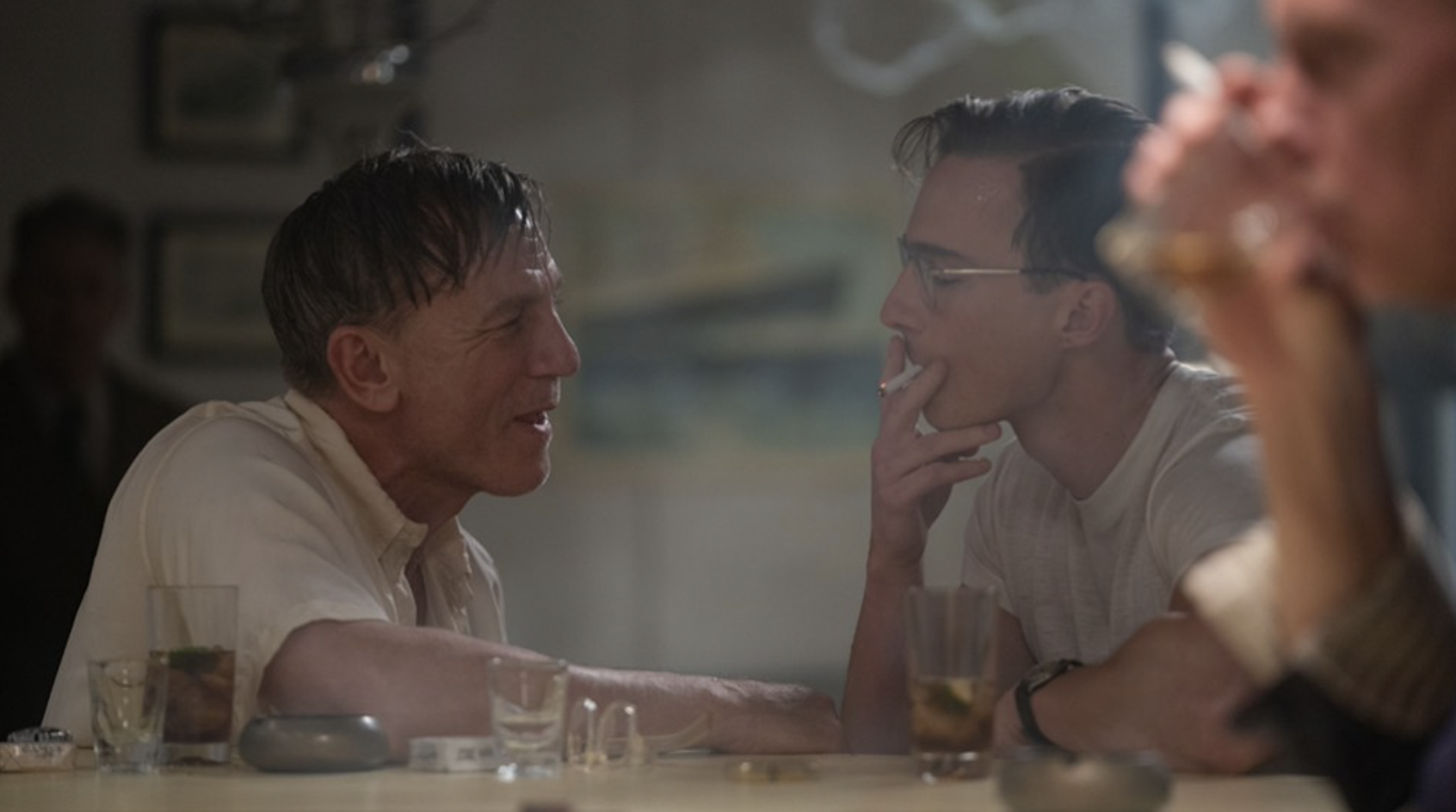
It’s notable that both Daniel Craig and Drew Starkey, who play the two leads, are straight actors playing queer characters. One might be tempted to call it regressive, except that Guadagnino himself is gay, and evidently these were the actors he wanted. If straight actors must be cast for gay parts, it makes up for a lot if the director is openly gay. And I cannot stress enough that Daniel Craig’s performance in this film is incredible. His William Lee is an aging gay man biding his time in 1950s Mexico City, engaged in casual sex but quick to infatuation, and singularly vulnerable and insecure. Craig’s portrayal is at once unique and broad, specific and heartbreaking. William is a man who seems in search of something to fill a void in his life that his era just cannot accommodate.

The one thing I genuinely struggle to get on board with in Queer is Jason Schwartzman, giving an admittedly delightful performance in the deeply unfortunate use of what appears to be a fat suit. I’m having a hard time finding specific confirmation that this is indeed a fat suit, but given how thin he is in recent photos, I’m not sure what else we can conclude. And there are definitely genuinely fat actors who are just as talented as Schwartzman and could have given just as good a performance. On the upside, his character, Joe, is not only also queer, but is only ever seen making out with hot young guys. So at least we’re seeing a fat guy onscreen who can get it.

Speaking of which, there's some unusually frank depictions of gay sex in this movie–another point in its favor. Daniel Craig looks amazing at age 56—25 years Drew Starkey’s senior. But Euguene, played by Starkey, is an independent and almost aloof young man, barely acknowledging William’s obvious yearning for him.

And here is where Guadagnino’s dependably delicate touch comes in handy: at no point does Queer feel like some kind of gay version of Lolita (it helps that Eugene is well out of his teen years). A great deal of time passes with very little seeming to have happened, even though a great deal is happening onscreen, with oddly but effectively focused cinematography, great performances, and great finesse in editing. There is no question some will be bored by this movie. I was fully compelled at all times, even when it shifted into areas I could not fully grasp.

Queer takes a hard turn in that direction as it explores William’s drug use, and specifically his search for a root that he’s told will give him telepathic capabilities. The story is split into three “Chapters” and then a particularly impenetrable epilogue; the third chapter is titled “Lady in the Jungle,” the title character there being a sort of slicked-back woman with long greasy hair who looked incredibly familiar but was nearly impossible to place: it turned out to be the amazing Lesley Manville.

It’s in this third act when William, with Eugene right there beside him, goes on a bit of a wild trip, on the drug they’ve traveled out there for. Guadagnino pivots to what is essentially an interpretive dance on ayahuasca, the two shirtless men moving in and out of each other, quite literally: we see a hand passing underneath the skin, or their two torsos barely melting into each other. It is at once romantic and unsettling, unlike anything I have ever seen. I suppose it could be seen as a comment on two people truly connecting, but sometimes with Guadagnino, you just have no idea and perhaps you never will.

This is one filmmaker where, depending on the vibes anyway, I am okay with having no idea. I couldn’t tell you precisely what Queer is going for. Guadagnino is capable of such mystery in ways both deeply unsatisfying and deeply satisfying. For me, this round was pretty satisfying. If nothing else, he has a gift for molding thoroughly realized characters who elicit your compassion and interest. Queer is certainly not perfect, not least of which because of several scenes with pointlessly obvious CGI (background landscapes of South America; a near-miss attack from a viper). Still I’m glad to have gone on its journey, and would happily do so again.

Insecure vulnerability and comfortable confidence intersect in Queer-ness.

Overall: B+