
FINDING EMILY

Directing: B+
Acting: A-
Writing: B+
Cinematography: B
Editing: B+

If you’re here to criticize Finding Emily because of its predictable, formulaic writing, then you need to read the room. Get out of here! Find some other vibe to kill, because you’re missing the point.

And that point? It’s the genre: romantic comedies. They either work for you or they don’t, and the truth is, even within the basic rules of the genre, most romantic comedies are crap. Just google “best romantic comedies of the 21st century” and you’ll find lists that are, in the aggregate, a bit pathetic. Is Finding Emily better than, say, Bridget Jones’s Diary? I’m going to sound ridiculous to many when I say yes, it is. I certainly suspect it’ll age better over time, even if it is very much of its time. Is it the best romantic comedy since Four Weddings and a Funeral? Only time will truly tell, but: maybe!

Finding Emily does have its imperfections, even if they largely lend themselves to its ample charms. Spike Fearn is utterly adorable as the lovesick Owen, and his performance is superb. I also love how Rachel Hirons’s script flips the usual positions of the two leads, here making the woman (a charming Angourie Rice, who the criminally few who saw The Nice Guys might recognize as the 13-year-old girl from that 10-year-old movie) the one who makes the big mistakes and has to offer all the grand apologies. That said, as adorable and sweet as Owen is, he’s a little too perfect. He’s just a little naive, sweetly making his way through life and having no inkling that someone is taking advantage of him.

Owen meets a girl at the club at which he works as a sound engineer, in the opening sequence—the Emily of the title, or at least one of them. They connect, they have easy conversation, and when she has to rush off with her friends to the next thing that night, she leaves Owen her phone number, but it’s missing a digit. Along comes another Emily (also, we know instantly, of the title), this one being the Angourie Rice Emily, who is an American student at this unnamed Manchester university. She’s looking for a subject for her dissertation, someone she can use to make a strong case for how “romantic attachment” leads to self-sabotage, and she offers to help him find this Emily. He winds up sending an email to the more than 300 Emilys who go to this school (that seems like a lot), and hijinks ensues, along with predictably desperate secrets and misunderstandings, and we see where this is all going a mile away.

And I don’t care how far away we can see it! I had a blast watching this movie, and it even moved me, if not to tears, then to misty-eyes by the end. It’s worth noting that many of the movies on those lists of “best romantic comedies” really stretch the definition of comedy; some even include movies like Materialists, which I was surprisingly taken with, but it’s not a comedy. But Finding Emily? This is a movie that will actually make you laugh. What a refreshing change!

It’s also, evidently, an example of a “Gen Z romantic comedy,” which is definitionally true given that Angourie Rice and Spike Fearn are both 25. I also found it refreshing to see such a well-made movie about people this young; the kids need quality too, don’t they? Where else are they going to find light, fun movies this good about people in their own generation? (Not that I have a clue what the kids are doing these days or what they think of as high quality. I’m 50.)

If I had any real complaint about Finding Emily, it’s the Manchester accents. Rice is actually Australian but plays an American student whose visa is on the line with her dissertation, and half the time she was the only person I fully understood. You might do well to find a showtime with closed captions included. I’d say you could wait until it’s on a streamer where you can also turn on the captions, but this movie deserves the same success as, say, My Big Fat Greek Wedding—even though we all know it won’t get it; we don’t live in that world anymore. Oh wait, I also want to complain about Minnie Driver as Dean Watkinson. There isn’t enough of her! Why do people keep under-using this excellent actor?

Anyway, Finding Emily gives you everything you want from it and more—genuinely effective humor, heart, romance, and precisely the story beats you expect from a romantic comedy. Formula works because that’s what it does. It treats ideas like toxic masculinity with a light hand but without trivializing it; conversely, it does also follow the unfortunate formula of centering Whiteness in its main characters while self-consciously diversifying its supporting cast. I’m not sure it’s worth holding a grudge against it for that, but it’s certainly worth mentioning. Whether the ample charms to be found here can transcend its smattering of imperfections over time may long remain to be seen, but for now, British director Alicia MacDonald has offered up something that’s impossible to resist, and will have you leaving the theater with a pep in your step.
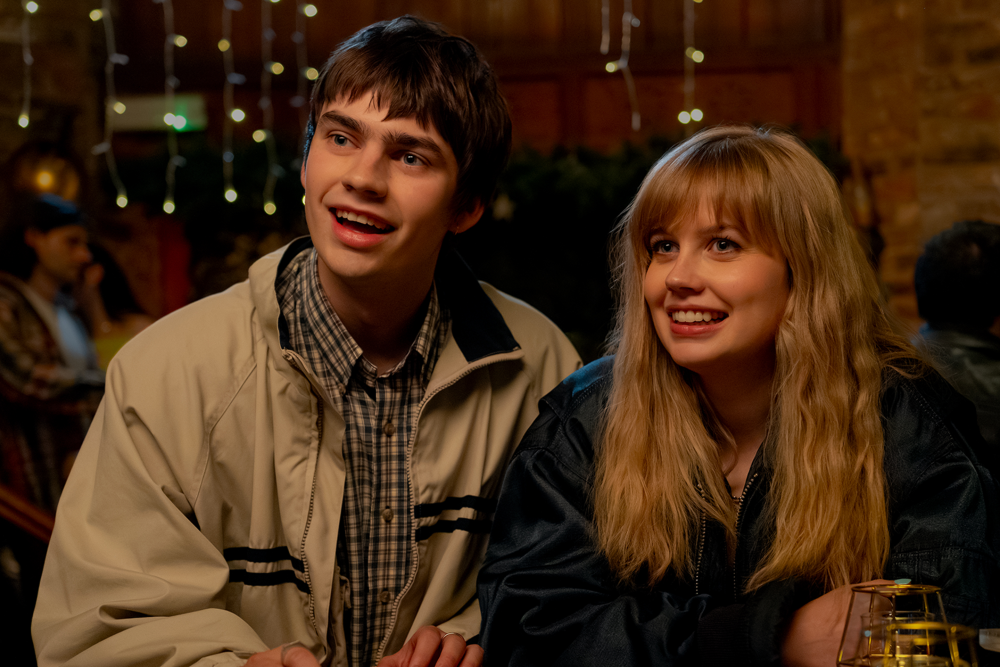
The kids are not just all right, they’re delightful.

Overall: B+
ETERNITY

Directing: B
Acting: B+
Writing: B
Cinematography: B
Editing: B+

I really enjoyed Eternity, but I also have a lot of nitpicks. Let’s go through them all!

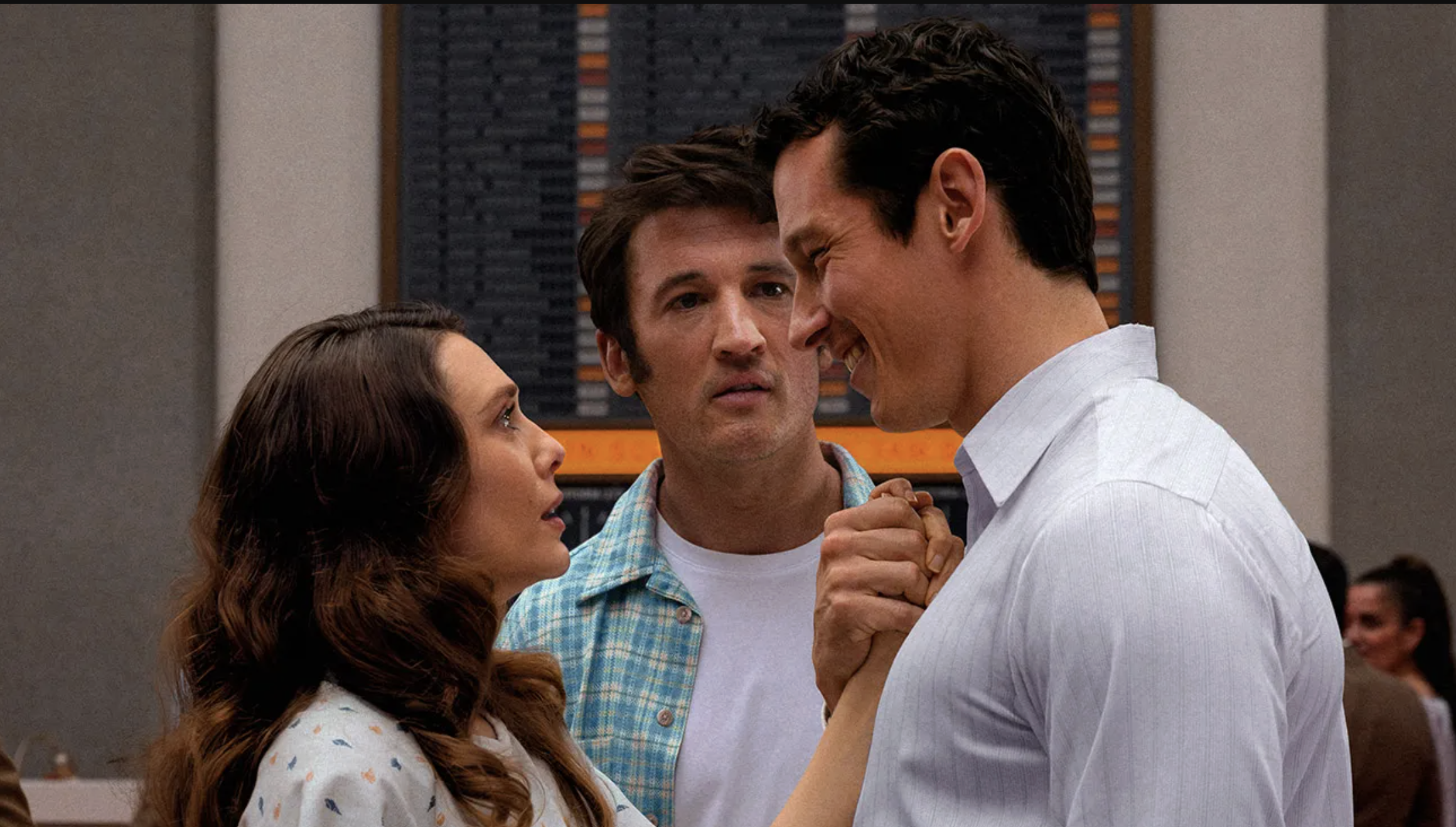
But let’s back up a step, to the premise, which is that our three main characters spend time in a place called “Junction,” where they have as long as a week to decide a single environment (or world, or universe, whatever you want to call it) in which to spend eternity. The twist, and the whole reason for this story, is that Joan (Elizabeth Olsen) is also faced with another agonizing decision: whether to spend eternity with the first husband, Luke (Callum Turmer), who died in the Korean war, or her second husband, Larry (Miles Teller), with whom Joan enjoyed 65 years of happy marriage.

The first death we see is Larry’s, and it’s the circumstances of this death that is my first major nitpick. It happens at a gender reveal party for one of their great grandchildren. A gender reveal party? Really? To be fair, the script, by Patrick Cunnane and director David Freyne, passingly acknowledges how stupid these parties are: “People die at these things!” says Larry as an old man, played by Barry Primus (Joan as an old woman is played by Betty Buckley). There is even a bit of a callback to this gag when a later couple met in Junction is revealed to have been killed in a freak accident at a gender reveal party. Still, the deliberately inoffensive jokes aside, the use of a gender reveal party in the opening sequence of this film both reflects and participates in the preposterous normalization of "gender reveal” parties. These things are both pointless and blithely presumptuous, and might as well be called “Genital Identification Parties.” But nobody in this movie dares say that.

We learn on the car ride to the party, before Larry dies, that Joan has cancer, and is waiting until after the party to tell the rest of the family. When Larry wakes up in Junction, he’s the first character we follow there, and at first the story is just from his perspective. But, we already know that Joan is not far behind, and basically the second act involves a shift in perspective to hers. Not long after that, we learn that Luke has been waiting for Joan in Junction for the past 67 years.

The rules of how things work in Junction are both undeniably entertaining and often nonsensical. This film clearly owes its existence to the widely loved (I always thought it was just fine) 1991 Albert Brooks film Defending Your Life, except instead of a character pleading his case for having lived a life worthy of spending eternity in a better place, here characters merely have to choose where to spend eternity—and in this case, with whom.

Why time means anything in Junction at all escapes me, but it very much does: “clients” are assigned an Afterlife Coordinator (“AC”) as a guide to help them choose, but they get one week in which to do it. The people who work these jobs in Junction, whether they are ACs or janitors or bartenders, are people who have chosen, for various reasons, not to go to any eternity at all. Some of them just enjoy helping others and that gives them a feeling of purpose. Some are waiting for their beloved to arrive, as in Luke, who has waited there for 67 years. It’s a little weird that measurements of time should be so important in Junction when it means nothing in eternity, but whatever.

The thing is, in the film Eternity, it’s all the scenes that take place in Junction that are really fun and compelling—and, crucially, contains all of the surprisingly effective humor in this film. Now, it also makes no sense that the system here should be so modeled on capitalism, with representatives from countless “Worlds” trying to sell it to people passing through Junction—not with money, but just simple persuasion, I guess. We see characters walking past countless booths (or in some cases, watching commercials) for different “Worlds,” from Paris Land to Smokers World to 1920s Germany “with 100% less Nazis.” Larry’s inclination is toward Beach World, and Joan’s is toward Mountain Town—basically the same argument they had in the car on the way to the party. I loved seeing all these examples of eternities, and when I saw booths for Queer World and Studio 54 World side by side, I thought: I’d have a hard time choosing between those two. That said, why does this system only have a selection of offerings created by someone else? Can’t we just create one of our own? What if I want to spend eternity in Andrew-Garfield-and-Timothée-Chalamet-Sandwich World?

Junction is also made much more fun by the supporting characters who are Larry’s and Joan’s ACs, respectively: Anna (Da’Vine Joy Randolph) and Ryan (John Early). These two are very invested in their clients but also have a sexual past together, which is an odd turn in this film given how openly and obviously queer John Early is. He does marvel at the handsomeness of Luke, a running gag in the script, but he later explains to Anna that he could never do polyamory because “I am a one-woman man.” Oh really, John Early? The oddest thing about that exchange is that it is the one time in Eternity that polyamory is brought up, and it’s only within the context of Ryan and Anna’s relationship. Why does no one ever bring up the idea to Joan, Larry and Luke? Couldn’t they at least test out Polyamory World?

It seems like that’s the only thing that could be a suitable compromise for all three of them. Why should Joan have to choose? Isn’t eternity supposed to be the place they choose in which they’ll be happiest? This script does, amusingly, acknowledge how one eternity could quickly get tedious: enforcement officials are constantly running down people trying to escape the eternity they have chosen, one of whom shouts, “Museum World is so boring!” But would not any eternity be so? Whether it’s an eternity at the beach or in the mountains?

Indeed, there’s a ton of detail in Eternity that is really easy to pick apart, not least of which is the fair amount of time spent in different eternities in the second half of the film. These scenes are constructed so that characters can reflect on whether or not they made the right choice, but when the backdrop is just serene mountains or an inexplicably overcrowded beach (why would there be a limit on the amount of beach that can be shared for eternity?), Eternity, as a film, instantly just becomes far less interesting, compelling, or fun. It’s less fun without Early or Randolph around. And the technique for rendering the “Archive” building in each Eternity where characters can view replayed memories from their lives is mystifying: they see themselves as tangible people, but in a sort of diorama box with the environment of these memories rendered in large hand drawn backdrops. I can’t tell if this was a legitimately artistic choice or if it was a production cost saving measure. It sure felt like the latter,

Eternity is the kind of movie that is undeniably entertaining but also does not stand up to even the slightest bit of scrutiny. I laughed a lot the entire time the film was set at Junction, from the many sight gags to the delightful performances of both Da’Vine Joy Randolph and John Early. This made me happy to have seen this movie even though none of it really makes any sense.

Overall: B

SPLITSVILLE

Directing: B+
Acting: B+
Writing: B+
Cinematography: B
Editing: B+

Splitsville takes romantic comedy into a peculiarly unusual direction, contextualizing it with the concept of open relationships in a way that may not be for everyone. Broadly speaking, it worked for me. I laughed more than I do at most contemporary romantic comedies. I may need to spend some time thinking about exactly how non-monogamy is explored in this movie, and everything ties up a little too neatly in the end, and in a way some may feel negates the idea that people can do non-monogamy successfully. I’ll let other people get into the debate about that, though, because I was as entertained as I hoped to be and therefore got what I wanted out of this movie.

That doesn’t mean some of it is a little tricky. Let’s start with Dakota Johnson, the biggest star in the cast, and an actor who seems to embody characters who exist in the same universe no matter which movie they’re in. I would not say Johnson is the most versatile of actors, and yet there is something undeniably compelling about her screen presence. There’s something almost ethereal about her, which you wouldn’t think would work in the part of Julie, a thirtysomething mom unhappy in her marriage, and yet here we are. At least she lives in an incredibly nice house with floor-to-ceiling windows and a pool thanks to being married to a very successful husband, Paul (Michael Angelo Covino), so her elegant and very-Dakota-Johnson fashion choices seem to fit.

The story actually revolves around Carey (Kyle Marvin), who happens to be Paul’s best friend. Carey works as a private school gym teacher, and I suppose the private school is meant to indicate how Carey can work as a gym teacher and still be close friends with a wealthy property developer without any class differences causing awkward tensions. In the opening scene, Carey and his wife Ashley (Adria Arjona) are on their way to a weekend getaway, and after witnessing a freak accident on the road, Ashley declares she wants out of the marriage.

In a comically extended sequence, Carey bails out of the car and runs to the home of Julie and Paul, where talk of divorce leads to the revelation that Julie and Paul are not monogamous. I won’t spoil where things go from there, but I will say that these characters consistently justify their open relationships in ways that seem a bit regressive: “If you make the bad thing not bad, then it’s okay.” This seems logical on the surface, except that Splitsville spends its time suggesting that non-monogamy will inevitably lead to problems—which is to say, non-monogamy is inherently bad—rather than acknowledging that it actually works for some people.

To be fair, it also doesn’t work for a lot of people. Spoiler alert: when Carey takes Julie and Paul’s news as a revelation and proposes it to Ashley as an idea for saving their marriage, it doesn’t work. Especially considering who Carey decides to have sex with. All this is to say, the idea not working out for characters like these is still valid. I would just like to see a movie in which people have open relationships and it’s not the major challenge for them all to overcome.

And, to clarify, non-monogamy does work, for all of these characters, for quite a long stretch of Splitsville. It works until it doesn’t. Or it may never have happened at all. Things get complicated, of course–especially when sex and romance does a bit of merry-go-round movement around this foursome. Declarations of not feeling jealous are made, and petty jealousies are quickly revealed. One might even say predictably—though a fight sequence that occurs between Carey and Paul at Paul’s house, destroying furniture and windows and more, is exceedingly well staged and quite entertaining. These are characters who have trained on certain defensive moves, so they both get some good ones in, but they are also both crippled by rage and sadness, which makes them fumble a great deal, lending the scene some realism. They spend more time damaging the house than they do each other, although they still do plenty of that.

There’s a lot of great dialogue in Splitsville, sometimes just short of Aaron Sorkin-esque. This is a movie with both compelling ideas and compelling performances. I do have some technical nitpicks, though, such as the multiple sequences with the camera swooshing back and forth around one or the other of their houses, as a means of communicating the plot. At Carey and Ashley’s house, we see how Carey amasses a group of friends out of Ashley’s growing number of ex-lovers (and these guys—and one woman, though we never see her—run the scale of plausibility as characters). In another scene, we glide through the many rooms of Paul and Julie’s house during a birthday party for their son. In one moment of the extended cut, a guy the kid barely knows arrives at the door while the party is in full swing, and as he’s let in and the camera moves past him, we hear the man walking while bellowing “Feliz Cumpleaños,” as if that would happen. Everyone sings “Happy Birthday” together, hello!

As I said, these are nitpicks. A pretty big one is the decision to hire a “mentalist” rather than a magician or clown or the kid’s birthday, and he’s played by Succession’s Nicholas Braun. This is played as a comic thread of the many things going on in the scene, and it just doesn’t quite fit with the rest of the movie, nor is it ever very funny.

The rest of the movie is, though. Your mileage will vary with Splitsville, but it got pretty far with me. Nitpicks notwithstanding, I had a really good time with it.

Two couples get messy, and then clean up their messes, in Splitsville.

Overall: B+

JANE AUSTEN WRECKED MY LIFE

Directing: B-
Acting: B
Writing: B-
Cinematography: B
Editing: B+

Who decided on this English translation of Jane Austen a gâché ma vie, I wonder? That’s the original, French title of this film, and when you ask Google to translate, it comes up with Jane Austen Ruined My Life. That’s a better title, no? Am I wrong here? If you remove every word except gâché, however, it translates as spoiled. Should the title have been Jane Austen Spoiled My Life? I should note that I do not speak French at all, and for all I know, gâché is closer colloquially to wrecked in American English than to ruined. I have no idea! I’m really glad we had this talk, I think we really accomplished something here today.

Did writer-director Laura Piani, though? That’s the real question here, because I feel a little ambivalent about this film. It seems to have genuinely charmed a lot of critics. Right now I am kind of leaning toward the title Jane Austen Muted My Evening.

I mean: it’s fine. I have no major complaints. Well, except that I could get little sense of Piani’s direction, and I often could not tell if the characters here lacked any naturalism or if it’s just a vibe of French sensibility that is foreign to me. The characters interact with each other with an unusually comfortable familiarity, which ironically radiated off the screen to me as awkward.

Here’s a burning question. Are Parisians big on book stores? The one where Agathe (Camille Rutherford) works appears to be thriving. Apparently, this is one of the things in Jane Austen Wrecked My Life that is real: the French love books. In fact, the bookstore where Agathe works, Shakespeare and Company, is very real—an English-language bookstore that has been open in Paris since 1951. I wish I had known that while I was actually watching the movie. I’d have paid more attention during the many book store scenes. I remain a little annoyed by the seemingly haphazard way they put books on the shelves. Is there no order in this store?

Agathe works with her best friend, Félix (Pablo Pauly), who indulges Agathe in her obsession with Jane Austen novels. She is also a writer, an insecure one who writers “cheap romances” (as one writing teacher puts it), but Félix submitted her unfinished chapters to the Jane Austen residency without telling her. After much resistance, Félix convinces her to go. This place is located in the middle of the woods somewhere in England, and the sweet old lady running the place speaks French fluently—as does her grown son she send to pick up Agathe, Oliver (Charlie Anson). These are British actors and characters, and Agathe of course speaks English fluently, so Jane Austen Wrecked My Life has dialogue pretty evenly mixed between the two languages.

Here we get to the Great Question: should Agathe be with Félix, or with Oliver? The story here plays out in a way transparently meant to mirror Elizabeth Bennet and Fitzwilliam Darcy from Pride and Prejudice. Ironically, when Agathe and Félix first meet, he has a prejudice against Austen’s work, calling it “overrated.” We already know Agathe has deep pride in Austen’s work.

It’s all pleasant enough, although Agathe longs for the “poetic spark” of novels that she finds lacking in reality—and most of the time, I kind of felt the same way about this movie. The one exception, and a notable one at that, is when the Jane Austen Residency puts on a ball, with everyone wearing the clothing of Austen’s era, and doing the same English Country dancing. At this point, Félix has surprised Agathe with a visit, the day after she actually has discovered a spark with Oliver, and here she moves from dancing with one, to dancing to the other, and back. This sequence is dazzling in its execution, the moment when Jane Austen Wrecked My Life actually sidesteps into the realm of movie magic. I rather wish more of the rest of the movie were like it.

As it is, Jane Austen Wrecked My Life is sprinkled with subtle charms, including Oliver’s dad evidently slipping into the kind of giddy dementia that has him gardening with nothing on from the waist down. I’ll probably forget this movie entirely within a week, as it blossoms in moments but utterly wilts in the shadow of the work that inspired it, but it’s still a nice memory for the short time it will last.

That moment when magic happens.

Overall: B

THINGS LIKE THIS

Directing: C
Acting: C+
Writing: C-
Cinematography: B-
Editing: B

Things Like This is an awfully bland and forgettable title for a movie premise with real promise: it’s a romantic comedy about two young men who fall in love in New York City, and one of them just happens to be fat.

I use the word “happens” loosely, because this is the first of many flaws in the execution of this film. The trailer makes it look like it’s just about two guys who don’t have their lives together, and falling in love with each other eventually helps them figure their shit out. It seemed refreshing to see a fat guy get cast in one of the lead roles, and in the trailer, his fatness is never even mentioned. And here’s the weirdest part: his fatnesss is incidental to the romance int his movie—and yet, in the opening scene, Zack Anthony (Max Talisman) is verbally dressed down by a hookup he’s just had sex with, telling him how he finds him unattractive. Zack’s response is to eat cake frosting straight out of a can. What the hell is this shit? There is almost none of this through the rest of the movie, so why make it a part of setting the stage, in the very first scene?

Things do not exactly get better from there, unless you want to count the few moments of genuine sweetness. Zack meets his love interest at a party, and the other guy’s name is also Zack—Zack Mandel. Mandel is played by Joey Pollari, and I hate that I have to say this since he’s the one “conventionally attractive” major character in the movie, but he’s also the only one with a natural screen presence, the only one with an unforced or unself-conscious delivery. The one critical thing he doesn’t have is chemistry with Talisman as the other Zack. They might have found someone he did have chemistry with had they been able to spend much time on, say, chemistry reads, but this film quite clearly did not have the budget for that.

To be fair, there is a sense that Talisman might have fared better under a different director. But the thing is, he is the star, and the director, and the writer. Which means he made the choice to cast and write himself as the fat guy who not only loves to eat right after sex (that alone isn’t so bad, I guess), but also defiantly eats cake frosting when made to feel bad about himself. These are choices I find frankly baffling.

Beyond that, Things Like This is utterly predictable, in ways that are inherently disappointing, because it didn’t have to be—it being a romantic comedy notwithstanding. Overall, the script has a vibe of being a first draft. (Realistically, it was not the first draft, which means I shudder to think what the actual first draft was like.) There’s a deeply dramatic, emotional scene on Zack Anthony’s apartment building rooftop, where Zack Mandel freaks out and breaks things off because of fear he’ll screw it up. This is a pretty universal feeling, sure, but the way the scene plays, this early in the film as well as this early in their relationship, the clear expectation of our emotional investment as viewers is entirely unearned.

Zack Mandel works for a talent agency where his boss is a complete caricature, where his friend is thinly drawn at best. Zack Anthony is a struggling writer looking to get a book about vampires published. One of Things Like This’s few accomplishments is giving Zack the confidence to say “I’m really good” about his own writing without coming across as insufferable. Nevertheless, there is a scene in which Mandel tells Anthony the plot of his book, and while Mandel says it sounds really cool, I just thought: this book sounds dumb as shit! It would never get published, but in the world of this bizarro movie—spoiler alert!—a book publisher almost immediately offers him what, to Zack Anthony at least, is a shocking amount of money.

There’s a climactic scene in which Zack Anthony sings a song (of course) in order to win over Zack Mandel, and Talisman has some genuine vocal talent. Honestly, even his performance as Zack Anthony might have been honed into something convincing in the hands of a director other than himself. Bringing another writer also wouldn’t have hurt. He must have been desperate to cover many jobs in order to get this movie made, but sadly, the final product just leaves you wondering how this movie got made. Even the outtakes that play during the end credits fall flat, a bunch of clips that make no real impact and simply intensify the mystery of their own existence.

There are many problems with Things Like This, but the fundamental one is the one-dimensional nature of nearly all of its characters. There’s earnestness here, even occasionally effective sweetness (I quite liked the winter scene in the park when they first kiss, albeit after some truly clunky dialogue), but no depth. There is always a sense that there is some depth around, somewhere, but this movie is always out of it.

A deceptively sweet image of characters who have no idea how contrived they are.

Overall: C

THE WEDDING BANQUET

Directing: B+
Acting: B+
Writing: B+
Cinematography: B-
Editing: B+

It’s probably safe to say that Ang Lee’s international breakout 1993 original The Wedding Banquet is not a broadly famous movie. It’s probably also safe to say that film is widely appreciated among aficionados of queer cinema, international or otherwise. The film was notable for several reasons, not least of which was its nomination for the Best Foreign Language Film Oscar (which it lost to the Spanish film Belle Epoque). It has charm to spare, although one particular plot point, which was played at the time as borderline innocent but by today’s standards crosses a line into sexual assault, has aged rather poorly. Overall, this makes the original Wedding Banquet an incredibly progressive film for its time.

Enter director and co-write Andrew Ahn (Fire Island), who has reimagined The Wedding Banquet for 2025 sensibilities with mostly great success. The broad strokes remain the same, but many of the details have been reconfigured. Instead of the bride who marries a gay man for a green card being a desperate tenant, this time she’s part of a lesbian couple: Angela (Kelly Marie Tran) and Lee (Lily Gladstone) are trying to start a family using IVF, now disappointed by the failure of a second attempt. Chris (Bowen Yang) has been best friends with Angela since college, when they made a single attempt at straight sex; he’s now coupled with Min (Han Gi-Chan), whose family fortune inheritance is conditional to his involvement with the family business.

Said business is managed by Min’s grandmother, Ja-Young (a stupendous Youn Yuh-jung, Best Supporting Actress winner for Minari), a very stern woman who makes a stark contrast with Angela’s per formatively supportive mother, May (Joan Chen). Ja-Young is the catalyst for one of the best and most unexpected twists of this version as compared to the 1993 original, as it pertains to the attempted ruse—I won’t spoil it here.

Evidently by virtue of Angela and Chris being best friends, both couples are also very good friends—so much so that Chris and Min are living in the garage of Lee and Angela’s house. Side note: ff Min has access to a fortune, why he would be living in someone’s garage remains a mystery. Min is an evidently very talented artist and Chris’s life lacks direction, so maybe it’s just the lifestyle they’re choosing, although it still doesn’t make a lot of sense under scrutiny. All of that regardless, the depiction of a gay male couple and a lesbian couple being such close friends is maybe my favorite thing about this movie. I can’t recall ever seeing that in cinema before, at least not where all four people are the principal characters.

I do think the Chris character is a bit awkwardly underdeveloped. I could never make any real sense of what his problem is, why he has such insecurity that he won’t accept Min’s proposal of marriage. Min is perhaps the most open-hearted of the four characters, the kind with the potential to provide a lot of comedy—and, although there is plenty of comedy, The Wedding Banquet is not quite as funny as I expected or hoped. Han Gi-Chan as Min is fun but rarely funny; Yang gets perhaps the most chuckles with subtle gestures and expressions executed with finesse; Kelly Marie Tran (The Last Jedi) is convincingly messy as a woman terrified of being a bad mother; and Gladstone brings an almost incongruous gravitas to a film meant to be a romantic comedy. She’s a stellar actor but not the funniest person in the world.

Where The Wedding Banquet isn’t funny, however, it is repeatedly surprisingly touching, and I shed several tears over several different scenes. To the credit of Ahn and his co-writer James Schamus (who wrote the original), the many narrative threads in this film come together with impressive precision. Among the ensemble cast, Bowen Yang is really the only one with a true understanding of comic timing, which leaves this film feeling a bit more like a sweet dramedy than a straightforward comedy.

But even if I didn’t get quite the vibe I was hoping for, this is an incredibly satisfying watch, just for different and unexpected reasons. Some narrative turns are predictable if you have seen the 1993 film; some are not, and those changes serve this new version well. This is not a film that will make its mark on cinema history the way the original did, as that one was genuinely groundbreaking, poorly aged flaws notwithstanding, and the same cannot really be said of this one. Still, most of the characters feel real and multi-dimensional—especially Angela and Lee as a couple. The four of them are ultimately served up as an excellent example of found-family, a ragtag group of people who care deeply for each other in ways that are thicker than blood. It’s a uniquely satisfying representation of possibility.

“Love makes a family” is more than just a platitude. It’s also a movie!

Overall: B+

A NICE INDIAN BOY

Directing: A-
Acting: B+
Writing: A-
Cinematography: B+
Editing: A-

Full disclosure, it’s a bit more difficult for me to be objective in my assessment of A Nice Indian Boy than it is for most films. Setting aside the myth that true objectivity even exists, this is a film that really hits home for me: it’s about a white man who marries a South Asian man in an Indian wedding that’s made as gay as a traditional Indian wedding can be made. And, I am a white man who married a South Asian man in an Indian wedding as traditional as we could make it. Some of it was modified in ways it would have had to have been regardless of our sexuality: truly traditional Indian weddings last for days; ours lasted an afternoon. The same goes for the wedding that occurs in this movie, but which featured very specific, Hindu rituals that I performed in my own wedding to my husband.

It’s an unusual thing indeed, to see a film so steeped in South Asian culture, and yet even as a white guy, see so very much of my own experience reflected in it. A pretty significant subplot involves multiple characters’ love of the very famous 1995 Bollywood movie Dilwale Dulhania Le Jayenge (translated as The Brave-Hearted Will Take the Bride), commonly abbreviated as “DDLJ”—and, very specifically, its signature song, “Ek Duke Ke Vaaste” (“For Each Other”). I have seen that film only once, myself; but that song has been a staple of my Hindi music playlists for a solid two decades. It has had a particularly nostalgic place in the hearts of South Asians the world over for thirty years that I could never access, but it also has a very particular nostalgic meaning to me personally.

A Nice Indian Boy does push the bounds of plausibility a tad, but therein lies the magic of movies, I suppose. Only once did I feel a bit dubious about the meet-cute setup between Naveen (Karan Soni) and Jay (Jonathan Groff), as they actually meet in a temple, Jay showing up to pray to the elephant god Ganesha, as though he were a natural practicing Hindu. But, not long after that, we learn that Jay, now orphaned due to his parents having been older when they took him in, was adopted by Hindu parents. So then, I though: okay, I guess I buy that.

Soni and Groff are well-cast and have clear chemistry, Soni as someone still struggling to overcome shame and embarrassment; Groff as someone self-assured after the heard-learned lessons of a youth spent in foster care before finding the parents who ultimately welcomed him home. I’d love to learn more about Groff’s unique experience, but the fact of his parents’ deaths makes it easier for the story at hand to focus on Naveen and his family.

A Nice Indian Boy is arguably more sweet and romantic than it is funny, although it is also plenty funny. I just wish I had known to bring in plenty of tissues—I cried a lot more than I expected to. It is perhaps to this movie’s greatest credit that all the tears were shed in response to touching and heartwarming turns of events, as opposed to anything sad or tragic. It is told in five chapters, starting with Naveen and Jay meeting and then going on a sweetly awkward first date. In a particularly well-executed scene at a bar, Jay surprises Naveen by admitting that he’s nervous. The special thing about Jay is his comfort with simply acknowledging such things, while Naveen still has much to learn on that front.

Naveen and Jay are very well rounded, flawed and adorable characters. But what truly makes A Nice Indian Boy special is the cast that rounds out Nareen’s family: his parents, Archit and Megha (Harish Patel and Zarna Gang), have had six years to come to terms with a son who is openly gay—so much so that, in fact, they spend a lot of time watching the gay cable channel—but, until now, no experience meeting one of his boyfriends. Naveen also has an older sister, Arundhathi (Sunita Mani), struggling with the loveless marriage her parents arranged and now resentful of how much more effort to be open minded her parents are being about their son than they seemed to have been when they married off their daughter.

It would be easy to make these characters one-note punch lines, but in all three cases, they bring a level of humanity not usually given to such supporting characters, particularly in romantic comedies—even good ones. These characters feel like real people, ones that you might meet in reality. Archit and Megha’s unusual acceptance of their gay son does not change that. These are simply loving parents who are making an effort, often stumbling adorably along the way. Archit in particular has a lovely arc in the story, never overtly judgmental of his son but with some clear discomfort, which feeds into Naveen’s discomfort with himself.

There is an on-again, off-again, on-again arc between Naveen and Jay that feels tied a little too neatly, but it’s the ensemble cast, including loving and colorful friends on both their parts, that really sells their story. There is real and believable development among all of the principal characters, concisely written by Eric Randall as adapted by the play of the same name by Madhuri Shekar. A Nice Indian Boy runs a brisk 96 minutes, which gives it a key thing in common with Steven Soderbergh’s Black Bag (an otherwise very different movie—except that it’s also very romantic): it packs a lot into a lean runtime, without every feeling rushed.

I couldn’t tell you yet whether I will wind up seeing A Nice Indian Boy many more times, or if it will become a long-lasting favorite. It might. All I can tell you for certain is that I was deeply moved by it, on a very personal level, and I would recommend it to absolutely anyone. You’ll laugh, you’ll cry, and you’ll love it either way.

I don’t know if you’ll fall in love with this movie but I would encourage you to find out, because I sure did.

Overall: A-

ANORA

Directing: A
Acting: A+
Writing: A
Cinematography: A
Editing: A

It’s so rare, and so deeply satisfying, when a movie actually lives up to the hype. Anora is everything it promises to be and more.

It’s also very much a riff on the 1990 romantic comedy Pretty Woman, a movie as beloved as it is quite rightly criticized as a vapid look at sex work. Anora takes the concept of a rich guy who woos a sex worker with the promise of riches in exchange for exclusivity, and makes it grittier, more real, with both more authentic joy and more authentic sorrow. Instead of a high-end Beverly Hills escort played by Julia Roberts, we get a no-nonsense Brooklyn exotic dancer played by Mikey Madison—who is a revelation in the role.

And in the case of Anora (Ani for short), the fairy tale begins to crack fairly early on. She’s on the job when she meets Ivan (a stupendous Mark Eydelshteyn), a young Russian man with money to burn. He buys a lap dance, then invites her to his giant home, and within days he’s asking her to be his “boyfriend” for a week. Within that week, he proposes to her, convinces her he’s serious, and flies her with some friends to Las Vegas, where they do indeed get married,

This is all extended setup, and it last probably a good hour into the movie: Ani being taken in by a whirlwind fantasy life moving so fast she doesn’t even have time to consider whether it’s too good to be true. All the while, Ivan has an irresistibly sweet, youthful exuberance that is easily mistaken for innocence. It’s just as easy to be taken in by it as a viewer as it is by Ani as a character, which is testament to Eydelshteyn’s performance.

It’s when Ivan’s parents catch wind of this marriage that things take a turn. He is visited by two men we would reasonably read as henchmen, working for Toros (Karren Karagulian), the handler hired by Ivan’s parents. But Garnick (Vache Tovmasyan) and Igor (Yura Borisov) get far more than they bargained for when they come face to face with Ani, who is having trouble processing the idea, suddenly presented to her, that her marriage is a sham.

This turn in the plot, though, would in just about any other movie get scary and violent. Garnick and Igor, as it turns out, are not interested in violence—only in getting Ivan and Ani to sign paperwork to annul their marriage. It’s Ani who turns out to be unexpectedly wild, a young woman with ample experience not taking anbody’s shit, and she’s the one who get surprisingly violent. This is an extended sequence in Ivan’s house, and it is hilarious.

Garnick and Igor have such trouble containing Ani’s outbursts—which, to be fair, are reasonable under the circumstances—that Toros is forced to leave the performance of a baptism to assist. He’s astonished at how beat up Garnick and Igor are when he arrives at the house, and instead of being on board with Ani being tied up like he would be in most movies, he’s aghast. The other two struggle to convince him it would be a mistake to untie her.

Writer-director Sean Baker has made easily his best movie since his masterful 2015 breakthrough Tangerine. I wasn't quite as huge a fan of his next two films, The Florida Project (2017) and Red Rocket (2021), which were both very good but not quite as incredible as many other critics asserted. With Anora, Baker adds to a truly impressive body of work and, so far at least, makes possibly his crowning achievement. It’s beautifully shot, beautifully acted, expertly edited, and its sexual frankness only adds to its quality.

It doesn’t take long to find online discourse about whether Anora is “feminist,” which misses the point. This is not what the story is concerned about, but rather with telling a nuanced story of a stripper who is neither ashamed nor explicitly proud of her job. She’s just matter-of-fact about it, about the line of work she’s in, and even about the clear talent she has (and yes, pole dancing takes talent). I would argue that alone is a feminist take.

Anora exists in a fully realized world, which is both very specific and something you can’t look away from. And this is Ani’s story from start to finish, Ivan much more a part of it in the first half than in the second, during most of which Ani, Toros, Garnick and Igor are searching the city for him. Igor in particular proves a surprisingly tender character for someone clearly meant to be a villain, and how he relates to Ani over time evolves organically until he plays a part in the closing scene of the film that is bittersweet at best and tragically sad at worst. In either case, he’s the one character who offers Ani any truly genuine intimacy.

There’s a lot of sex in Anora, particularly in its first half, when Ani is falling in love with Ivan. The fantastic trick Sean Baker pulls off is that it’s never gratuitous, at least not in the context of storytelling—not even when Ani gives a kind of performance in Ivan’s living room usually reserved for a private room at the strip club. In every case, it moves the story forward, and has a refreshing frankness about how sex plays an undeniable part in people falling for each other.

There have been many characterizations of Anora as “Pretty Woman meets Uncut Gems.” I would push back a bit on that characterization, as Uncut Gems is an unbearably tense and stressful portrait of a gambling addict you’re desperate to see make the right decision even once and he never does. Anora gets somewhat similarly frantic in its second half, but it’s far funnier and nowhere near as stressful. What it does do, on the other hand, is end with a couple of extended, quietly profound scenes that really drive home the inability of Ani to escape the trappings of her social and economic class, no matter what gets disingenuously promised to her.

Anora is a movie that passes no judgment on any of its characters, even while plenty of them—especially Ivan’s parents–are passing judgment on her. Mikey Madison is a star among stars in this movie, all of them giving unforgettable performances, and this is a stellar movie I won’t soon forget,

The promise may be too good to be true but this movie isn’t.

Overall: A

FALLEN LEAVES

Directing: B
Acting: B
Writing: B
Cinematography: B-
Editing: B

Fallen Leaves is reveiving virtually universal acclaim, and I’m over here thinking: I must be missing something. It’s fine, but with all due respect, it has yet to strike me as being something particularly special. This is a very simple, surprisingly short (81 minute) tale of two middle-aged people awkwardly falling in love.

This film is being billed as a “romantic comedy.” Romantic, I can get on board with it being. I got a light chuckle out of it maybe three or four times. Otherwise, I’ll concede that Fallen Leaves has a unique sort of sweetness to it. This is about two people who lead very solitary lives, one a little more content with the solitude than the other. They meet at a karaoke bar, and in this particular scene, I did enjoy the furtive glances back and forth between a man and a woman who seem subtly taken aback by how attractive they’re finding each other.

We never learn the names of the characters, but Ansa is played by Alma Pöysti, who is 42; and Holappa is played by Jussi Vatanen, who is 45. Curiously, the story seems to be set over-so-slightly in the future: after getting fired at her supermarket job for taking expired food, Ansa is seen in the kitchen of a bar where she’s hired as a dishwasher, and a 2024 calendar is seen hanging on the wall. This might seem an insignificant detail given how close we are indeed now to 2024, but for the many scenes in which Ansa’s radio plays news reports of Russian attacks in Ukraine.

I had difficulty ascertaining the point of these news clips, in the middle of a love story between two people in Helsinki, Finland. Granted, Finland is the scandinavian country—indeed, the European country—with by far the longest border with Russia. But, there is no political element to the story here otherwise, and if there were supposed to be some symbolic element to these news briefs of war, they sailed right over my head.

Furthermore, the performances across the board are rather flat, muted, almost monotone. This was clearly a deliberate choice, something that happens in a lot of independent and/or foreign films. I wonder how this film is playing in its native Finland. Critics in America are loving it. Am I just jaded after being in my own relationship after twenty years? I’m inclined not to think so, but I’ve been known to be off base about things.

Holappa is a heavy drinker. Ansa doesn’t much care for it. Before they confront that issue, far more minor things occur that result in persistent missed connections: Ansa’s written phone number falling unnoticed out of Holappa’s pocket. Ansa’s playful but ill-advised decision to wait until their second date to tell Holappa her name. They both get fired from their jobs, although Holappa’s drinking is a good reason for it.

That’s not especially a spoiler. There aren’t any major plot turns in Fallen Leaves, which is appealingly unsophisticated in its execution. There’s not a lot to unpack here, really. Nor is there much in the way of emotion. Some movies are wildly emotionally manipulative; Fallen Leaves is the antithesis of that approach. Some might argue that this beautifully underscores the very simple love story at play, one about two people finding love much later in life than most people do. I would argue that this is just a pleasantly simple, straightforward love story and there doesn’t seem to be any more to it than that.

Yep. That’s about all that’s going on here.

Overall: B

WHAT HAPPENS LATER

Directing: B
Acting: B+
Writing: B+
Cinematography: B
Editing: B+

For a split second I found myself thinking: wouldn’t it be great if Tom Hanks had been cast in this movie with Meg Ryan? But then I got a few minutes into What Happens Later, Meg Ryan’s second directorial feature film and her first film acting role in eight years, and I realized Tom Hanks wuold have been horribly miscast in the part. For the character of Bill, a man who displays a playful cynicism, David Duchovny is perfectly cast. We can just hold out hope for a another pairing of Meg and Tom in some other movie before they die.

In the meantime, Ryan and Duchovny have fantastic chemistry, and it’s great fun to see them onscreen together, in a film that charms in a way few romantic comedies manage. Some might find What Happens Later to be too cute for its own good, and those people might have solid arguments. Personally, I rather enjoyed it, and found this movie to exceed my expectations.

Granted, Meg Ryan’s direction does eventually take us to a few moments a little too deep into the “magical thinking” that Bill consistently scoffs at, particularly in a scene where Bill and Willa (Ryan) take turns shouting at the universe from inside a snowed-in regional airport. The two characters have indeed endured a long series of irritations up to that point, but the level of outburst on both their parts feels unearned.

Such a moment is just a temporay speedbump, however, in the infectiously engaging dialogue that otherwise permeates What Happens Later, co-written by Ryan, Kirk Lynn, and Steven Dietz, the playwright upon whose 2008 play, Shooting Star, is based. It’s always a delight when a film based on a play actually works, and this one works so well as an adaptation, with filming locations in an actual airport, that it’s difficult to imagine it working as well on a live stage.

Ryan and Duchovny are both casually naturalistic performers, and are thus quite believable as a couple of aging, sometimes cranky ex-lovers who run into each other during passing layovers at the same airport. Usually romantic comedies are amusing at best, not eliciting a lot in the way of genuine laughter, but I laughed more than usual at this one—largely on the strength of its two lead performers. Well, them and the third of only three speaking parts in this film, the airport announcer (“Hal Liggett,” a credit apparently a pseudonym), who consistently respoonds to Bill and Willa’s questions in subtly funny ways.

Holing an audience’s attention for an hour and 45 minutes with only two characters is no easy task, but What Happens Later makes it seem easy. I had a lovely time just hanging out with these two, and appreciating the telling of a story like this with older actors. Although we learn that they had been in a serious relationship in their twenties, we never do learn their current age, although there is a sarcastic reference to Bill being “well into my fifties.” The two actors are in their early sixties, both looking their age and looking good—a rare Hollywood combination.

Ryan, for her part, plays a character less flightly than in her previous romantic comedy parts, in spite of Willa the character being, as Bill puts it, into “magical thinking,” putting her faith in “woo woo,” unscientific ideas. But, at her age, Willa is also hardened a bit, worn by the ups and downs of life, as is Bill, and the two characters catch up on the decades they’ve missed in each other’s eyes, as well as reexamine their previous relationship with each other, what worked about it and what didn’t.

In a fairly refreshing way, What Happens Later—a title that is both frustratingly vague and perfect for this story—ends without the typical burst of romance that ends most romantic comedies. It still ends on a charming note, with a bit of hope for these two and their connection to each other. I’d say it gives me hope for the movies, except that I was literally the single person watching it in the movie theater—because, these days, this is the type of movie audiences see no need to eventize in cinemas. Which is to say: this will be one to watch for when it hits a streamer near you.

It’s a good time just hanging out with these two.

Overall: B+