
ARCO
Directing: B+
Acting: B
Writing: B+
Cinematography: B+
Editing: B+
Animation: B+
I think I have finally pinpointed the primary reason I don’t care for anime. It’s the frame rate—or at least, the frame rate of moving objects. I prefer animation that looks more fluid, with a frame right high enough not to detect each individual frame with the naked eye. To be fair, anime covers a diverse array of visual styles, and some of it likely has higher frame rates; conversely, there are plenty of other animation styles that use lower frame rates. I don’t tend to care for those either. The key difference with a whole lot of anime is how it combines this style with stories that are either bonkers-weird or so culturally specific that I have no hope of understanding what’s going on.
You may be wondering why the hell I’m leading a review of a French animated feature that is definitively not anime with a paragraph about anime. Well, again: it’s the frame rate. We see our protagonist, the title character, picking fruit from a tree, and we see his arm in four positions as it raises up to the brand. Immediately I am thinking about how this was animated, rather than what the character is doing at this point in the story. I always find it a distraction.
At least this story is easy for me to follow. The closest this gets to bumping on cultural specificity is in the choice to release this film theatrically in the United States with American voice performances replacing the original French ones. This is the story of a preteen boy (Arco, voiced by Juliano Krue Valdi) who travels back in time from the year 2932 to 2075, and a trio of grown-men conspiracy theorists are sure they’ve discovered an alien in him, or some other equally mysterious entity, because of having seen a similar sight to Arco’s manner of arrival (with a streaking rainbow tail across the sky) twenty years earlier. In the American theatrical release, these men are voiced by Will Ferrell, Andy Samberg, and Flea. They have several lines that just come across as somewhere on the line between odd and stilted. It was the thing that most made me wish I could have just watched Arco in the original French with subtitles. There’s a sense that there’s some level of nuance lost in translation.
And they got some pretty big names for the America voice actors. In the year 2075, Arco meets a preteen girl named Iris, voiced by Romy Fay, who is fairly unknown—but, her parents, only ever seen in hologram form because they are stuck at their jobs in the city, are voiced by Mark Ruffalo, and Natalie Portman (who also co-produced the film). Arco’s mother is voiced by America Ferrera. Another major character is Iris’s live-in nanny robot, Mikki, whose voice is a blend of Ruffalo and Portman.
The distracting frame rate aside, the animation is drawn beautifully. When we meet Arco, we are in 2932, and he is jealous of his sister who is of age and thus can legally time-travel with their parents. It seems they travel back in time to bring back specimens of fauna they mean to replicate. They wear hoods that have a diamond embedded in the forehead as a tool for time travel, and rainbow colored hoods. This makes them look a little like futuristic clowns. Maybe it’s a French thing. In any case, they live on platforms that sit on the ends of giant white stilts somewhat like trees, among the clouds. Arco sneaks out in the middle of the night, snatches his sister’s clown outfit, and leaps off the edge of his family’s platform—you’d think they would have protective railings in the future but whatever. The momentum of falling is what triggers the time travel.
Arco wants nothing more than to travel back in time and see dinosaurs in person. I get it, that would be pretty awesome. But he makes a mistake and winds up in 2075, when houses are protected by automated glass domes from everything from gale force rainstorms to giant wildfires. Unlike in the distant future, the people of 2075 are integrated into a society with countless sorts of humanoid robots: the nannies are robots; all the teachers at school are robots; the police are robots; robots swarm to streets to work on repairs on damage from storms. I found myself amused by a pair of “insurance bots” that show up at Iris’s door with a very blue collar demeanor, and one of of them looks down at a tablet. Wouldn’t the robot already have the information from the tablet already stored in its memory? Younger audiences, of course, would not think to nitpick about this. Whew, good thing I’m here!
In any event, everywhere and any time between 2932 and 2075, every frame of Arco is beautiful to look at. Maybe that’s part of the point of the lower frame rate: it’s easier to soak in each frame. I still find it distracting. Lower frame rates are often a sort of cheat to save on production costs, and I can respect that. It doesn’t mean I have to have a preference for it.
Time travel stories are always tricky, and I am impressed when writers (in this case, Ugo Bienvenu, who also directed, and Félix de Givry) find a clever way to close the inevitable loop created by it. Arco does a pretty good job of it, both in terms of Iris’s attempts at helping Arco find his way back home, and of where Iris’s life leads after meeting him and how that influences the future. Having such a direct influence on how humanity lives 857 years later seems like a stretch, but I guess I’ll allow it.
It’s a fun premise, a fun story, and a compelling way to look at where society might be in 50 years versus centuries after that. Arco is the kind of movie that works very well as both surface entertainment and a treasure trove of themes when you dig deeper. I have mixed feelings about the three men who are chasing after the kids, who are quite easy to suspect as villains at first and then turn out to be something else. I can’t quite decide of that something else quite works, but if nothing else, even with the stilted dialog as performed in English, they are entertaining. Such is the case with Arco overall.
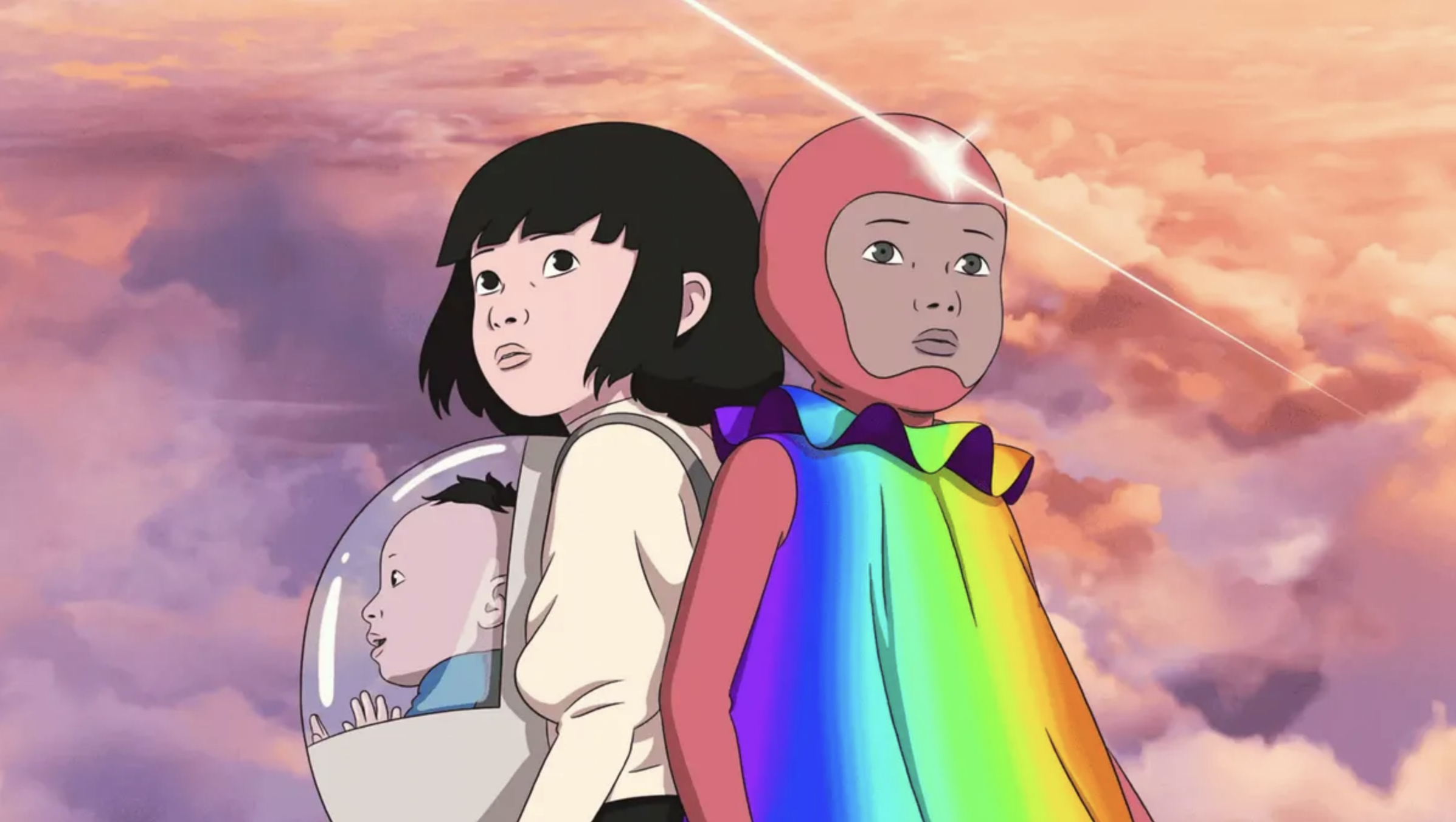
I guess that’s one way to look ahead.
Overall: B+