
SLANTED
Directing: B-
Acting: B+
Writing: C
Cinematography: B
Editing: B-
Slanted has been widely referred to as “Mean Girls meets The Substance.” There is some accuracy to those comparisons, except that Slanted lacks the gonzo savagery of The Substance. And I really want to say it lacks the wit of Mean Girls, except that at the time I even thought Mean Girls was rather overrated, a warmed-over Heathers, which had far greater satyrical bite. This is precisely what Slanted is missing: satyrical bite.
I really wanted Slanted to go harder. A story about a high school girl who undergoes cosmetic—some say “trans-racial”—surgery to become White is some fertile ground for the kind of satire it’s going for. But Slanted is less biting satire, and a little more lower-rung Black Mirror. It does a pretty good job of reflecting the social and racial structure of America, but doesn’t go very deep into it. This kind of movie only really works if it makes you go deep. A bunch of White kids salting otherwise unadorned salads for lunch in synchronized movements isn’t really going to cut it.
There’s a very strange irony to this production as well. Writer-director Amy Wang is herself of Chinese descent, which bodes well for a movie about a Chinese-American family. She casts actors of Chinese descent to play characters of Chinese descent, particularly Shirley Chen, who plays the protagonist, Joan Huang, for the first third or so of the movie; also Joan’s parents, Sofia (Vivian Wu) and Roger (Fang Du). But these are the only characters—or actors—of Asian descent in the entire production, and once the surgery takes place, Joan renames herself “Jo Hunt” and is played for the rest of the movie by Mckenna Grace. The irony is that this is a film about the denial of racial and ethnic identity, made by a woman of Chinese descent, but the vast majority of the actors given work to play parts in the cast are pointedly conventionally—maybe even blandly—attractive White people. You know, the very people afforded the greatest opportunities in this society.
It even seems worth mentioning that Amy Wang is Asian-Australian—not, it must be noted, American. To be sure, there are other international directors out there with an astonishing ability to reflect deeply authentic, American characterizations. But Ang Lee, Amy Wang is not. Much of Slanted takes place in a high school environment that feels like a critique of what an outsider might thing American high school is like, based on countless other American movies they’ve seen. The “Mean Girls” vibe among the popular girls Joan/Jo is desperate to become friends with feel very contrived.
It’s the writing I have the biggest issue with in Slanted, which doesn’t even manage to be consistent. Joan is using an app to create White-faced filters on her phone called Ethnos, which clocks her heavy usage and then offers her a discount on their cosmetic services. Ethnos declares that they cannot do the full surgery without a parental signature due to her being a minor, but they’re perfectly happy to do a hair transplant without it—complete with masking her with gas to put her to sleep. We then see bloody spots where they begin pulling her black hair out. None of this requires parental consent?
I’m fully aware that Slanted is meant to be a fantasy world of subtle horrors, not something to be particularly concerned with realism. After all, when Jo’s face skin starts to droop, a significant plot point in the latter half of the film, Ethnos simply provides her with a cream and some tape. We see hands go to her face without the camera actually showing her face, and suddenly she looks normal again. The sticking point for me is that the parental consent is used only as a plot point in the process of Joan losing her parents’ trust; it otherwise has no point in the plot, if this guy’s going to do a hair transplant on a minor without parental consent anyway.
Where I really must give Wang her due is that the performances in Slanted are actually kind of astonishing. Shirley Chen is serviceable as Joan; it’s when Chen is replaced by Mckenna Grace that the cast truly impresses. Grace performs most of her role in English but does occasionally speak in Mandarin, and quite believably (not that I would have any idea how good or bad her accent is, mind you). Most significantly, even after Joan is no longer shown onscreen, but the character comes home and takes some time to convince Sofia and Roger that she’s actually their daughter, they’re still completely believable as a family. You never stop accepting that Jo is their daughter, even after she’s transformed into a White girl. This is a true testament to the performances of all three of them.
There is a bit of a plot twist that comes along that you can see easily see coming, but the performers involved, particularly Amelie Zilber as Olivia Hammond, the most popular girl in the school, also perform it well. Joan’s best friend, Brindha, is played by Maitreyi Ramakrishnan, from the Netflix series Never Have I Ever, and seems to exist simply to be a fellow Asian character who is not a member of Joan’s family. There is so much potential for a film like this to explore that it does not bother with, most significantly the intersection between White racism and the anti-Blackness of other races. Brindha is a young Brown woman who comes closest to representing the experience of anyone outside the Huang family who is also not White; the only Black people we see in this movie are extras used at the Ethnos clinic, and in one pivotal scene, a nameless and silent Black friend of Brindha’s who Jo is peer pressured into disinviting from a party. This feels like the very essence of Black tokenism.
If Slanted had any real curiosity about the diversity of American experience, even among insecure, White-supremacy-pilled people of all races and ethnicities, it might be easier to like. It’s perfectly fair to tell a story like this from the singular perspective of an Asian-American family, but then it brings in characters of other races and does them a narrative disservice. To be fair, Slanted still has its moments; I certainly got a good laugh out of Ethnos announcing new locations in “Richmond, Virginia; Pittsburgh, and Spokane.” If it spent a lot more time with pointed jabs like that and less time with a misguided undertone of melancholy and barely a hint of the “body horror” it seemed to promise, Slanted would have worked a lot better.
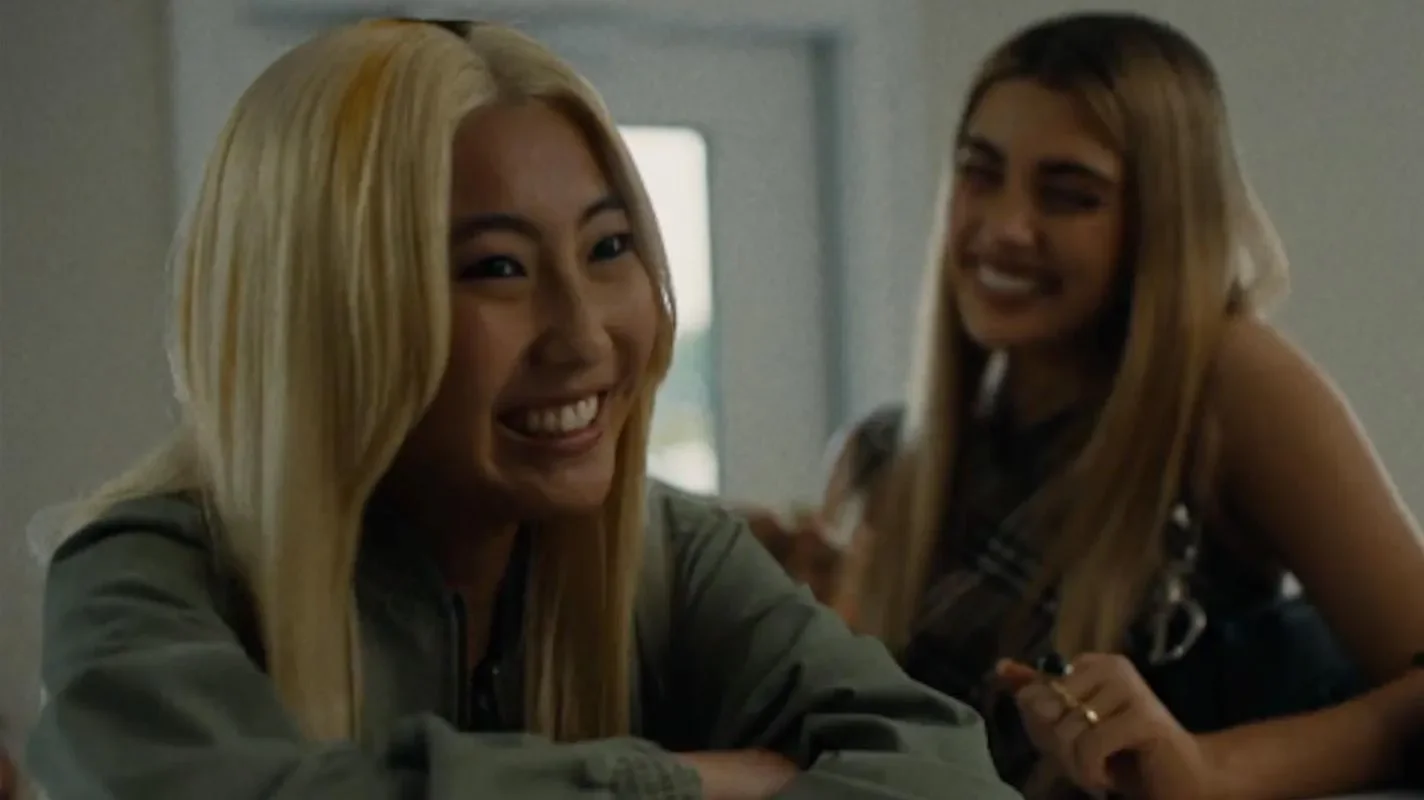
I see White people: this misguided irony of Slanted.
Overall: B-