
LEVITICUS
Directing: B+
Acting: A-
Writing: B+
Cinematography: B+
Editing: A-
Does Leviticus hit different if you grew up closeted and religious, I wonder? Well, I did, and there’s no escaping the very personal way this film unfolded in my eyes. This isn’t just “queer horror” in the metaphorical sense; queerness not only is the text, but it’s about how willfully ignorant people will use our own desires against us—sometimes to deeply effective, and even fatal effect.
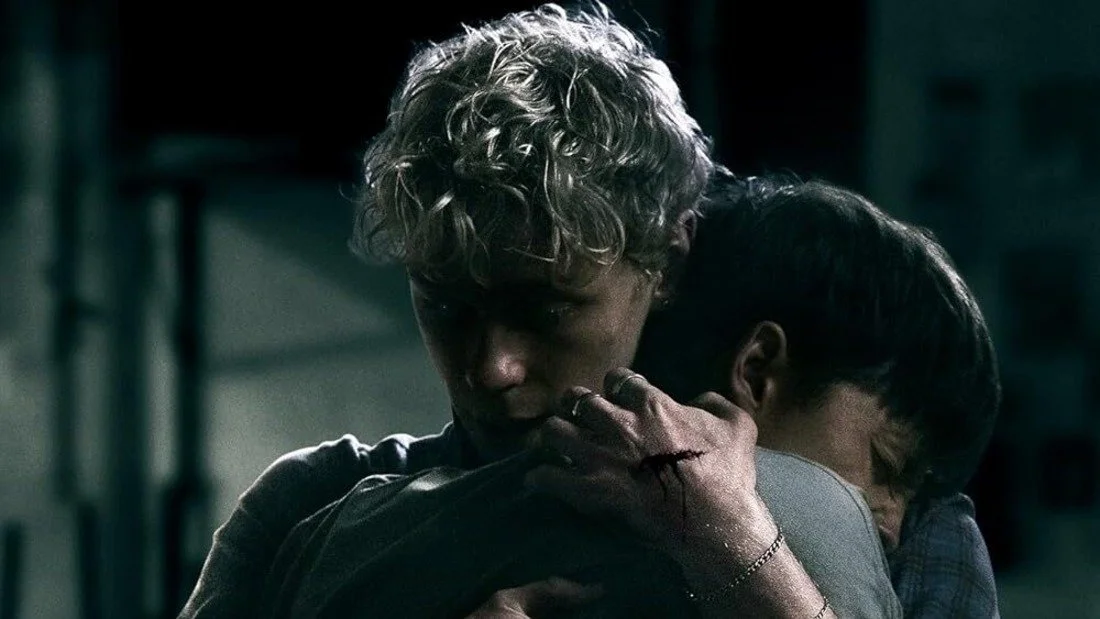
Leviticus is very effective just as a straightforward horror movie as well; Australian writer-director Adrian Chiarella understands how to make this movie work on both surface and deeper levels, allowing viewers to wade in as far as they’d like. Teenage friends Naim (Joe Bird) and Ryan (Stacy Clausen) are introduced to us like believably regular buddies, roughhousing until they tumble in each other’s arms, and before they know it they’re kissing. That may sound a little corny, but Bird and Clausen are such gifted, natural performers that it feels totally organic. There aren’t even any tropes of internalized homophobia here; they seem totally comfortable with themselves and each other, and are only wary of the rest of the world.
But then Naim happens upon Ryan in his backyard, with another teenager (Jeremy Blewitt), and they’re doing something rather unsettling: taking turns hurling stones right at each other. We have already seen scenes in the local church by this point, so at first I thought maybe this was some kind of allusion to stoning as punishment. This practice comes up several times more, until the it is finally revealed to be something very different—and desperate—and one of the pieces of the narrative puzzle clicking into place.
Soon enough, Ryan and this other kid are brought by the religious locals to a so-called “Deliverance Healer,” and the boys are openly derisive of the practice—again, comfortable in their own skin, dismissive of what they understandably regard as crackpot ideas. Except in this film, the ritual works, and it cannot be undone: the result is a sort of inner demon that never leaves you, but externalizes and manifests as the person, as another character puts it, “you’re most into.” So, when either Naim or Ryan is alone, they will see the other one, who seduces them, only to physically attack them. Left unchecked, it will literally kill them, as happens to the teen lesbian character in a pool shower in the opening scene.
I never saw the acclaimed 2014 film It Follows—I avoid most horror movies—but I do know Leviticus has invited many comparisons, though by all accounts It Follows is an allegory for sexually transmitted infections. Leviticus also explores a kind of personalized nightmare that never goes away, but its explicit queerness is what sets it apart. And I mean “excplicit” not in a sexual sense (there are two sex scenes, of sorts, and neither is at all explicit), but in the sense that it’s about queerness, with queer protagonists, and the pressures of a world that can’t even be bothered to understand.
The one character I have some ambivalence about is Naim’s mother, played by Mia Wasikowska, who looks strikingly like a young Martha Plimpton. Wasikowska looks so young, in fact, I wondered if she was too young to play Joe Bird’s mother; well, Bird is 19 and Wasikowska is 36. I guess this woman would hardly be the first in the world to have had a baby at 17 (or in the world of the movie, probably more like 19; Bird is clearly playing younger). Maybe it’s just because I have reached the ancient age of 50, but to me they looked so close in age that I really thought at first that she was maybe his much older sister taking care of him after the death of their parents.
Anyway, that’s not even the real source of my ambivalence; it’s the characterization of Naim’s mother, who never engages with him, never truly talks to him, and certainly never listens to him, particularly when he’s trying to explain the extraordinary things going on. She takes him to church, and writer-director Adrian Chiarella imbues her with a kind of prejudice that is unexpected: rather than, say, being disgusted by his sexuality, instead she fears the hatred of others—and uses that as an excuse for bringing the “Deliverance Healer” to him: “I can’t lose you too,” she says, as though curing him of what she sees as an affliction will protect him from outside threats. Instead, she invites one that manifests from within. There may be something to this among those of us with real-world experience in religious intolerance: the backfiring of actions by loved ones who are convinced they mean well.
Still, there is something weirdly repressed about Wasikowska’s mother character, stripping her of dimension even as she’s very effectively used to make the movie’s point. And there’s something very sinister about the effects of treatment like this, a lasting trauma that cannot be undone. There’s also an unsettling irony to the fascinating detail of how this living nightmare works, in that the demon manifestations only appear if you are alone. So as long as you are sure you are with the real version of the person you desire and not the nightmare version, presumably you’re okay? But also you can never, ever let them out of your sight, presumably for the rest of your life? That seems like a kind or forced commitment, a nightmare all its own.
Or maybe these two will inevitably fall out of lust with each other, start having eyes for other people, and then it will be those other people these nightmare entities take the form of when they are alone. Maybe they should just open up the relationship but never be apart? Shared orgies until the end of time!
I digress. I have to hand it to this movie, it really makes you think. It’s also very effective with its horror-movie scares, both in scenes with very successful jump-scares and scenes in which you are simply terrified one is coming. I’ve never been so terrified watching a hand job in my life, I was so convinced it was going to end with a nightmare version of either Naim or Ryan popping up and scaring the shit out of me.
And that’s what it all comes down to: “We need fear,” Naim’s mother says, as justification for what she’s done to him. “It’s how we survive.” That line will stay with me, a haunting idea by virtue of its deeply misguided contextualization. Well, I’m not sure I need the fear Leviticus put in me with effective horror staging, but it offers certain depths that make me very glad I saw it.
Okay but what if a man stands with a man?
Overall: B+