
GIRLS LIKE GIRLS
Directing: B+
Acting: A-
Writing: B
Cinematography: B+
Editing: B+
Between Leviticus and Girls Like Girls, I guess it’s the Month of Good Gay Movies, and I must say I’m delighted. It’s somewhat ironic that Girls Like Girls is set in 2006, because at that time movies about queer people had a pretty reliable, indie-janky vibe to them, some of them more charming than others. These days it’s much easier to find well-produced queer cinema, even if the budget is on the smaller side; I love that both of these movies were released on the same weekend, one week before most major cities have their Pride Weekend, but also simply in the month of June, which is Pride month. I can’t remember the last time I’ve been so satisfied with overtly queer cinema.
That’s not to say that either of these movies is perfect, of course; they are both definitively not—but, they are also both closer to it than they would have been twenty years ago, and for different reasons. Unfortunately I do think the script is Girls Like Girls’s weakest link, albeit not by a very wide margin. And a film need not to be perfect to be effective, and effective might be the best word to describe this film. I’m feeling all sorts of things about this movie, not least of which is that I really should have known to bring tissues into the theater with me.
This is a pretty straightforward love story, which just happens to be about two 17-year-old girls. And unlike Leviticus, which is a horror movie about the insidious influence of religious bigotry, regilion never even really gets mentioned here. The closest we get is Sonya (Myra Molloy) worrying about what her mom and her friends will think, if they find out how she feels about Coley (Maya da Costa), who is actually the film’s protagonist. And rather than struggling with her sexuality herself, Coley’s greatest challenge is with how Sonya expresses affection and then retreats out of fear. There is a heartbreaking, and deeply relatable, moment when Coley says, “Why can’t I be normal?” But that can be relatable whether you are queer, or just a teenager.
And this is the thing I love about Girls Like Girls, which simply illustrates what it’s like to be a teenager, dealing with other teenagers. These kids are all just learning how to be decent human beings through trial and error. But, Colely feels even more alone due to the recent death of her mother, and now living with a dad (Zach Braff) who did not raise her but is now trying his best to get to know her. This is a subplot that is at once an added dimension for Colely and a bit undercooked, but it does provide the context for the one scene in which I was constantly wiping away tears from my sleeve.
I did not know this until researching this movie—well, and director and co-writer Hayley Kiyoko’s recorded introduction to the film—but Girls Like Girls has had a bit of a journey over the past ten years. It began as a music video for the song by the same name, by Kiyoko herself, who began as a singer at the age of 16 and was taking acting roles not long after. The song was on her five-track 2015 EP This Side of Paradise, and it would be another three years before Kiyoko released her debut full-length album, the first of three to date, which I guess I need to check out now. Kiyoko also co-directed the music video, which eleven years later has 163 million views on YouTube. By 2023, Kiyoko had adapted the story from the video into a Young Adult novel, continuing its storyline, and along with co-writers Stefanie Scott and Chloe Okuno, it has now been adapted into a feature film.
It’s a good song, and Girls Like Girls the film follows many of the same beats as Girls Like Girls the music video, with several key scenes mirrored, just with different young actors. There’s a delightfully shocking turn in the video that was omitted from the film, and I can’t decide if that keeps the film on a higher level or if its inclusion would have improved it. It’s a curious thing to travel back in time when regarding all this story’s iterations; apparently the video was incredibly popular with many young queer people, and after the release of the film’s trailer you can find many fun comments on the video’s YouTube page like, “revisiting the ancient texts.” Because of course, something released in 2015 is an ancient text. And seeing a film created as a “period piece” set in 2006, complete with CD storage binders and a lot of scenes with texting over AOL Instant Messenger, makes me feel like I’m from the fucking Stone Age.
Honestly, I can’t decide whether Girls Like Girls overdoes it a bit with the AIM. Was it still that much in use in 2006? I think AIM and I think 90s. Grandpa Matthew went onto the Wikipedia to look into this, and evidently AIM was popular through 2005, at which time its decline began with the advent of SMS text messaging and Gmail. 2006 was pretty soon after that, so I guess I’ll allow it; it appears I didn’t even have my first iPhone until 2008, so for all I know I was still using AIM myself in 2006. I just can’t remember! Because I’m old!
Anyway, “period” details aside, there are moments of dialogue that come across as a little stilted. There are also scenes in which teenagers are socializing and talking about things no human adult would be interested in, and this comes across as authentic; it’s a different thing. The moment when Coley and Sonya have a “meet cute” of sorts didn’t fully work for me, and it was because of the writing. There’s a few scenes that unfold this way, but to Maya de Costa and Myra Molloy’s credit, they really sell it; they have real chemistry and it’s easy to believe they are falling in love with each other, yet being tentative with each other for their own separate, largely unclarified reasons.
When all was said and done, Girls Like Girls left me deeply moved, and I love that it’s part of a lasting legacy of making young queer people feel seen and feel good about themselves. The existence of movies like this makes it just a little bit easier to have hope for humanity.
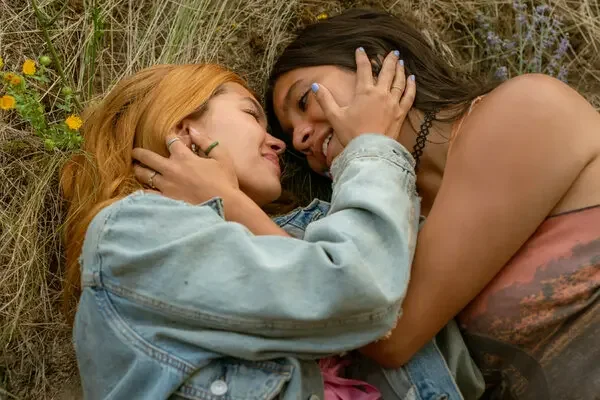
If this isn’t truth in advertising I don’t know what is.
Overall: B+