
THE END OF OAK STREET
Directing: B-
Acting: B-
Writing: C+
Cinematography: B-
Editing: B+
Special Effects: B
If there is some deeper context to The End of Oak Street, I couldn’t tell you what it is. It seems safe to assume writer-director David Robert Mitchell feels there is one, but he is not wholly successful at communicating it. Once the deeply uneventful plot involving fundamentally uninteresting characters takes a turn, it can’t be denied that this film becomes wildly entertaining—but it’s also the epitome of a popcorn flick, delicious but empty cinematic calories.
I spent a lot of the movie trying to figure out what year it was supposed to be. All the men and boys are wearing incredibly short shorts, even by today’s standards; I figured it had to be either the seventies or the eighties. A scene featuring a car dashboard cassette player leaned me toward the latter, but I also wondered if it was meant to be some undefined place in time. But then, very near the end, there is literally the dialogue exchange, “What year is it?” and “It’s 1982, of course!” Okay, so we’re getting specific now.
I suspect it’s no accident that Mitchell set this movie the same year E.T. was released. The End of Oak Street is quite obviously a riff on the Spielbergian tones of the time, crossing the adventure and subject matter of Jurassic Park with the setting and tone of movies like E.T. and Poltergeist. That said, Oak Street also feels like a riff on J.J. Abrams’s 2011 film Super 8, which was itself an homage to Spielbergian sensibilities. It’s worth noting that Abrams produced The End of Oak Street, which thus feels like a copy of a copy of a copy.
I’ll give it credit for an odd twist, at least: instead of scientists cloning dinosaurs in the modern age, as in Jurassic Park, a random wormhole ports an entire neighborhood, a couple of miles in diameter, into prehistoric times. This produces the same effect, of dinosaurs interacting with modern people and streets, the difference being that we’re in their time instead of them in ours. But, the main characters never leave this neighborhood, largely because the light that ported them has created high cliffs at the circle’s edges.
The family in question consists of married couple Denise (Anne Hathaway) and Greg (Ewan McGregor, in arguably his least remarkable performance ever); their children Audrey (Maisy Stella) and Brian (Christian Convery), and to a lesser degree neighborhood adolescent Jeannette (Jordan Alexa Davis). Rounding out the principal cast are their neighbor who hates their dog, Mel (P.J. Byrne); the elderly neighbor who is encouraging Denise’s writing, Mrs. Huddleston (Anne Gee Byrd); and the local librarian, Mrs. Valcourt (Emily Kuroda). Nearly every character who is not a member of the principal family gets some degree of a setpiece, some of them getting spectacular death scenes.
And that is all we’re here to see, really. The End of Oak Street can’t quite pick a lane when it comes to tone, opening with an almost self-consciously obtrusive score by Michael Giacchino (Cloverfield, The Batman), and quickly shifting from the facade of 80s suburbia to most of those suburbanites appearing as dead bodies on clean streets and manicured lawns. And I’d be lying if I said I didn’t absolutely eat that shit up—once the porting of the neighborhood occurs, I was rapt until the end of the film. I was always very conscious of how blandly plotted it was, especially with a certain death of a character that the film cheats its way out of in the end.
Say what you will about the sappiness of Steven Spielberg, but at least he has narrative integrity, even when he’s got plot holes. But some of the storytelling in The End of Oak Street is just plain egregious. It barely qualifies as “science fiction,” providing no semblance of an explanation except that these bright lights somehow “moved” their neighborhood—the Oak Street of the title now ends at a humid jungle.
And of course, at first Mitchell is coy about the dinosaurs, keeping them hidden behind bushes or around the corners of houses. One striking detail is how furry and/or feathery the dinosaurs in this film are, a clear nod to more recent research suggesting they probably looked more like birds than reptiles. This would not have been the prevailing view in 1982, of course, and yet none of the characters here say anything along the lines of, “They’re hairier than I expected.”
If you imagine the scenes in Jurassic Park where two kids and a couple of adults are scattering away from dinosaurs in pursuit, then you’ve got the gist of about 75% of The End of Oak Street. I regard Jurassic Park as one of the best movies ever made, so this is actually a complimentary comparison; it’s just that Jurassic Park was brilliantly paced and plotted, had real ideas for both the characters and the audience to ponder, and had incredibly sharp wit. The End of Oak Street gets about halfway there on all fronts, all the while using actors who are known widely to be deeply gifted but who give performances that feel phoned in. The delivery of some of the neighborhood kids is especially wooden. On top of it all, cinematographer Mike Gioulakis shoots some scenes with the camera looking at the character who is speaking from behind another character in very odd close-ups, which is very distracting. (Gioulakis also shot the 2014 It Follows, which was also written and directed by David Robert Mitchell.)
I had a great time watching The End of Oak Street, while also recognizing early on that it’s nothing special. It’s strange when a movie this thrilling to watch is simultaneously disappointing, though a lot of viewers clearly won’t care about that. If you’re just looking for a thrill, this movie will work for you. Although I still think you’d get more out of simply rewatching Jurassic Park, which had a depth that this movie doesn’t even aspire to.
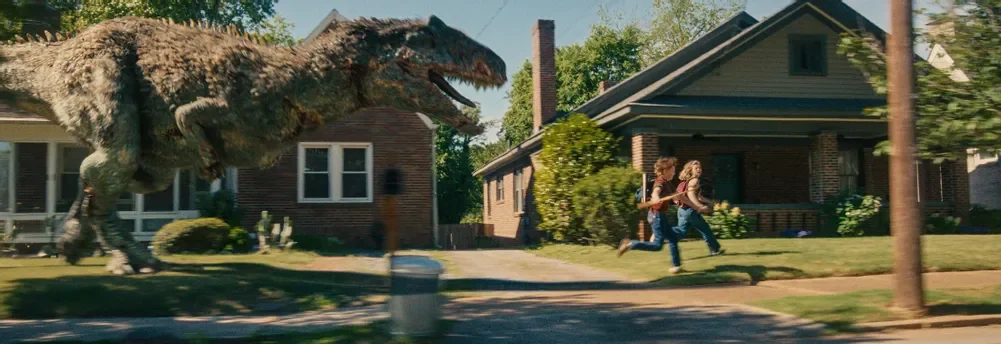
Listen, this guy needs protein too.
Overall: B-