
GOOD LUCK, HAVE FUN, DON'T DIE
Directing: C+
Acting: B
Writing: C-
Cinematography: B
Editing: B-
Special Effects: B
The more I think about Good Luck, Have Fun, Don’t Die, the less impressed I am with it. The best thing I can say about it is that Sam Rockwell gives a great performance, and is clearly having a blast. I wish I could say the same of the rest of the cast, who really seem like they’re just phoning it in. Well, Juno Temple gives a relatively strong performance, but far from a comic one; she plays a grieving mother bewildered by the offer of getting a subpar clone of her son who was killed in a school shooting. Michael Peña and Zazie Beets play school teachers who are a couple struggling in their relationship, and Haley Lu Richardson plays a suicidal young woman with an allergy to cell phones and wifi. Yes, really.
Rockwell is the otherwise nameless Man From the Future, who shows up at a diner and announces to everyone that he’s come back in time to save us from destroying ourselves with social media and AI. Social media gets name-checked early on, but only once or twice; after that, the target is both generally and consistently “AI,” and this film’s penchant for conflating the two (both being dangerous when unregulated notwithstanding) does nothing for its effectiveness.
This opening scene plays out very strong, giving a real sense of hope and promise for a fun and clever movie, which does not take very long to fade. And this is definitely a movie that thinks it’s clever—written by Matthew Robinson and directed by Gore Verbinski, I’d say at least this is a singular vision that is not written by committee, except that it feels like it was. I was diverted well enough by this film as I watched it, but it is blandly entertaining at best. The script takes on the point of view that AI is bad for us all, and then puts a bunch of VFX onscreen that looks like AI slop. I want to be amused by a centaur with an upper body made of hundreds of cats, except that it looks exactly like the AI crap that people keep sharing on Facebook.
Perhaps this was exactly the point? I can’t really tell how “deep” this movie is trying to be. If that is the intention, however, it fails. Satire needs to go hard, and this movie is jus lobbing thematic softballs. I wonder how many people watching even realize how deeply derivative it is? The aforementioned cat-centaur is the result of our group of heroes basically dreaming up their own adversary—exactly how the Mr. Stay Puft Marshmallow Man was manifested in the original 1984 Ghostbusters. Michael Peña plays a substitute teacher who makes the mistake of touching the smartphone screen of one of his students, which triggers to signal to all of them and causes them to mindlessly come after the teachers like zombies. Get it? There are even multiple scenes of teenagers, phones in hand, crashing through walls to get at the adults trying to hide from them.
Much later, in a climactic scene in which The Man From the Future is attempting to get the attention of a 9-year-old child said to be the architect of the AI that becomes self-aware, there is a moment when a bunch of dismembered and reassembled robot and toys come to life. One of them looks straight out of the Star Wars sequel trilogy; others look straight out of the scary neighbor kid’s yard in Toy Story.
A lot of these things reference movies so old that a many young viewers today won’t even know such references are happening. Or are we supposed to believe these similarities are coincidental? If so, that’s preposterous. If not, I can’t tell what the point was. Have Fun, Good Luck, Don’t Die has a lot to say about how our constant attention to screens is making us all brain dead, while doing exactly the same thing to its own viewers. Is this a lack of self-awareness, or a stroke of genius? I can assure you this film is not a work of genius, and a movie like this will hardly work as intended when the joke being made is on the audience.
But is it fun? Sure, some of the time. It’s far too long, at 134 minutes, for a film of this nature, which ultimately takes it into the realm of tedium. There are some scenes that work incredibly well, such as when Juno Temple’s grieving mother is asked by a smiling but impatient staffer to choose from comically limited personality options for her cloned son (who, by the way, is conditioned to inject ads into everyday conversation—this being something we already saw in the most recent season of Black Mirror). Or when she later meets another set of parents who have lost both their original daughter and two subsequent clones to school shootings, this being the kind of cutting, dark satire of our present era that this film doesn’t lean into enough.
Other times, the backstory just doesn’t land, as with Haley Lu Richardson’s young woman in a princess costume (she works children’s birthsay parties as a job) loses her “anti-phone” boyfriend (Tom Taylor) to a virtual reality game that mysteriously shows up at their door. They’ve been living off the grid, so who sent this console to him, and why? This movie has no interest in these questions—only that he’s received the device. In any case, the dissolution of this relationship is too rushed and contrived, even within the context of a film in which you readily accept its ridiculous (and overused) premise.
I cannot find any evidence that AI tools were used in the making of Good Luck, Have Fun, Don’t Die, but it sure feels like it was. If you asked an AI prompt to create a comedy about the dangers of AI, it’s easy to imagine this movie being the result. Aside from Sam Rockwell’s impressively committed performance—it was his delivery alone that got the most laughs out of me—really nothing about this film is particularly smart or clever. It’s just a barrage of shit we’ve already seen before, repackaged and redelivered.
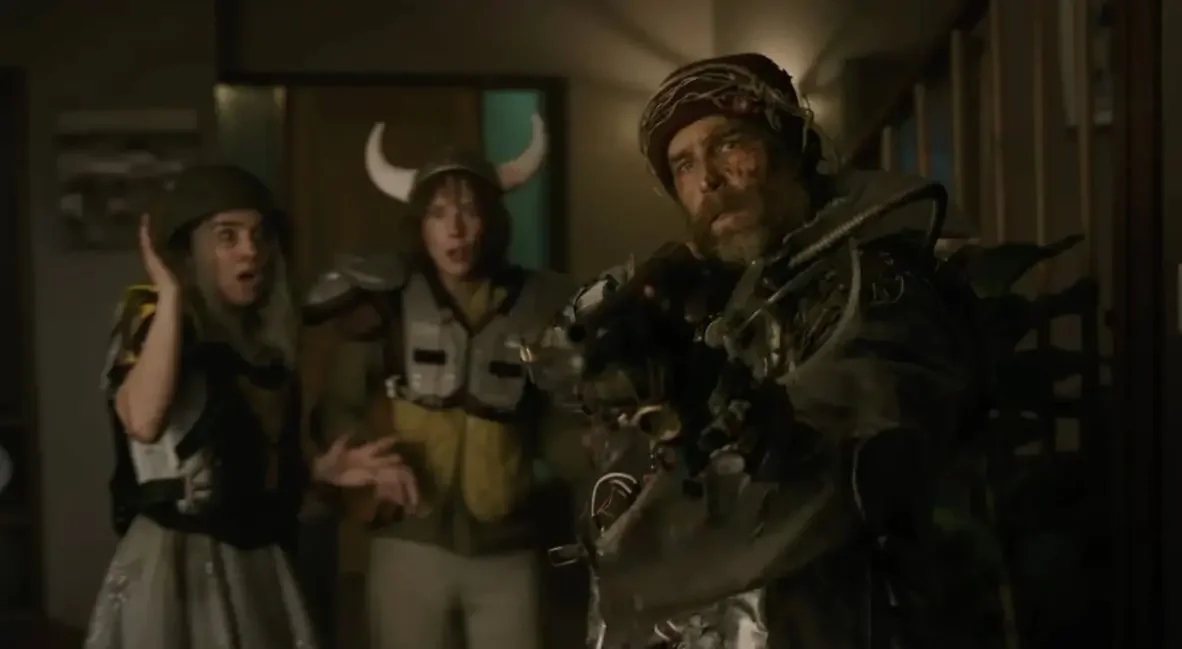
This movie is about as smart as it looks.
Overall: C+